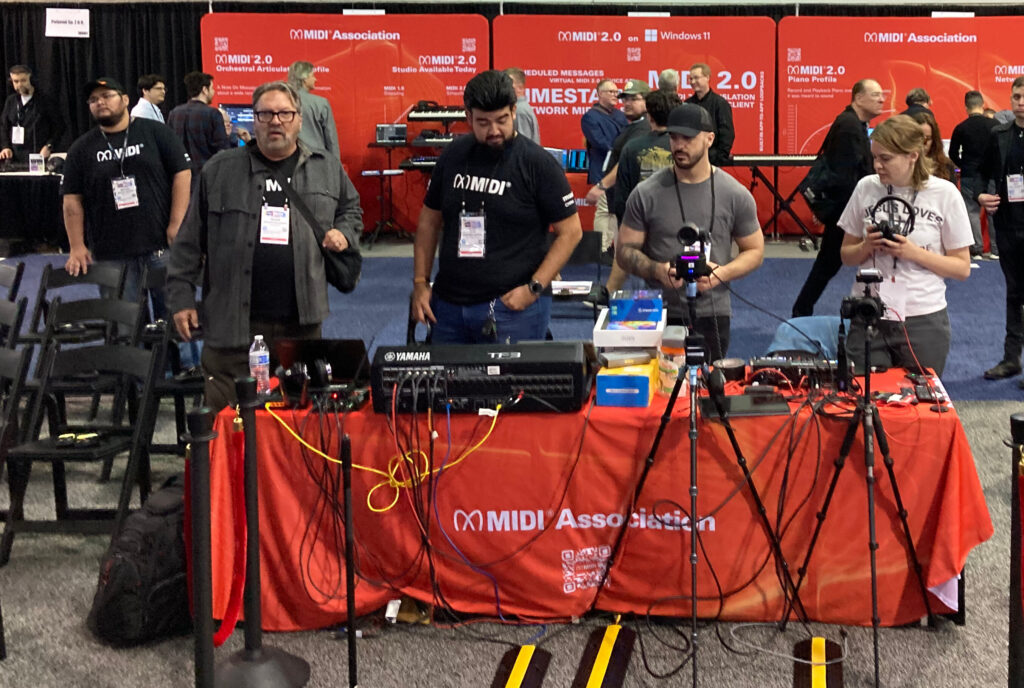
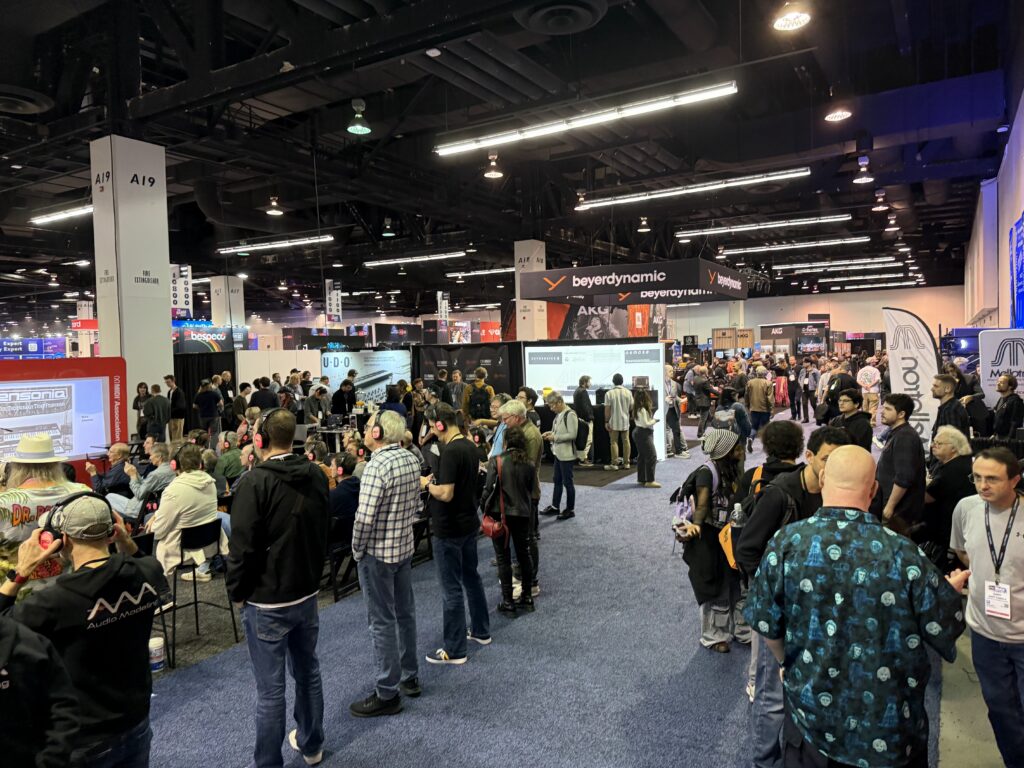
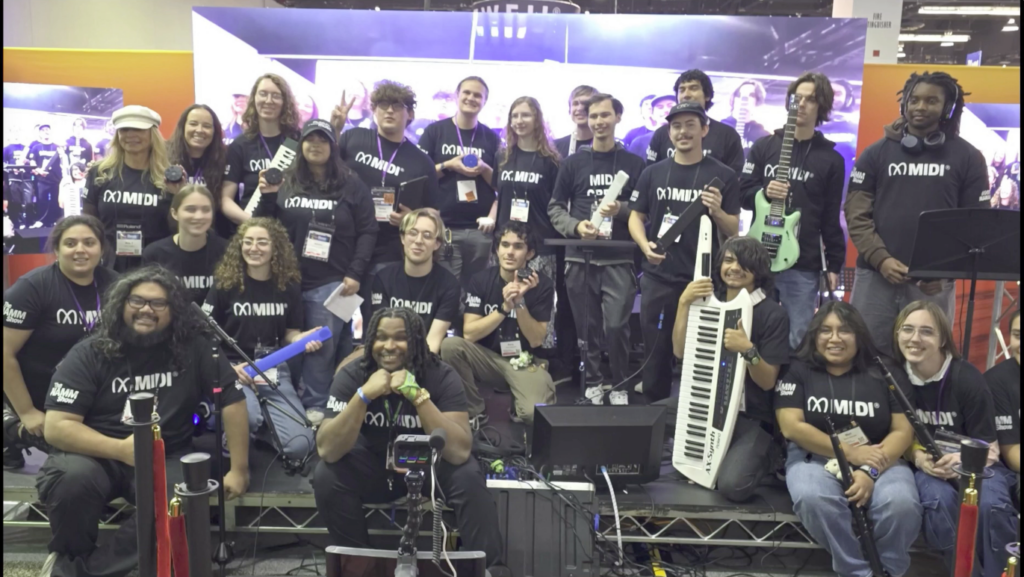
As usual, NAMM 2026 was a blur of activity at The MIDI Association booth.
We hosted 21 events over three days at our booth and participated in many Tec Tracks and A3E sessions as well.
We know this article has a LOT of information in it. But take your time and read through everything. Maybe bookmark it and come back to it a couple of times.
Finally much of the best stuff is at the very end so make sure you see the details of our MIDI In Music Education and Music Accessibility initiatives.
We recorded audio and video or all our sessions and over the course of the next two weeks will be doing articles on each of the events we hosted and participated in.
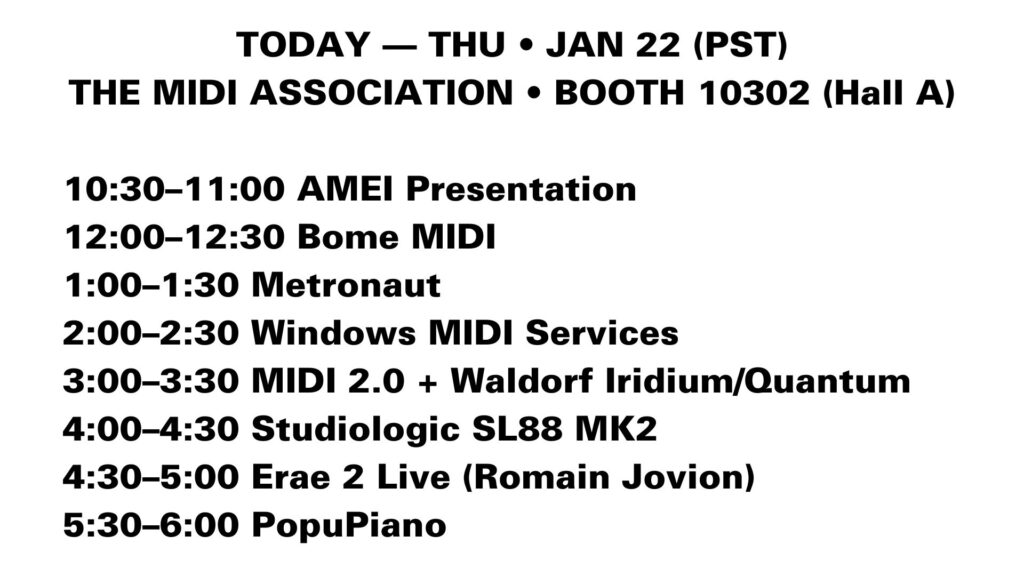
The MIDI Association Thursday Booth Schedule
Day 1 – MIDI 2.0 Product Day
The first day was focused on MIDI 2.0 products in the market.
The day started with a presentation by Takayuki Tomisawa from Roland, Chair of AMEI’s MIDI 2.0 working group who explained their long cooperative relationship with the MIDI Association.
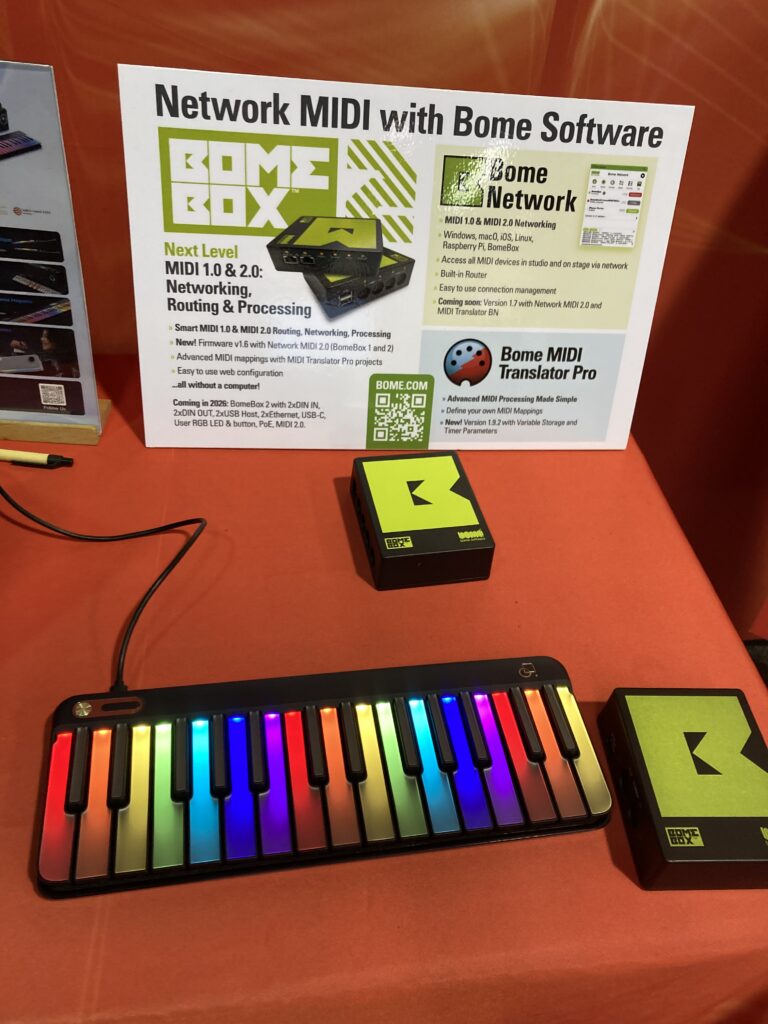
Florian Bomers introduced the Bome MIDI products—Bome MIDI Translator Pro, Bome Network, and the BomeBox—and demonstrated how they can be used individually or together to enable advanced MIDI routing, processing, and control. Using real-world examples, he showed practical solutions before highlighting what’s new and offering an exclusive look at what’s coming in 2026.
One of our newest members is Metronaut which is headed up by Arshia Cont.
Metronaut is a unique AI-Powered mobile App for amateur musicians! Metronaut allows musicians to Practice and learn thousands of masterpieces while getting feedback and being accompanied by high-quality backing tracks that adapts to them as they practice.
Chosen by Apple as Editor’s Choice for two consecutive years, Metronaut is empowering hundreds of thousands musicians worldwide in 21 languages by helping them to enjoy practicing music.
Arshia Cont is the CEO and Co-founder of the Music Tech Startup Antescofo, behind the mobile Application Metronaut. After completing a PhD in Computer Music in UC San Diego, he served as research scientist between 2008 and 2016 at IRCAM, a center dedicated to fostering music technology and artistic creativity; and head of the MuTant research team at INRIA. In the same period, he acted as the director of Research/Creativity Interfaces in the institute where he founded the Ircam Musical Research Residency program and pushed Ircam Forum to the social network era.
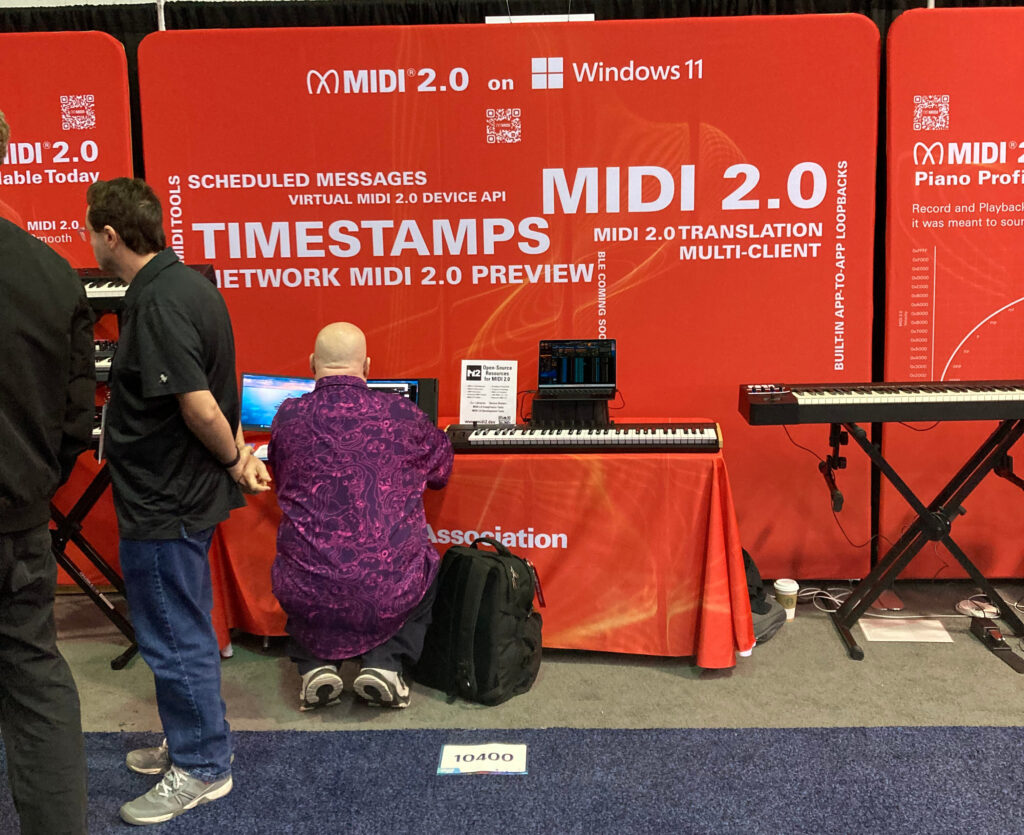
One of the most important announcements about MIDI 2.0 came from Microsoft. We found an excellent article from the European Motion Picture Association.
At NAMM 2026, Microsoft made waves by highlighting a major step forward in music technology: its ongoing Windows MIDI Services initiative — a full-stack integration of MIDI 2.0 support and next-generation MIDI tools into Windows 11.
This represents the most significant update to MIDI on Windows in decades and promises a huge leap for musicians, producers, and developers working in electronic music and digital audio production.
What’s New in Windows MIDI Services
Built-In MIDI 2.0 Support Microsoft has introduced the Windows MIDI Services stack with full support for the MIDI 2.0 standard — offering higher-resolution data messages, bi-directional communication, improved timing, and richer control over musical parameters compared with the decades-old MIDI 1.0 protocol.
Universal USB MIDI 2.0 Class Driver Thanks to a collaboration with AMEI (Association of Musical Electronics Industry) and contributions from partners like AmeNote, the new USB MIDI 2.0 class driver enables both MIDI 2.0 devices and compatible MIDI 1.0 devices to communicate efficiently with Windows applications.
Multi-Client & App Interoperability Windows MIDI Services brings multi-client MIDI support, meaning multiple applications can share access to MIDI endpoints simultaneously — a big improvement for workflows involving DAWs, controllers, and monitoring tools.
Developer Tools & SDK Accompanying the core stack is a Windows MIDI Services App SDK and set of tools that make it easier for developers to build next-generation music apps and utilities with enhanced MIDI features. These include utilities for diagnostics, loopback creation, port management, and more.
Why This Matters to Musicians For the first time, Windows users gain an integrated platform that fully embraces the potential of MIDI 2.0, a standard designed to unlock higher expressiveness, finer control resolution, and modern two-way communication between instruments and software.
While initially available via Windows Insider previews and SDK releases, this technology points toward broader availability throughout 2026 as Microsoft rolls out support into production Windows 11 updates.
Whether you’re using advanced controllers, cutting-edge synths, or complex DAW setups, the new Windows MIDI Services stack promises more reliable timing, better device interoperability, and richer creative potential for electronic musicians and producers everywhere.
Learn more about Windows MIDI Services and the MIDI SDK tools on Microsoft’s official GitHub and documentation pages.
European Motion Picture Association
Here is a bit more detail from MIDI Association Exec Board Chair and Microsoft lead MIDI developer, Pete Brown.
As announced at the NAMM Show, assuming all proceeds as planned, Windows MIDI Services will start rolling out at the end of this week to retail supported Windows 11 builds (24h2, 25h2). This will be installed as a KB update, through Windows Update. If you do not have Windows Update enabled (LTS etc.) you likely will not get the new feature.
Pete Brown
Microsoft
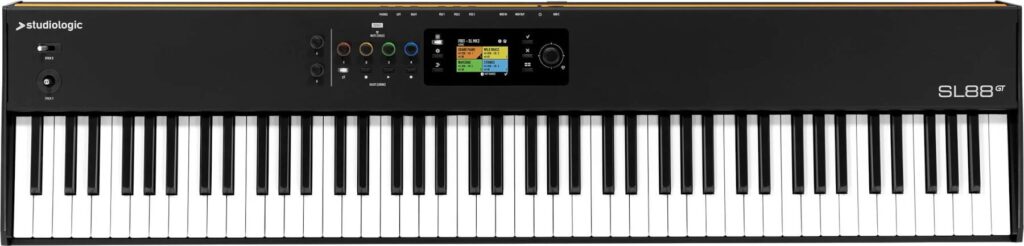
StudioLogic SL88 MK2
There are now a number of MIDI controllers on the market that support MIDI 2.0 hi resolution controllers including the StudioLogic SL88 MK2.
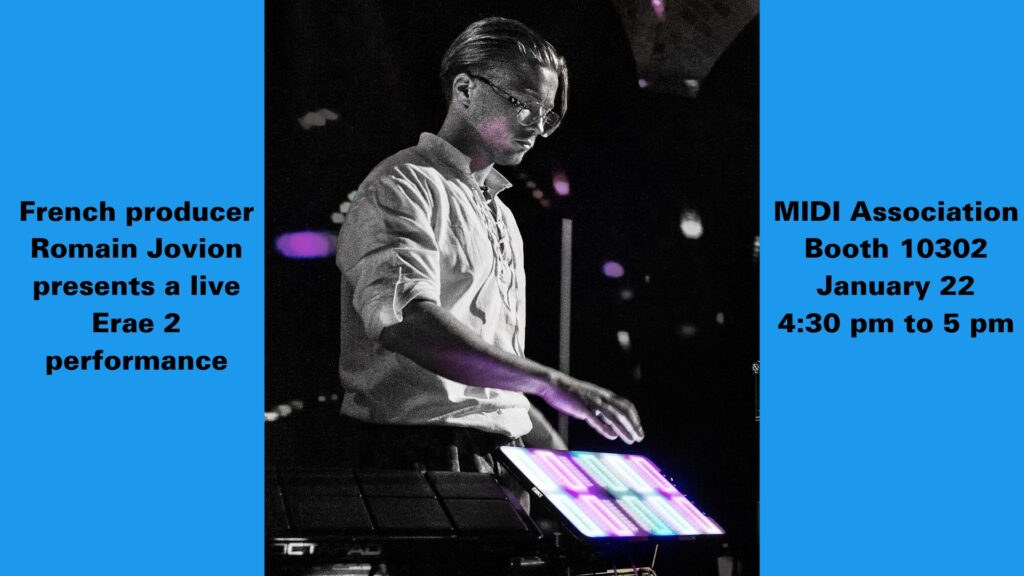
At the end of every day we featured performances showing off MIDI 2.0 in action.
This performance featured French Producer Romain Jovian performing on the Erae Touch.
The multitrack recordings of the performances are currently being mixed and synced with the multi camera video feeds controlled by a Roland video switcher.
We are planning on having all the performance up in the next two weeks.
PopuPiano and Party Speaker
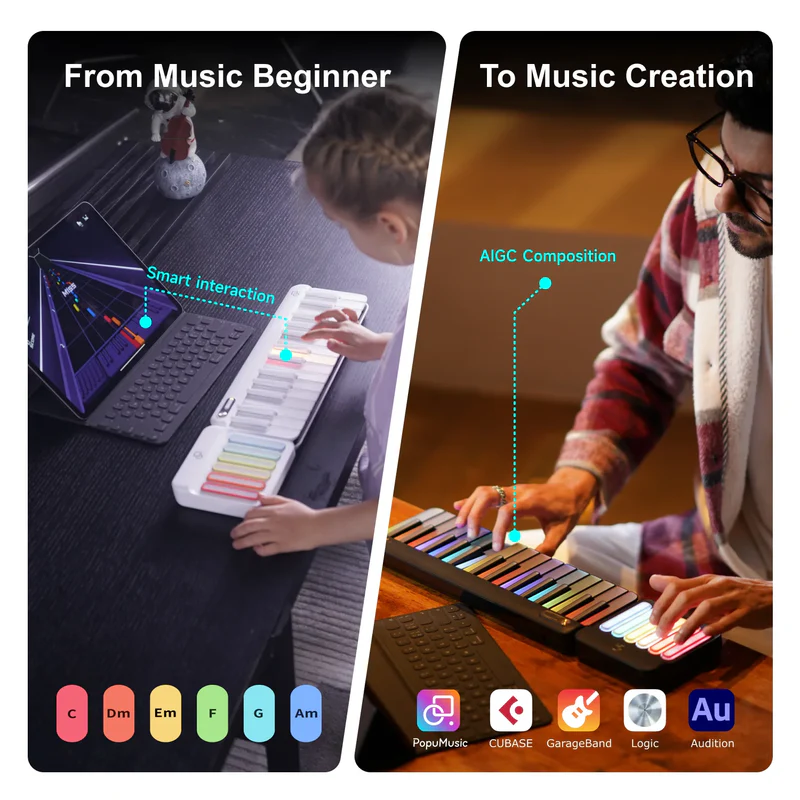
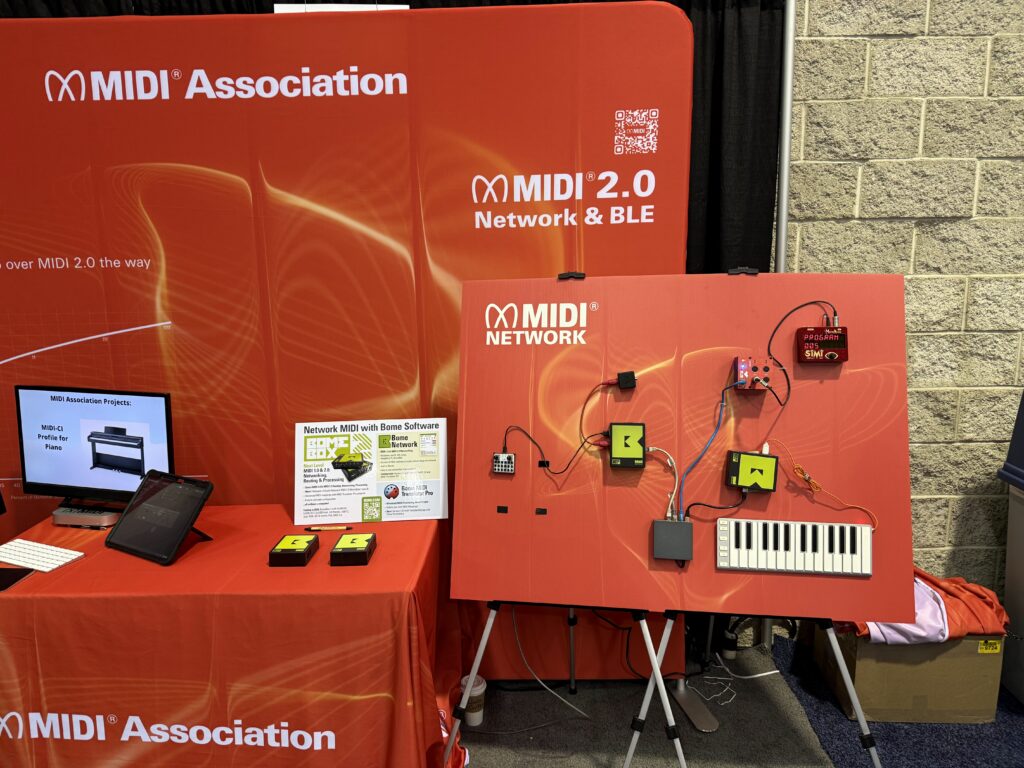
New MIDI Association member Popumusic presented their products. On top of doing a presentation, the folks from Popumusic also loaned us lighted keyboards and party speakers for our network display.
The MIDI Association Friday Booth Schedule
Friday focused on MIDI 2.0 specifications and at the end of the day performances from young artists from Smoothloop.
New MIDI 2.0 Transports-BLE, Web MIDI and Transport Remote Management
Members of the Transport working group highlighted the latest progress on MIDI 2.0 transports for Bluetooth, Web MIDI and updates to the Network spec to add remote management capabilities.
SMF2 Container Format
The MIDI Project Container File format is intended to deliver multiple tracks of MIDI data and other media. The set of tracks and media used in the file are enumerated and arranged in a Manifest file in XML format. Media types supported include: ● MIDI Clip Files (for MIDI 1.0 and MIDI 2.0) ● Musical Notation (MusicXML or PDF ) ● Audio Files ● Video Files ● Lyrics: may be in MIDI Clip Files and/or in Musical Notation files. ● Metadata – XML and MIDI Message
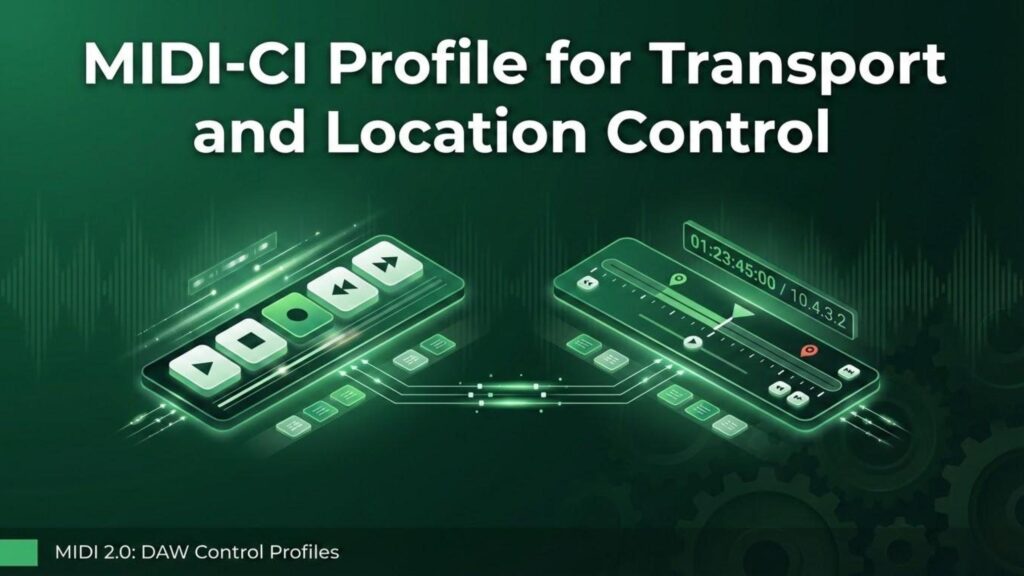
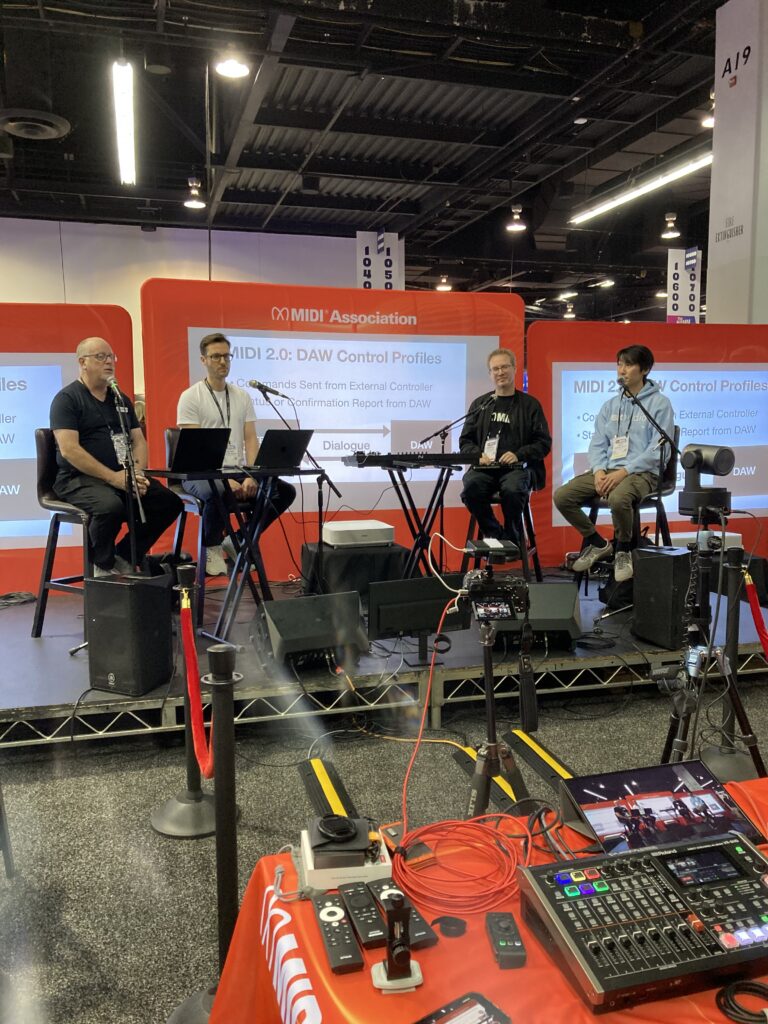
DAW Control Profiles
The MIDI Association is working on a modular set of MIDI 2.0 DAW Control Profiles intended to eventually replace Mackie Control with a unified industry standard for all hardware and software.
MIDI 2.0 WG Chair Mike Kent from Amenote, Jochen Troppe from Steinberg and TSB Chair Andrew Mee
The modular approach was taken because of the wide variety of capabilities of DAW controllers from simple start, stop and record buttons to elaborate devices with multiple displays.
Drum Profiles Update
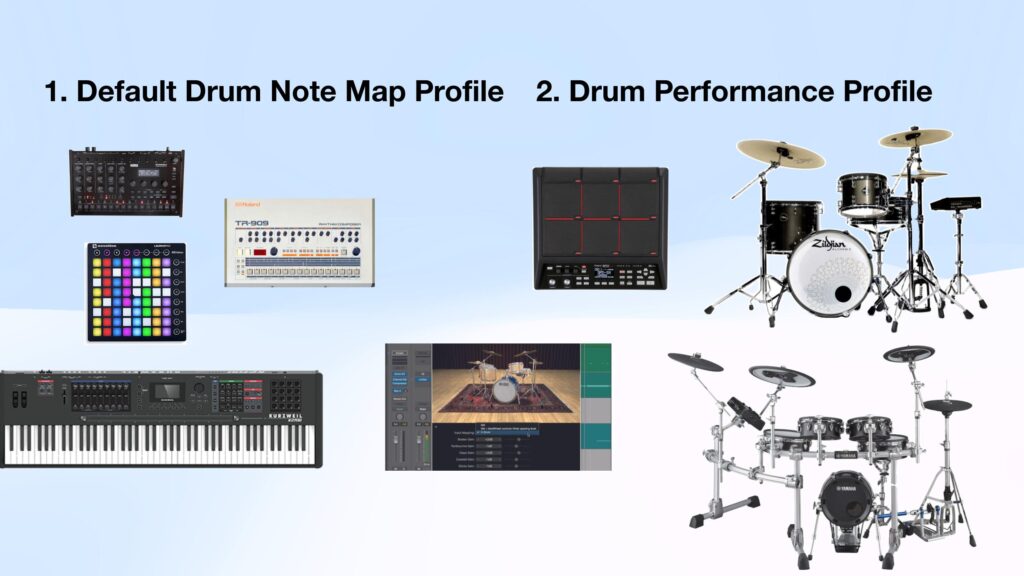
The MIDI Association has worked on two Drum Profiles in 2025.
The Default Drum Note Map Profile specifies 62 Drum/Percussion Sounds mapped to Specified Note Numbers.
This is the common GM based mapping in many Drum Machines and Synthesizers since the 1980s.
This Profile was adopted in the fall of 2025.
The Drum Performance Profile is focused on the more advanced features available in electronic drums kits which have positional sensing for cymbals and drums and complex hihat configurations.
The Drum Performance Profile design is complete and it should be approved in Q1 of 2026.
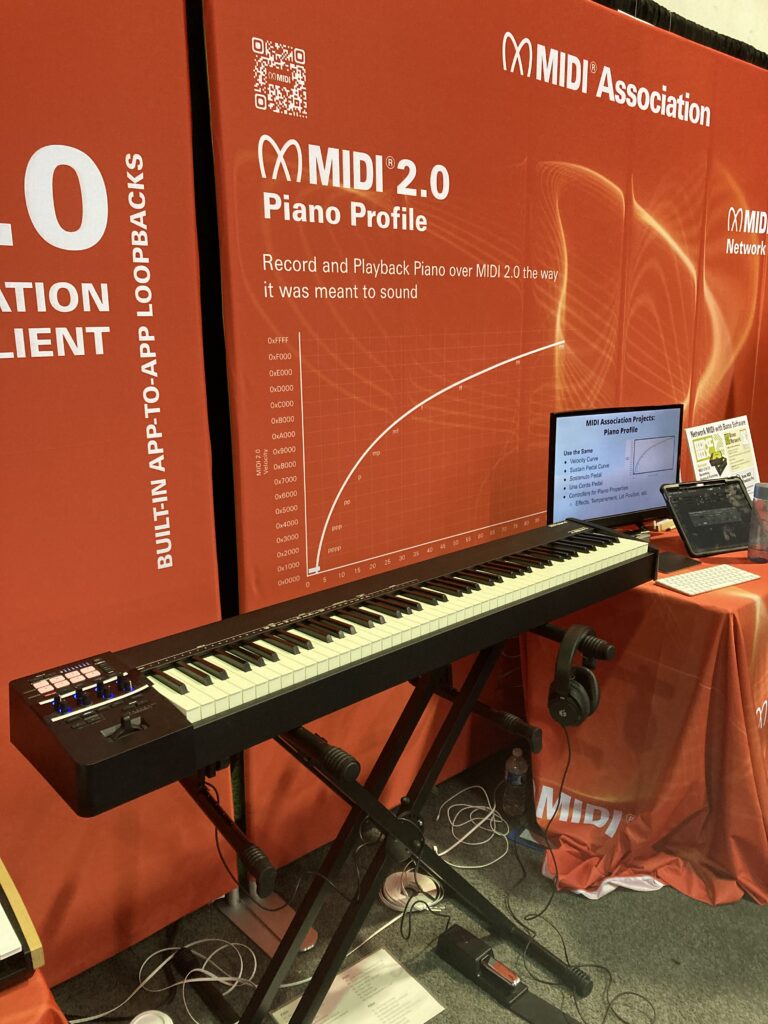
Just before the 2026 NAMM show, The MIDI Association and AMEi passed the Piano Profile specification.
The Piano Profile standardizes the velocity and pedal curves and the registered controllers used to control a piano’s performance via MIDI.
The model is based on the acoustic piano which is why it was important to have Kawai, Steinway and Yamaha involved in the project.
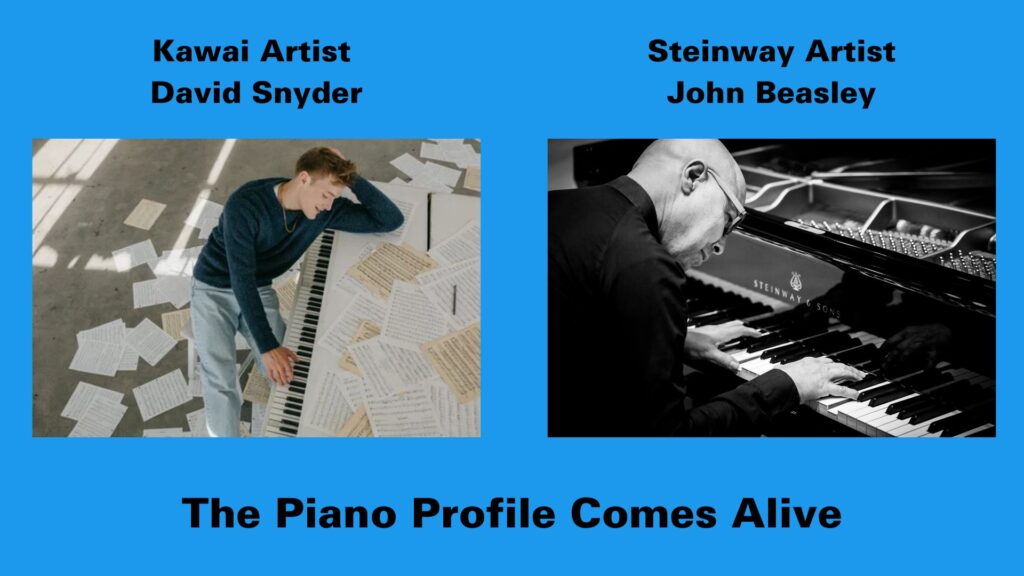
Kawai Artist David Snyder and Steinway Artist John Beasley performed on a Roland A88 MKII and Synthogy Ivory software that supports the Piano Profile.
During the show, both Roland and Synthogy released updates for support of the Piano Profile.
A88 MKII with Registered Controllers for Volume, Dynamic Range, Curve Offset, Lid Position, Hammer Hardness, Thump Noise, Sound Board Resonance, and String Resonance.
Again we will be posting the performances on the Roland A88 MKII and Synthogy Ivory by David Snyder, John Beasley, Lachi and Ellis Hall when the multitrack recordings have been mixed.
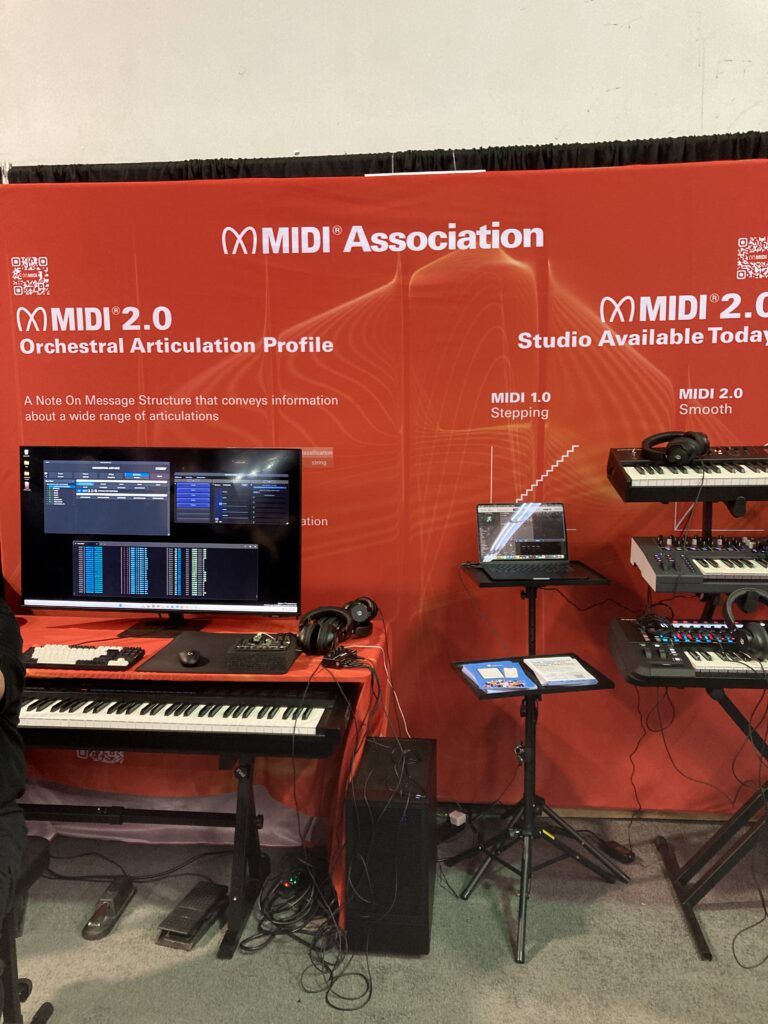
Orchestral Articulation Demo
The MIDI Association showed a working demo of the Orchestral Articulation Profile at NAMM 2026.
This profile will standardize the method for embedding articulations directly into the MIDI 2.0 Note On message.
Once implemented by plugin companies using the MIDI -CI helper library being developed by the 4 plugin format companies ( AU, AAX, CLAP and VST), this will provide composers a standardized way to handle orchestral articulations.
MIDI Association member Audio Impressions has developed a sample library that supports a wide range of different articulations and The MIDI Association helped create a hardware prototype that allows switching the articulations by MIDI 2.0 note attributes.
These performances will also be made available soon.
The MIDI Association Saturday Booth Schedule
2026 MIDI Association Lifetime Achievement Awards Ceremony
As you can see from the picture above, it was literally standing room only for 2026 MIDI Association Lifetime Achievement Awards. All 50 seats in the booth were filled and many people were standing in the aisles to see the presentation.
The MIDI Association honored pioneers whose work helped define MIDI, computer music, and modern music production.
• Chris Adam — Co-founder of C-Lab and Emagic, key architect behind Notator and Logic
• Roy Elkins — Connector of artists, technology, and community across the global music ecosystem
• Greg Hendershott — Founder of Cakewalk, who democratized MIDI sequencing on personal computers
• David Kusek — Founder of Passport Designs and pioneer of computer music and MIDI education
• Gerhard Lengeling — Co-founder of C-Lab and Emagic, creator of Logic and architect of modern DAWs
• Dave Oppenheim — Co-founder of Opcode Systems and pioneer of MIDI sequencing and DAW workflows
• Charlie Steinberg — Founder of Steinberg, visionary behind modern MIDI sequencing and virtual studios
• Emile “Dr. T” Tobenfeld — Algorithmic music innovator who expanded MIDI’s creative boundaries
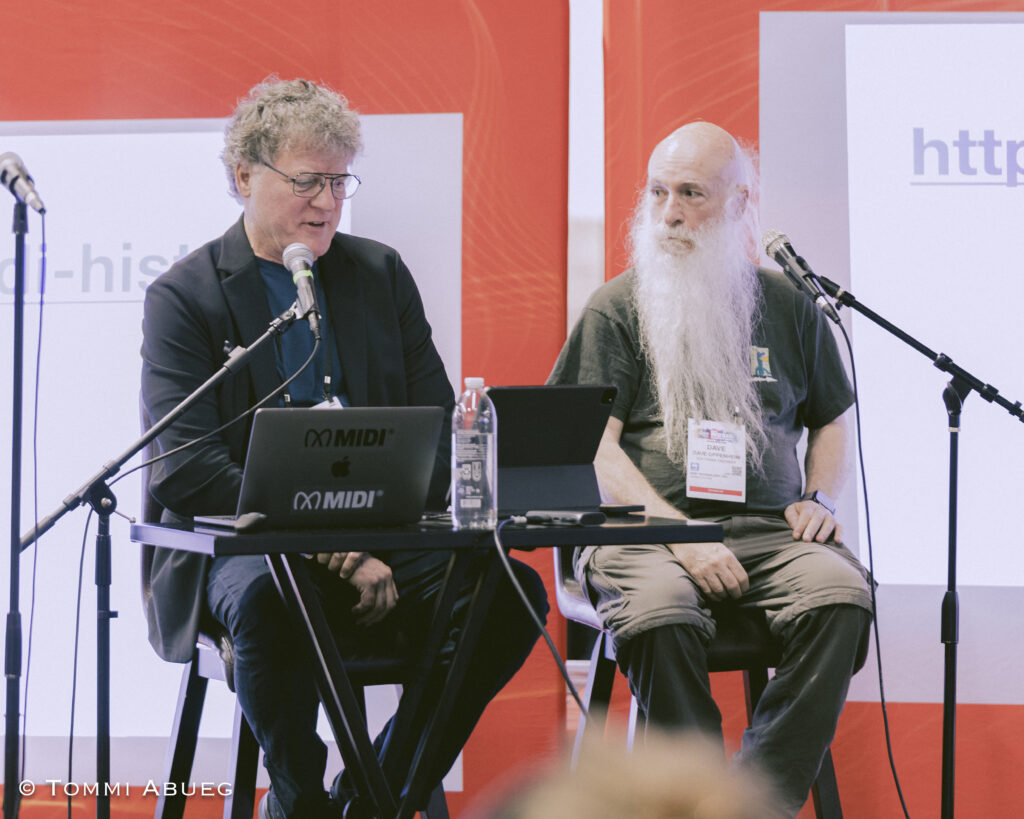
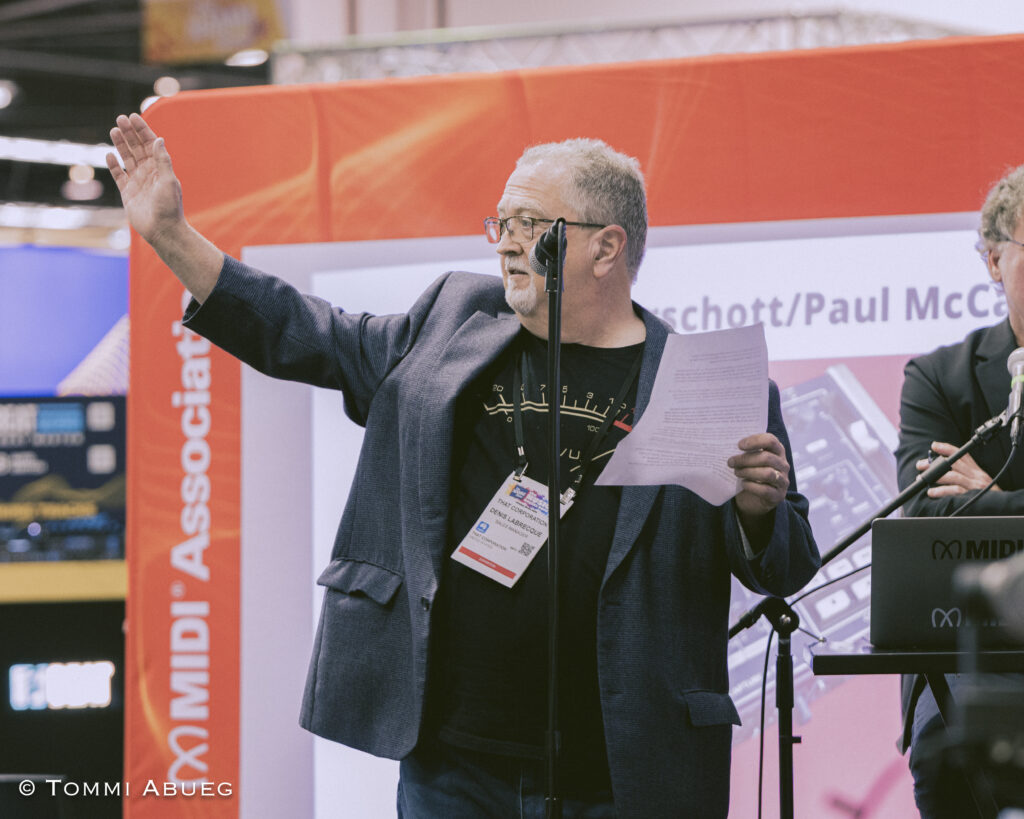
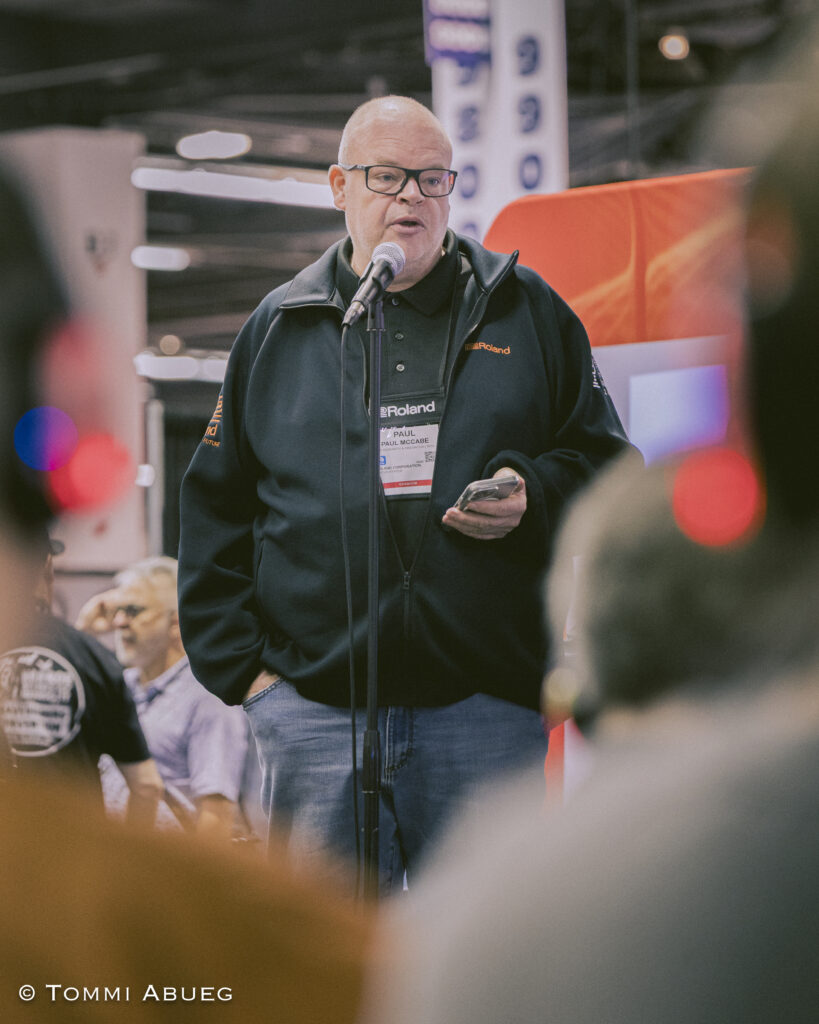
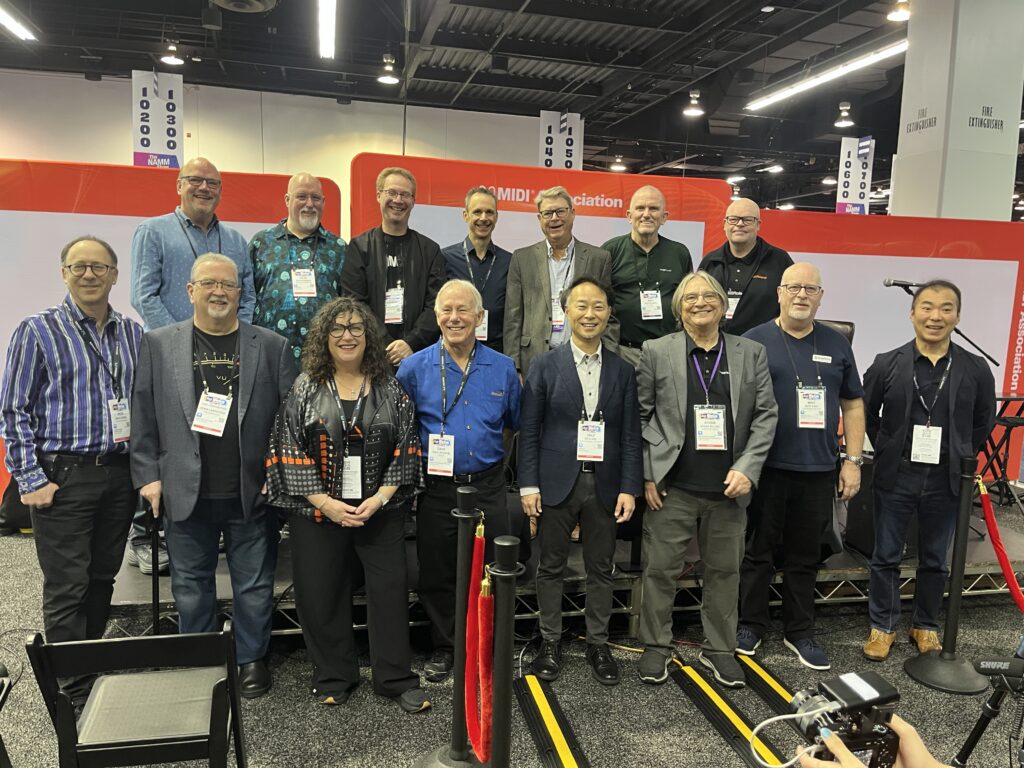
Chris Halaby, panel moderator and David Oppenheim – together they founded Opcode Systems and launched Vision, one of the first DAWs to include audio. Gerhard Lengling and Chris Adam who were the developers behind C-Lab and EMagic. Denis Labreque (former MIDI Association Exec Board member) accepting for David KusekClyde Sendke, managing director of Steinberg accepting on behalf of Charlie SteinbergPaul McCabe from Roland accept on behalf of Greg Hendershott from CakewalkClyde Sendke from Steinberg (accepting on behalf of Charlie Steinberg), Gerhard Lengling and Chris Adams from EMagic, Roy Elkins from Ensoniq, Sonic Foundry and Broadjam an d Dave Oppenheim from Opcode Vision.Gathering of MIDI Association Lifetime Achievement Award winners and TSB and Exec Board members
If you would like to read about the Lifetime Achievement Award winners, there are articles for every Lifetime Achievement Award winner here.
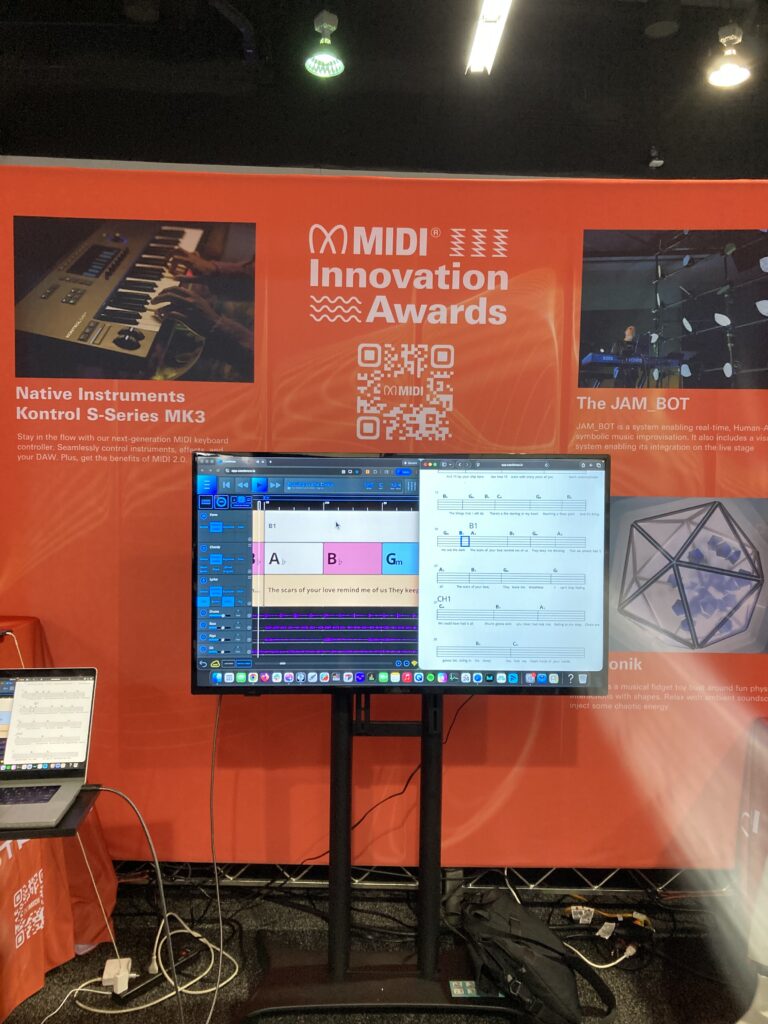
We had a display of MIDI Innovation Awards all three days of the show.
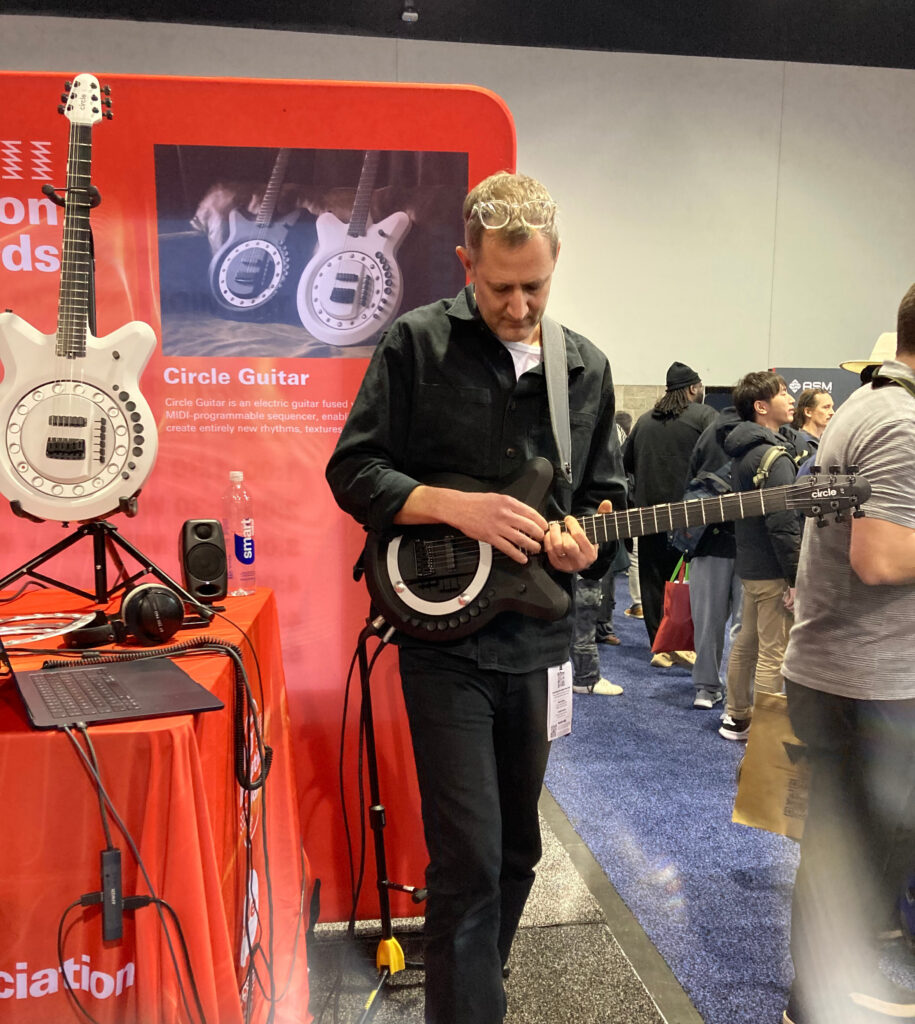
Then Jean Baptiste Thiebaut from Music Hackspace held a panel with MIDI Innovation Award Judge Lucas Cantor Santiago, 2026 MIDI Innovation Award winners Anthony Dickens from Circle Instruments and Mike Venter from Azoteq talked about their experiences with The MIDI Innovation Awards.
Innovators Meetup with Rock Paper Scissors
Our friends from Rock, Paper Scissors held an Innovators Meetup where a whole group of people got to network and share their ideas on Innovation.
Karrie Keyes, long time monitor engineer for Pearl Jam hosted a panel on Sound Girls.
SoundGirls was established to provide women working in professional audio a community to come to for support and advice, and for empowerment and inspiration.
MIDI In Music Education
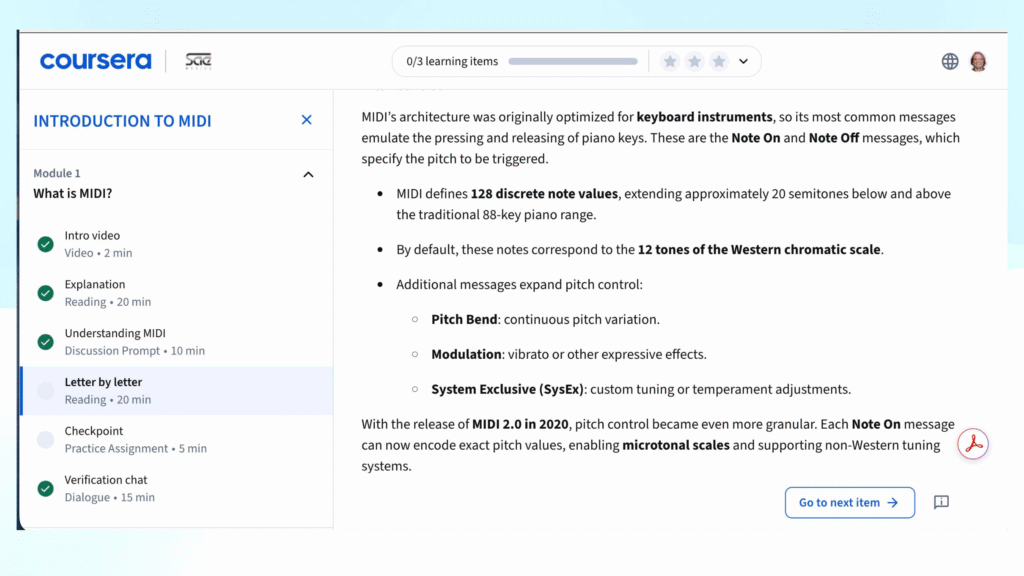
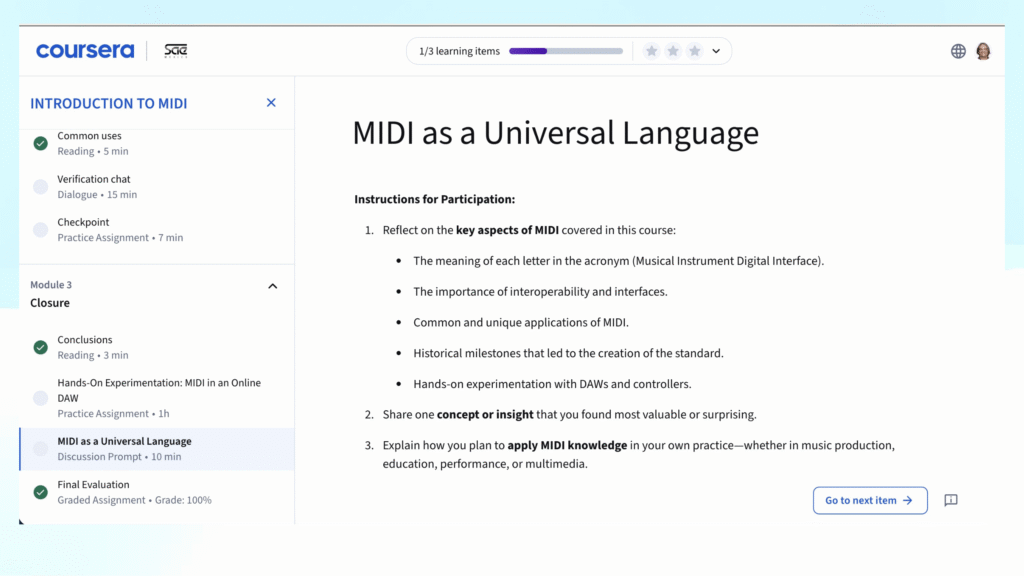
One of our major initiatives this year is the MIDI In Music Education curriculum that we are developing with SAE Mexico.
Our goal is to raise awareness about MIDI in education at schools (secondary, college and university, and pro schools), MIDI Musical Instrument manufacturers and Dealers who sell MIDI products.
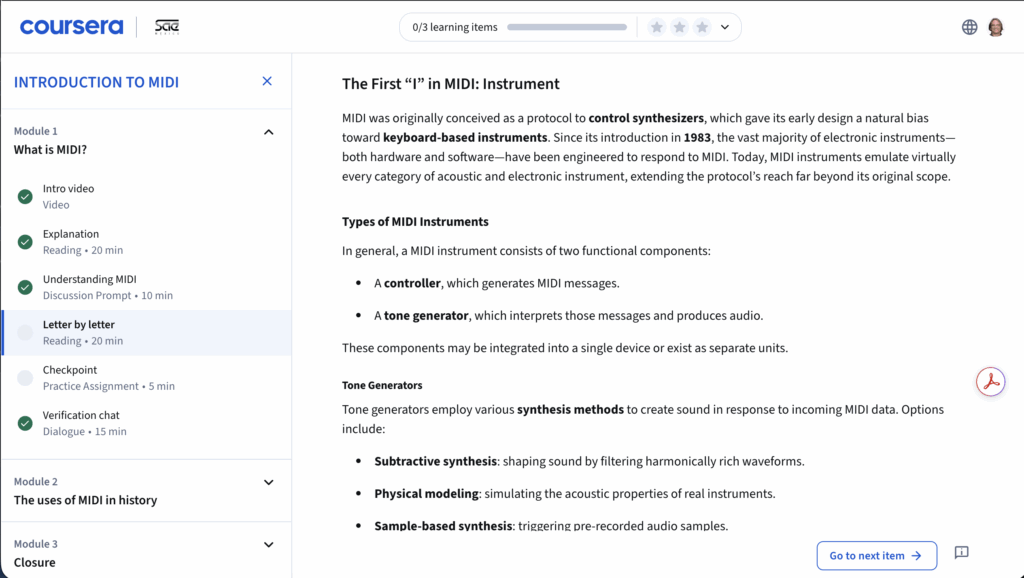
SAE Mexico, The NAMM MIDI Fund and The MIDI Association SAE Mexico has been selected to create a MIDI In Music Education curriculum in both English and Spanish by the MIDI Association.
SAE Mexico have a unique relationship with Coursera, the massive open online course provider so the curriculum and certification will be available at no charge.
All of the materials created for The MIDI In Music Education curriculum will also be provided under a Creative Common license.
This means that Universities, Schools, Dealers and digital musical instrument manufacturers can include portions of the MIDI Association materials without any concerns about copyrights or licenses by just a simple Creative Commons attribution.
Again, we will be making the videos of the panel available soon.
We think everyone should be able to experience the joy of making music.
We brought together music accessibility experts from all over the world to meet regularly & discuss how to make digital musical instruments more accessible.
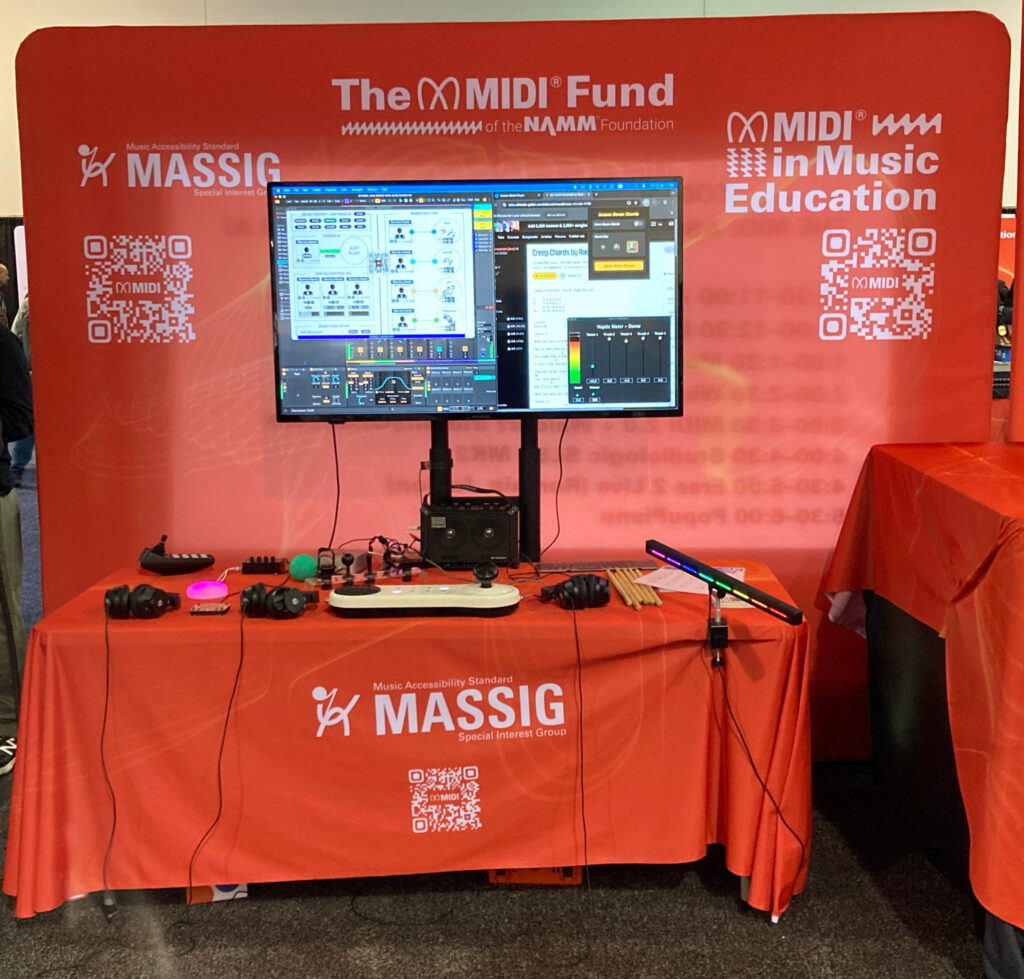
For all three days of the show, we hada MASSIG display that featured the Arcana Strum, Connect Through MIDI, Cosmos Dots, a MIDI Blaster and a Drum Beam. This is the same set up we took to Music China, Tokyo Gakki Fair and Music Tectonics.
Tobi Hunke from AbletonDrummer.com and Haim Kairy from Arcana Instruments
The MASSIG display was always busy and we also had a few well known guests.
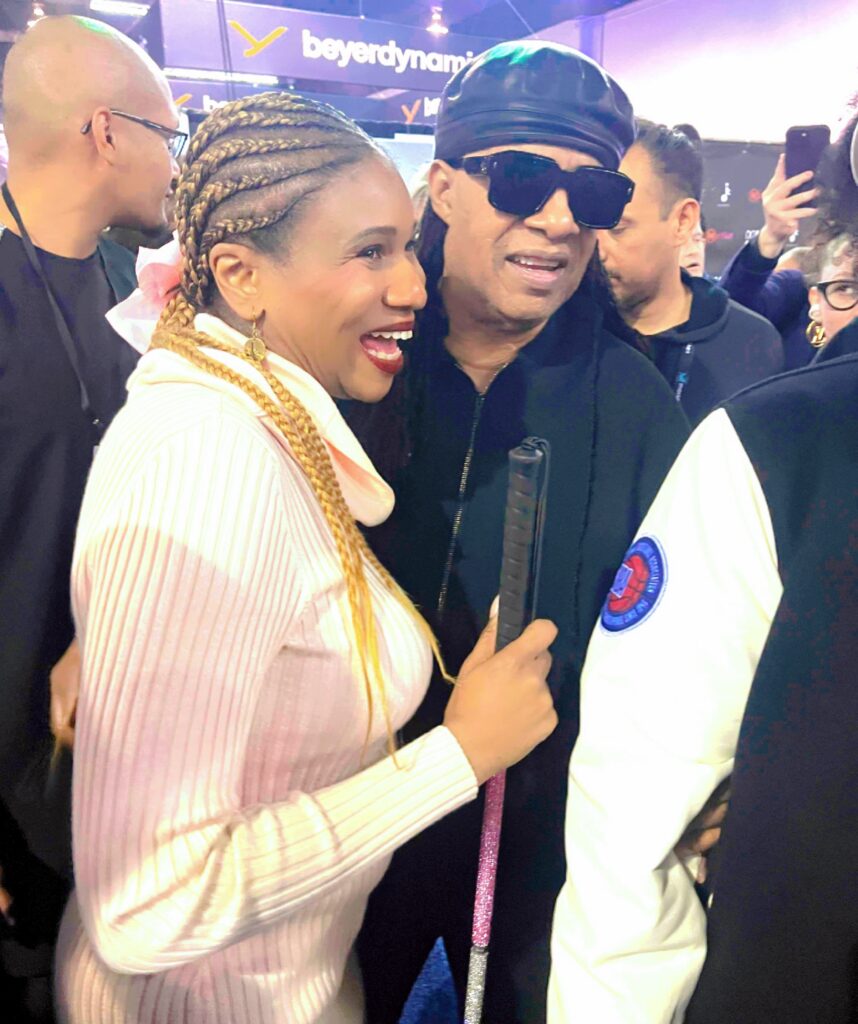
Lachi from RAMPD and Stevie Wonder at NAMM 2026
Athan Billias from the MIDI Association Executive Board, Tobi Hunke from Ableton Drummer and Connect through MIDI, Haim Kairy from Arcana Instruments, and Lachi from RAMPD held a panel discussion on the latest advances in Music Accessibility.
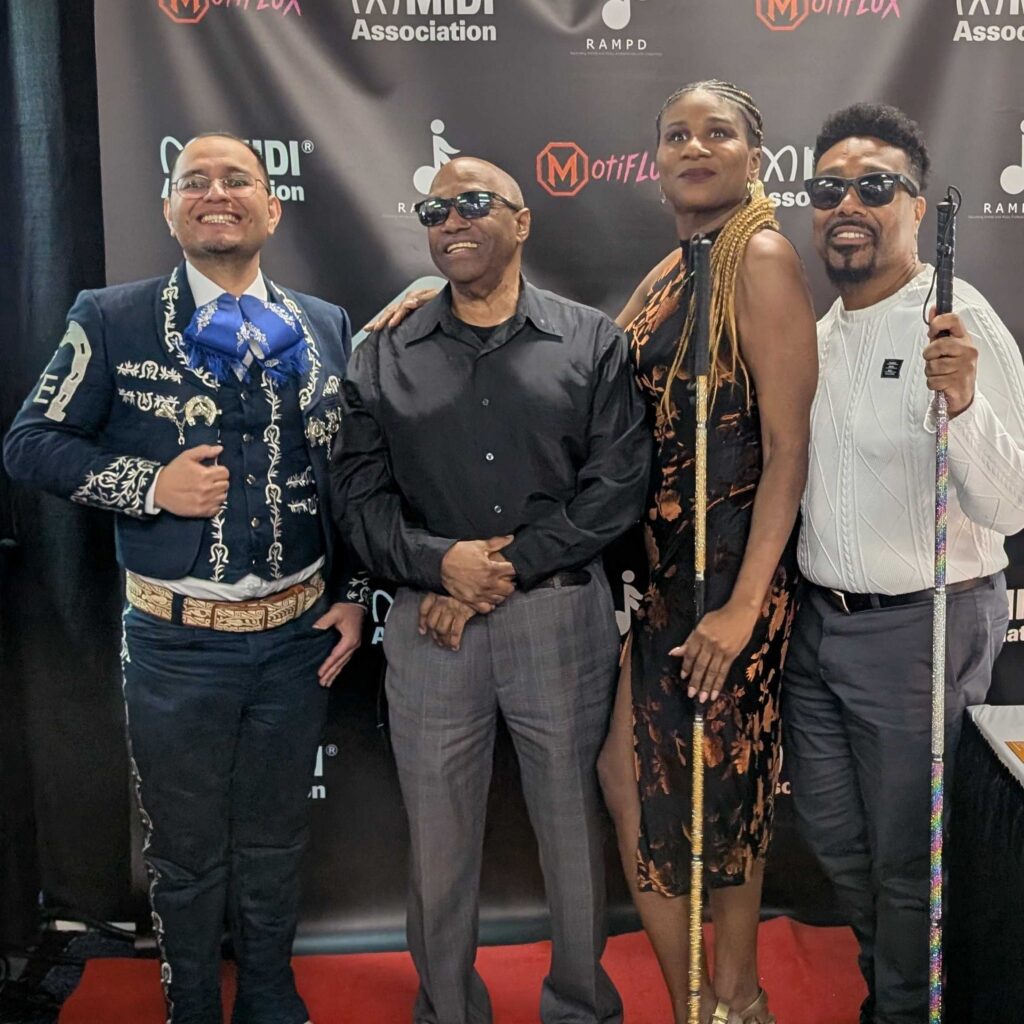
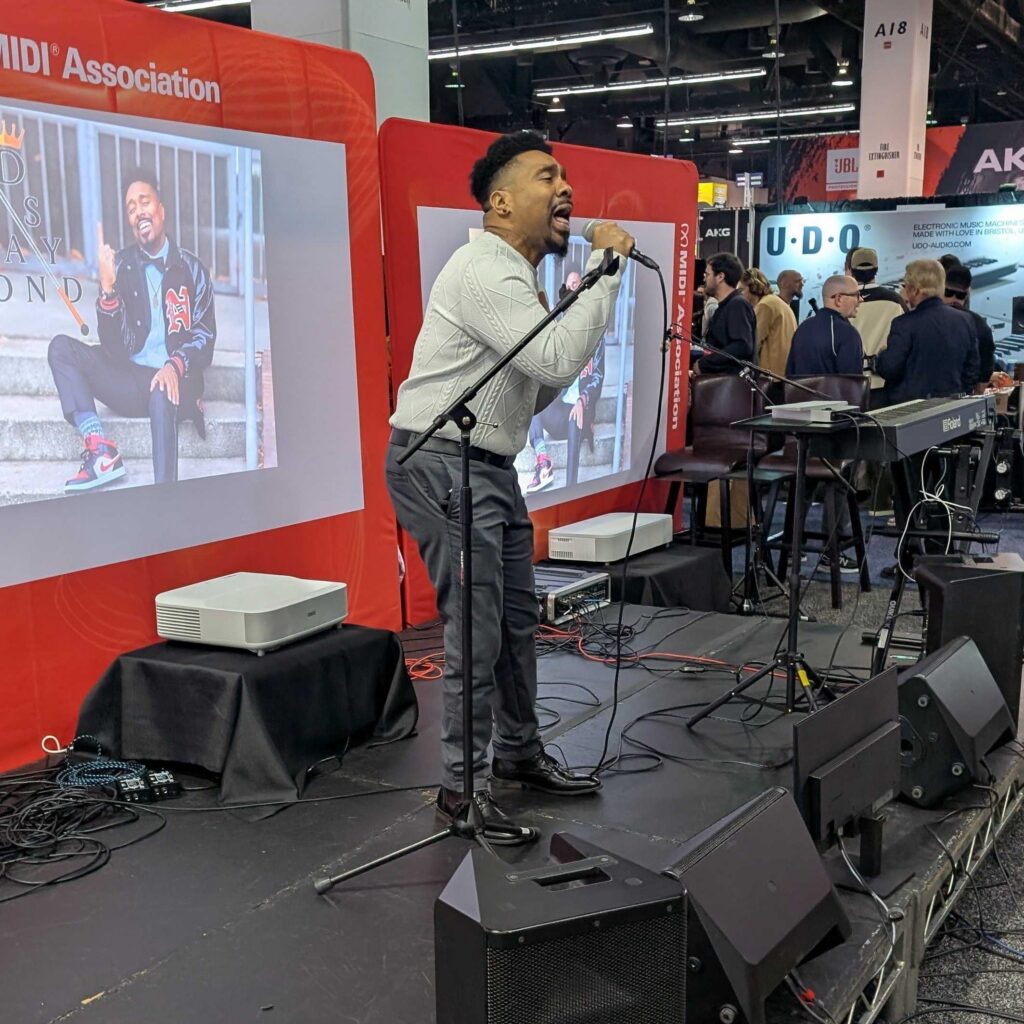
We closed the show with performances by RAMPD members and a finale with the Ambassador of Soul – Ellis Hall.
Deshaymond Solomon Deshaymond is a blind R&B artist, songwriter, producer, entrepreneur, and the visionary founder of Deshaymond Media LLC.
Ivan Estralla, is a Mariachi singer, concert producer, and cultural storyteller dedicated to preserving and sharing the rich traditions of Mexican music.
Indi Robinson is a groundbreaking deaf actress redefining the way music is experienced by blending American Sign Language with expressive artistry.
LACHI Award Winning Artist, CEO RAMPD Lachi is an award-winning recording artist, global renowned disability advocate, Recording Academy National Trustee, who’s produced a GRAMMY-Nominated album. Lachi is the Founder/CEO of the U.N.-recognized organization RAMPD.org—a consultancy group working with music industry giants on disability-inclusive solutions, as well as a global network of music creators and professionals with disabilities and neurodivergence.
Her 2023 peer-reviewed work on accessibility in the recording industry has been published by the Audio Engineering Society. Named a USA Today Woman of the Year and included in Forbes Accessibility 100 list, Lachi’s work amplifying access in the music industry has landed in Billboard, TIME Magazine, Good Morning America and the New York Times.
We can’t wait to share the amazing performances we witnessed during the show so stay tuned here for more details and updates coming in the days ahead.
The MIDI Association Booth on Monday, January 19, 2026
The MIDI Association and SAE Mexico are close to launching a free MIDI Curriculum on Coursera.
So now seemed like the perfect time to engage with some of the other non-profit organizations that support music technology and the GiveANote Foundation is a natural fit.
Supporting the next generation of creators by putting modern music-making tools—controllers, software, and recording workflows—into classrooms that need them most.
The MIDI Association is proud to donate $3,000 to Give A Note Foundation, a national 501(c)(3) nonprofit dedicated to expanding access to music education—especially through innovative, culturally relevant, and technology-forward programs in underserved communities.
Why Give A Note Is a Natural Partner for the MIDI Community
MIDI has always been about access: connecting instruments to computers, apps, and each other so more people can create. Give A Note’s approach mirrors that mission by using music technology to attract new students into school music programs—often through non-traditional entry points like audio production, songwriting, modern band, and creative digital tools.
Give A Note’s own program overview emphasizes the role of music technology in making music education more accessible, and reports more than $1.5 million in direct funding to school music programs. Their impact reporting also highlights reach across hundreds of schools and tens of thousands of students.
A Quick History of Give A Note
Give A Note was established in 2011, launched with investments connected to GLEE and partners including the National Association for Music Education (NAfME), with an early focus on helping restore school music programs impacted by budget cuts. In its first phase, Give A Note awarded grants to schools nationwide through the “GLEE Give A Note” competition.
Over the following decade, the organization expanded into multi-year initiatives and programs that combine educator support, visibility, and direct resources—especially for communities where sustained funding is hardest to secure.
Programs That Put Music Technology to Work
"Music is the heartbeat of our emotions, while technology is the pulse that amplifies it; together, they compose the symphony of our connected world." @GiveANotehttps://t.co/79lu9ubNbb
Give A Note’s programs are designed to help schools launch or grow modern music pathways—where students can build skills that connect directly to today’s creative industries. A few examples:
Music Tech Empowers – grants and professional development that support music technology instruction and help schools diversify music offerings.
SongFarm Program – “Creation Stations” placed into traditional classrooms (including an iPad-based workflow, a MIDI keyboard controller, headphones/monitors, and a mic) to spark interest and seed a pathway toward a full music tech lab.
Music Education Innovator Award – recognizing K–12 public school educators building inclusive, innovative models that keep students engaged in music as part of the school day.
“Access to music technology and production curriculum encourages student participation in school and provides a safe, inclusive environment…”
Meet Dendy Jarrett, CEO of Give A Note
Give A Note is led by Dendy Jarrett, a 35-year music industry veteran known for his passion for music education and his focus on expanding opportunity for every school. Jarrett’s background spans performance and multiple sides of the industry—including retail, wholesale, and manufacturing—giving him a practical perspective on how schools can adopt sustainable, real-world music-making tools and workflows.
How This Donation Helps
The MIDI Association’s $3,000 donation supports Give A Note’s work helping educators create modern learning environments where students can compose, produce, and perform using today’s tools.
When classrooms include music technology—MIDI controllers, software instruments, recording, and production—students who may not initially join band or choir often discover a creative “on-ramp” that feels personal, relevant, and achievable.
That is exactly the future MIDI was built for: empowering more creators, in more places, with more ways to make music.
Event: MIDI In Music Education Working Group Presentation and Webinar
The MIDI Association will host an education-focused webinar, bringing together music educators, industry leaders, and students to discuss new initiatives and expand engagement with MIDI in education globally.
Featured Participants
Dr. Lee Whitmore – Focusrite Group, MIDI Association Executive Board Member
Jennifer Amaya – Riverside City College, Coyle School of the Arts
Isaac De La Mora – SAE Institute Mexico
Athan Billias – The MIDI Association
Agenda Highlights
Introduction of the new MIDI Association charitable programs
Launch of a MIDI education materials grant program
Showcase of music education efforts at Riverside City College
Call to action for deeper involvement in the Association’s working groups
Webinar Chapters and Key Moments
1. Introduction by Dr. Lee Whitmore (00:00:03)
Dr. Whitmore welcomed attendees and introduced the goals of the meeting, emphasizing the importance of industry-educator collaboration.
2. Webinar Agenda Overview (00:01:12)
The agenda focused on new MIDI education programs and projects like Riverside City College’s music tech initiatives.
3. Launch of New Education Materials (00:02:58)
New MIDI education resources were announced, developed in collaboration with SAE Institute Mexico, aiming to increase accessibility and inclusivity.
4. Curriculum Development with Isaac De La Mora (00:04:30)
Isaac De La Mora shared progress on a bilingual (English and Spanish) MIDI curriculum tailored for Latin American educators.
5. A Global Distribution Platform (00:05:32)
The MIDI Association is partnering with Coursera to distribute these educational resources globally, reinforcing the importance of multilingual support.
6. Educator Engagement and Bilingual Access (00:08:16)
Flexible integration into existing curriculums was discussed, alongside strategies to reach educators and students in Latin America.
7. Riverside City College’s NAMM Involvement (00:11:15)
Jennifer Amaya highlighted student participation in the NAMM Show and their upcoming associate’s degree in music industry studies.
8. Student Roles and Real-World Experience (00:16:56)
Students took hands-on roles at NAMM, including booth management and performance—providing invaluable industry exposure.
9. Event Challenges and Coordination (00:18:40)
Jennifer described challenges in logistics and coordination with Yamaha and other partners—valuable learning moments for students.
10. Reflections and Future Planning (00:22:46)
Looking ahead, the group discussed ideas for MIDI-related competitions and further integration of student engagement in future events.
11. Global Perspective with Athan Billias (00:26:38)
Athan shared the MIDI Association’s mission to democratize music education through global partnerships and open-access resources.
12. Call to Action (00:27:10)
Dr. Whitmore and Athan closed the webinar with a call for broader involvement in MIDI’s educational working groups and outreach projects.
Get Involved
Educators, developers, and institutions are invited to contribute to MIDI’s educational mission. Whether through curriculum design, language translation, or local outreach, your participation can help broaden the reach of music technology education around the world.
Imagining our augmented now and the future through the lens of AI art.
The artwork above is generated by Mostafa ‘Neo’ Mohsenvand of the MIT Media Lab, using AI tools and manual editing and drawing.
In September 2024, the MIT Media Lab staged a one-of-a-kind performance that blended human virtuosity with machine intelligence. Featuring Jordan Rudess (keyboardist of Dream Theater), violinist Camilla Bäckman, and an artificial intelligence system called jam_bot, the concert marked a major milestone in live AI-assisted improvisation.
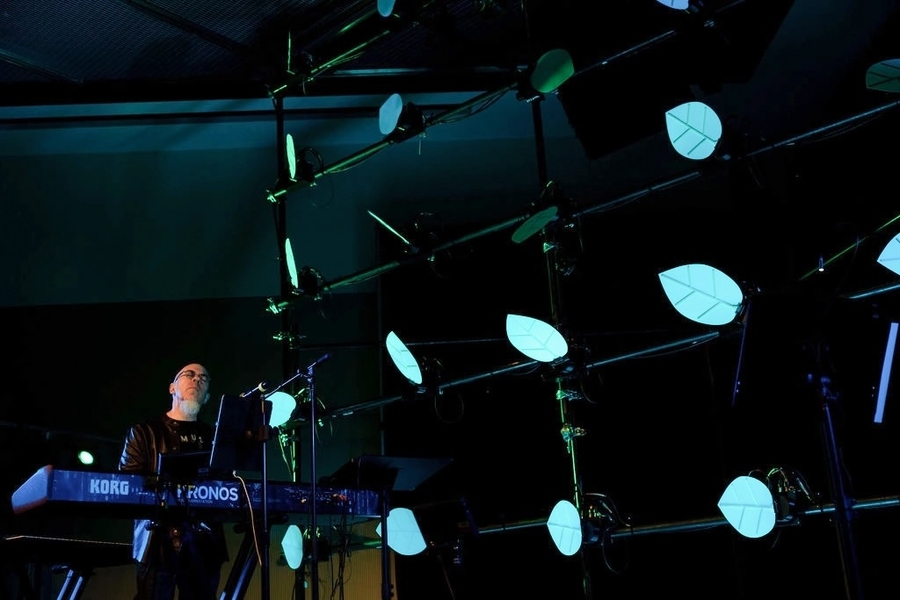
Visiting Artist Jordan Rudess performing at “Jordan and the jam_bot: a work-in-progress performance” on Sept. 21. Credits:Photo: Caroline Alden
The performance wasn’t just experimental — it was immersive. A kinetic sculpture suspended over the stage danced to the rhythms of jam_bot’s contributions, creating a multi-sensory dialogue between light, movement, and sound. The event highlighted a bold new future in which machines become collaborative partners in musical expression, and MIDI remains the essential glue that binds it all together.
The Technology Behind jam_bot
jam_bot was developed by the Responsive Environments Group at MIT’s Media Lab, led by Professor Joseph Paradiso. Graduate researchers Lancelot Blanchard and Perry Naseck trained the AI model to listen, respond, and even improvise with live musicians in real time.
At the heart of the system is a neural network trained on a vast dataset of MIDI and audio recordings. During performance, jam_bot uses live audio input and MIDI messages from Rudess’s and Bäckman’s instruments to make decisions about when and how to join the jam.
Its musical responses are transmitted via MIDI back to the synthesizers and kinetic sculpture controllers, creating a real-time feedback loop between performer and machine.
“We didn’t want it to just play along — we wanted it to have a personality,” said Naseck. The team explored how AI could exhibit *expressiveness*, not just accuracy, and the result was a surprisingly intuitive duet partner.
Last spring, Rudess became a visiting artist with the MIT Center for Art, Science and Technology (CAST), collaborating with the MIT Media Lab’s Responsive Environments research group on the creation of new AI-powered music technology.
Rudess’ main collaborators in the enterprise are Media Lab graduate students Lancelot Blanchard, who researches musical applications of generative AI (informed by his own studies in classical piano), and Perry Naseck, an artist and engineer specializing in interactive, kinetic, light- and time-based media. Overseeing the project is Professor Joseph Paradiso, head of the Responsive Environments group and a longtime Rudess fan.
Paradiso arrived at the Media Lab in 1994 with a CV in physics and engineering and a sideline designing and building synthesizers to explore his avant-garde musical tastes. His group has a tradition of investigating musical frontiers through novel user interfaces, sensor networks, and unconventional datasets. The researchers set out to develop a machine learning model channeling Rudess’ distinctive musical style and technique.
In a paper published online by MIT Press in September, co-authored with MIT music technology professor Eran Egozy, they articulate their vision for what they call “symbiotic virtuosity:” for human and computer to duet in real-time, learning from each duet they perform together, and making performance-worthy new music in front of a live audience.
For Jordan Rudess, whose career has embraced everything from prog metal to app design, playing with jam_bot was more than a novelty — it was a glimpse into the future. “It was like having a creative partner with a mind of its own,” Rudess said. “It responded in ways that surprised me — sometimes gentle, sometimes chaotic — but always musical.”
Camilla Bäckman, an acclaimed Finnish violinist known for her genre-spanning performances and expressive stage presence, echoed the sentiment: “I felt like I was in a conversation, not just a performance. jam_bot would throw out a phrase and I’d reply. It wasn’t just reacting — it was listening.”
Aligning with the MIDI Innovation Awards
The MIDI Innovation Awards, a joint initiative of The MIDI Association, NAMM and Music Hackspace, celebrate groundbreaking work in music technology. jam_bot embodies this spirit — combining MIDI’s versatility with machine learning to explore new realms of live performance, composition, and collaboration.
By building on MIDI’s robust communication protocols, jam_bot was able to “listen” and “respond” to live musicians with millisecond precision. MIDI not only carried the performance data but helped structure the AI’s output to stay musically relevant, from harmony to rhythm. This technical backbone made the performance feel less like code and more like chemistry.
Meet the Artists
? Jordan Rudess
Jordan Rudess is widely recognized as one of the greatest keyboardists in progressive rock. Best known for his role in Dream Theater, he has also released solo albums, developed music apps like GeoShred, and championed new musical technologies. Rudess frequently collaborates with developers and researchers to push the limits of what keyboards — and keyboardists — can do.
? Camilla Bäckman
Camilla Bäckman is a classically trained violinist from Finland whose performance career spans folk, metal, and electronic music. In addition to her rich solo work, she is known for experimenting with loop pedals, voice, and live FX. Bäckman’s technical precision and expressive flair make her an ideal performer for boundary-pushing collaborations like jam_bot.
Looking Forward: The Next Movement in AI + MIDI
What makes jam_bot especially exciting is that it doesn’t replace the artist — it enhances them. By serving as an improvisational partner, AI becomes a source of inspiration, pushing performers in unexpected directions and redefining live music as a dynamic co-creation.
This project exemplifies the future MIDI aims to support: open, inclusive, and creatively adventurous.
It also serves as a call to developers and performers alike — to embrace not only new tools, but new relationships with the technology itself.
As Rudess put it, “It’s not about AI taking over — it’s about discovering what we can do together.”
The MIDI Association Visits The MIT Media Lab In April 2025
After the weekend at the 2025 Berklee Able Assembly, on Monday, April 14, 2025, we visited The MIT Media Lab.
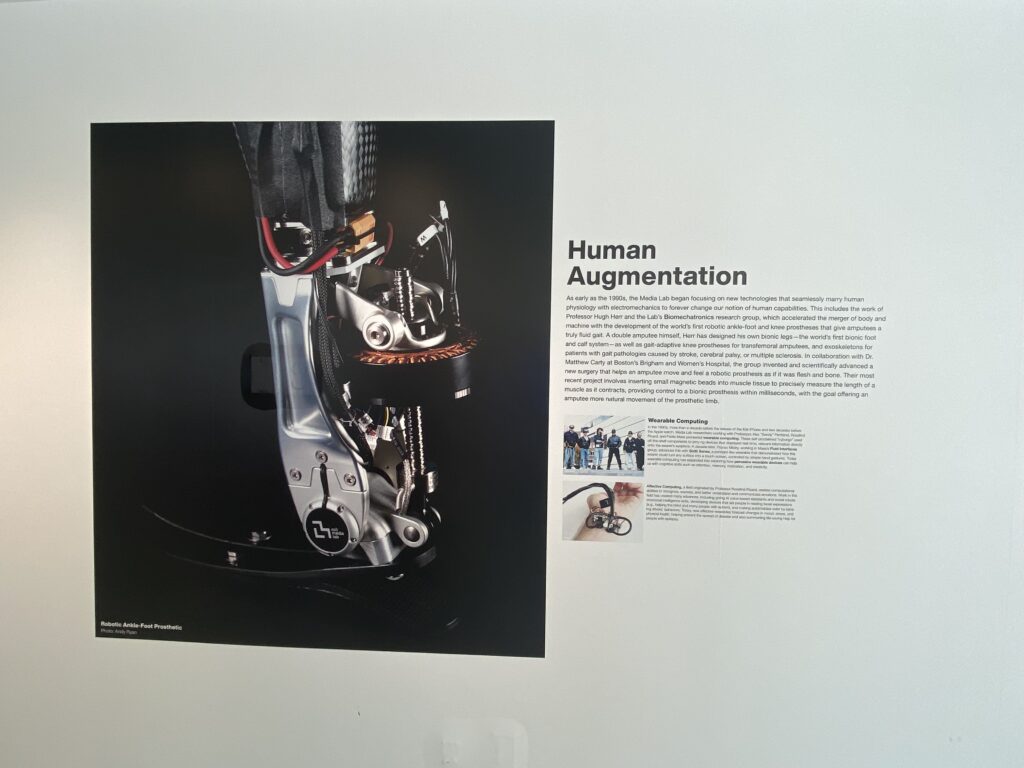
Graduate researchers Lancelot Blanchard and Perry Naseck who worked on the Jordan Rudess project gave us a tour of the amazing MIT Media Lab facility.
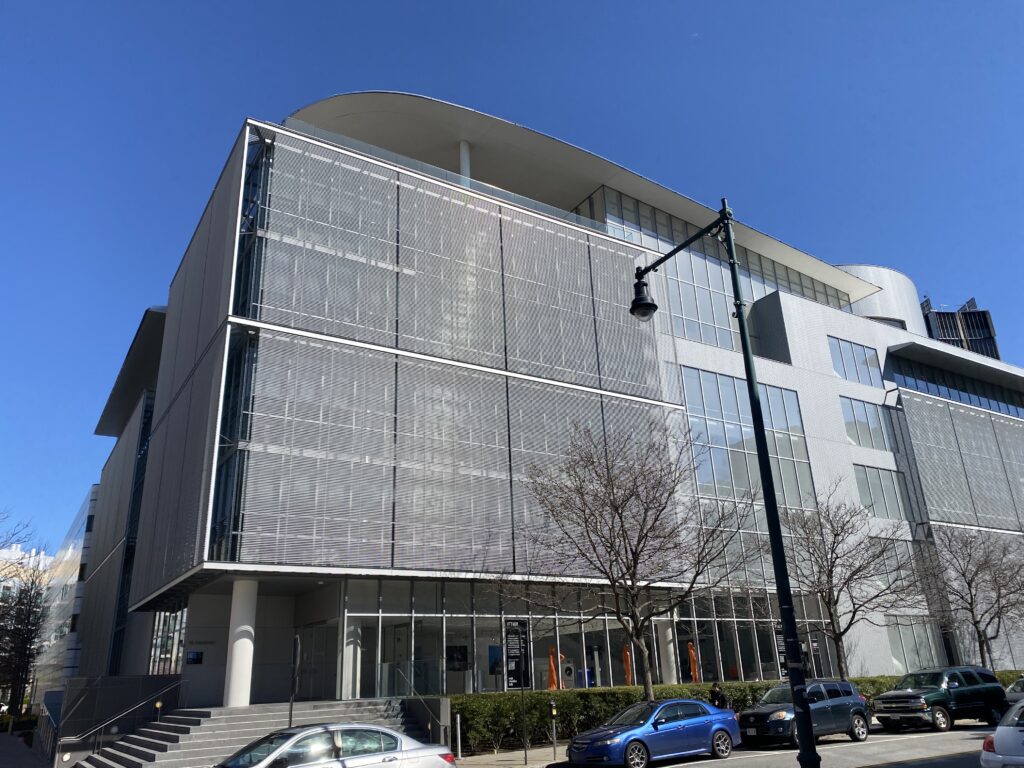
The MIT Media Lab Building in Cambridge, Mass on the banks of the Charles River
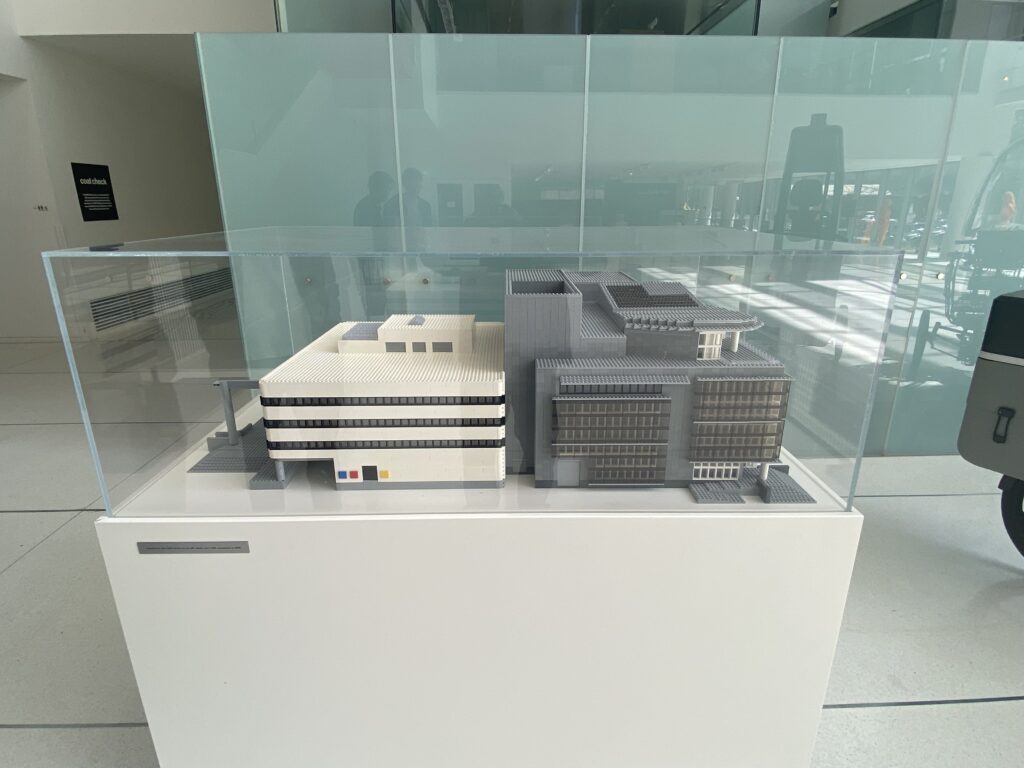
The view from the Harvard Bridge over the Charles River- (Love That Dirty Water!)A Lego model of both the old and new MIT Media Lab buildings side by side one white and one metallic.
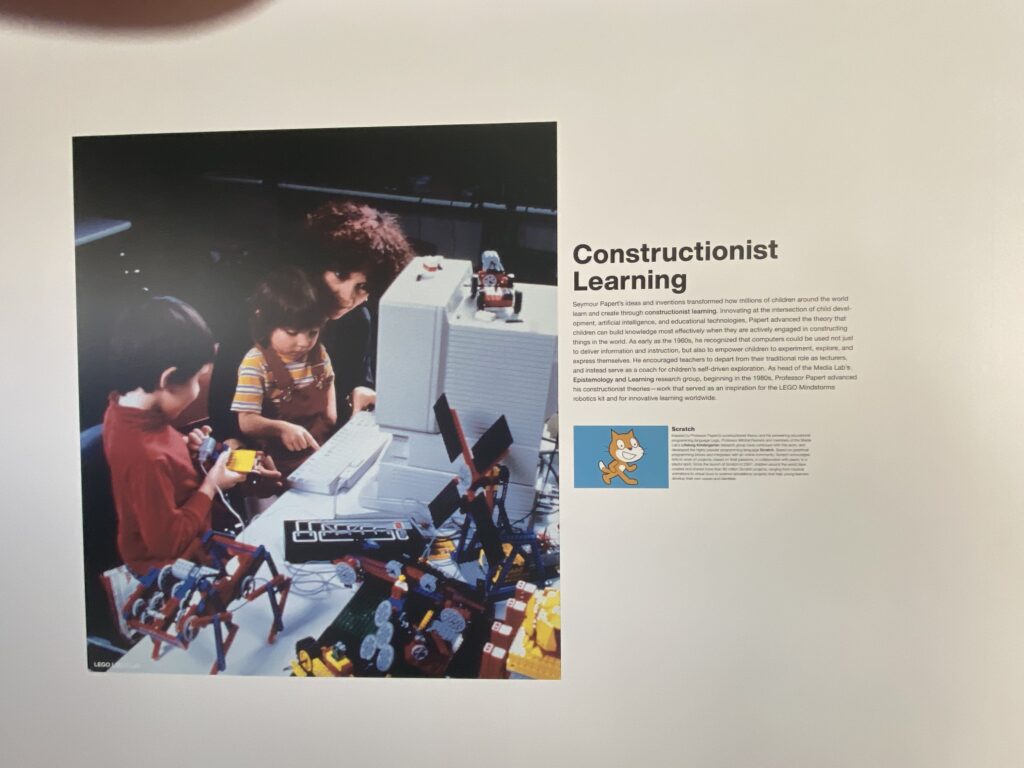
There is a reason for the Lego model of the buildings. MIT Media Lab did a lot of work with Lego on both the Mindstorm Robots for Kids and the Scratch, a programming language for kids. Check out the poster below on Constructionist Learning.
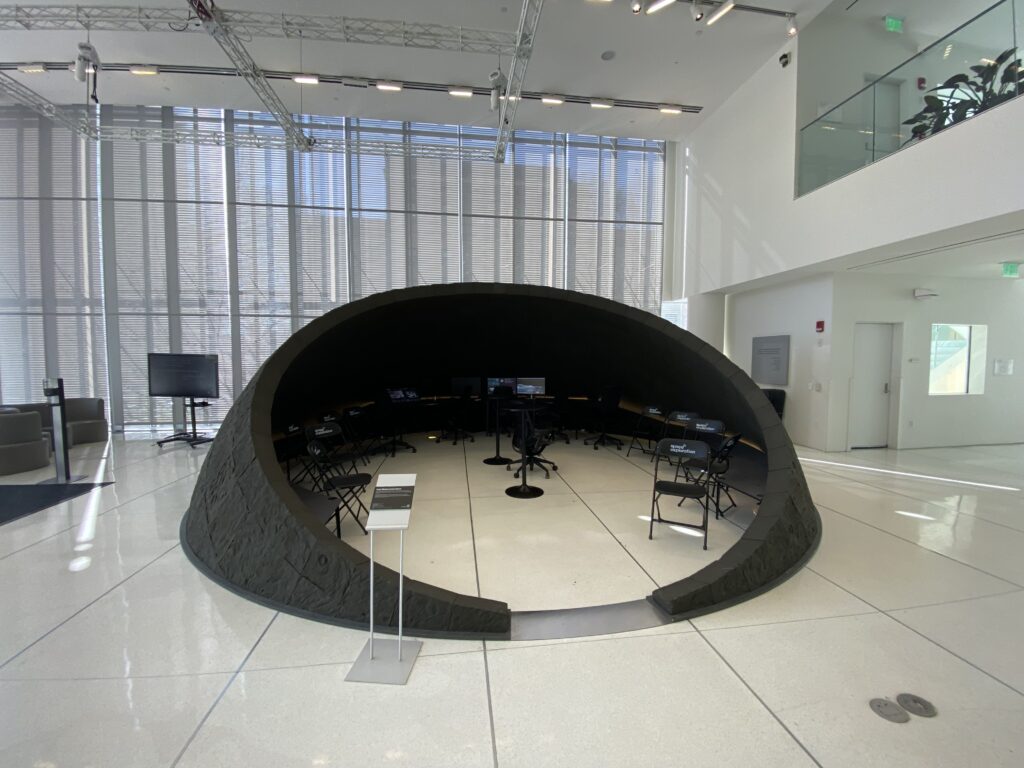
The MIT Media Lab Mission To The Moon
The mission was based out of Luna, a mission control space designed by MIT Architecture students and faculty in collaboration with the MIT Space Exploration Initiative, Inploration, and Simpson Gumpertz & Heger.
It is installed in the MIT Media Lab ground-floor gallery, and is open to the public as part of Artfinity, MIT’s Festival for the Arts.
The installation allows visitors to interact with the software used for the mission in virtual reality.
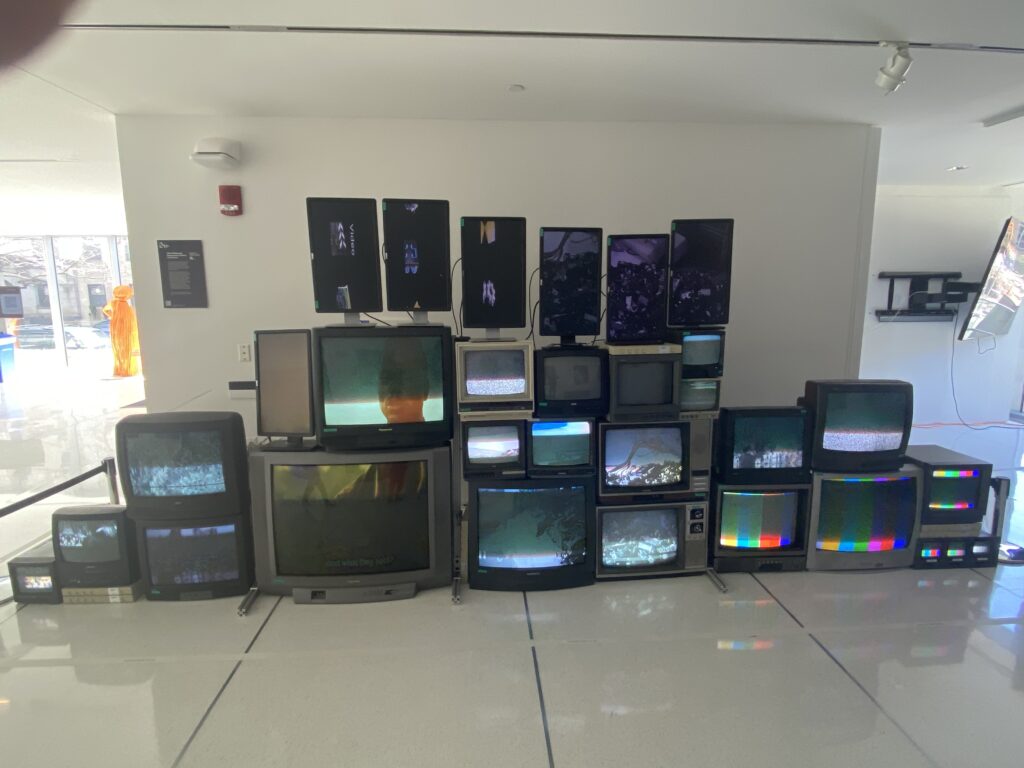
Here is a picture from the first floor of the MIT Media Lab of a wall of old TVs in different condition and showing content on every screen.
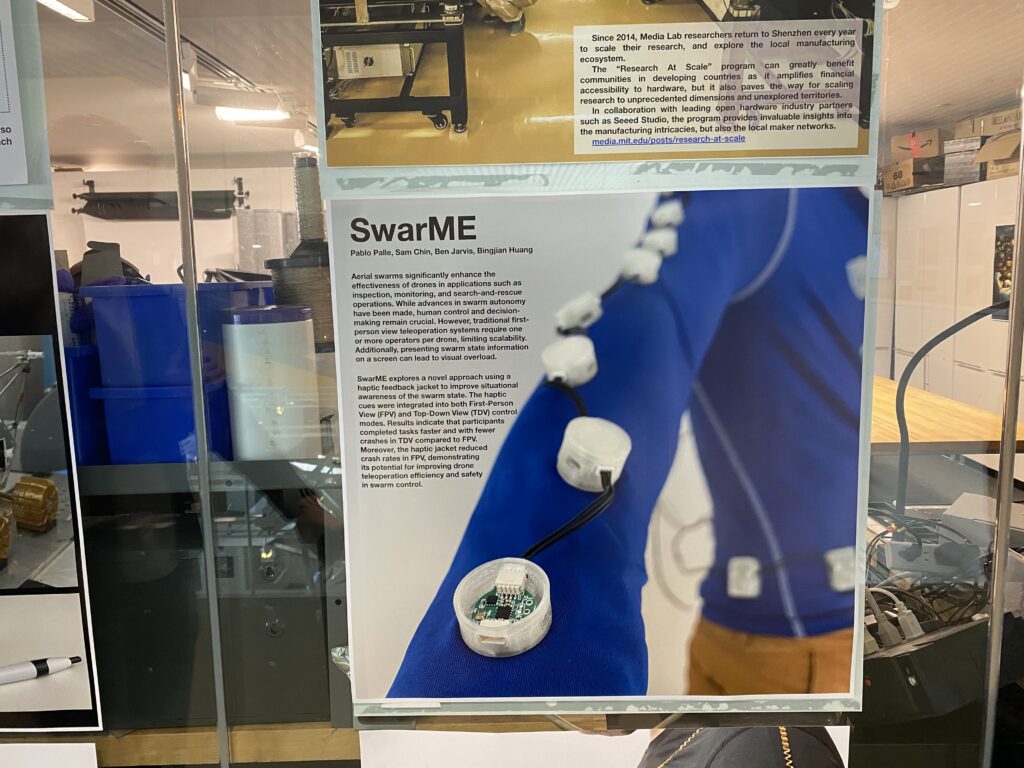
This jacket was designed to control drone swarms, but maybe some of the same technology could be used to provide haptic feedback for deaf people attending concerts like the initiatives that were highlighted at the Able Assembly.
We also agreed that we should get them access to new specifications under development by them joining The MIDI In Music Education Special Interest Group.
We are excited about all the work that the MIT Media Lab is doing and are looking forward to further interactions in the future.
Our goal is ensuring that every professional or aspiring musician, producer, artist and manufacturer has free access to our comprehensive suite of educational MIDI content.
This curriculum, designed to bridge cultures and languages, will be accessible in both English and Spanish. It’s tailored not just for an academic audience across secondary schools, colleges, universities, and professional institutes, but also for the dedicated staff of manufacturers and resellers, marking a significant stride towards a global standard in music technology and digital arts education.
The MIDI In Music Education Special Interest Group is led by Dr. Lee Whitmore, Focusrite Group ‘s Vice President for Education, Americas.
Whitmore’s career most recently includes six years in Boston, Massachusetts, as Berklee’s Vice President for education outreach and social entrepreneurship, and then as the inaugural executive director for the Grammy Music Education Coalition.
He joins Focusrite Group with more than 30 years of product, sales, marketing and leadership experience, including time at Avid and Sibelius, and Korg USA.
He is joined every two weeks in the MIME special interest group by a wide variety of educators and industry veterans including Jennifer Amaya from Riverside Community College, Chandler Bridges from Indiana University, Seth Cluett, from Columbia University, Paul Lerhman from Tufts University, Keith Mason from Belmont University, Issac de la Mora from SAE Mexico, Brian Smithers from Full Sail University, Michael Strickland from Florida State and many more.