

Sit down at the booth, pick a song you know, and play. Every note you play lands inside the chord — on whatever controller is in front of you, with no training and no setup. This article is about the software underneath: three programs that pass the song’s harmony along as MIDI 2.0 Flex Data. It is a technical companion to Athan Billias’s ADC article, to Part 2 of the Music China series, and to the Kakehashi MIDI MEETUP recap.
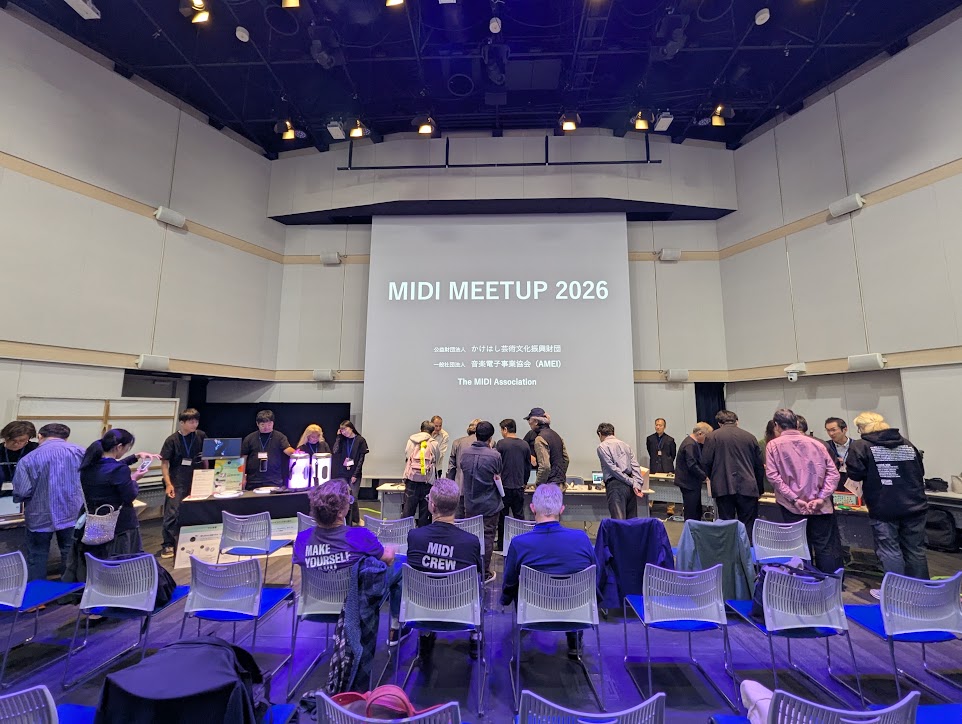
At the accessibility corner in Shanghai and at the Kakehashi Foundation in Tokyo, visitors sat down at a keyboard, an Arcana Strum, or any other MIDI controller — MIDI 1.0 or MIDI 2.0 — picked a song they knew, and played along, and every note they played landed inside the chord.
That is the accessibility argument in a single gesture. A visitor who has never had a lesson, or who cannot reliably put a finger exactly where they intend to, is musically right anyway. The system takes on the part of playing that training normally pays for — knowing which notes belong — and leaves the person everything that makes playing worth doing: when to move, how hard, how fast, how often. Part 2 and the Kakehashi recap tell that story from the floor. This article covers the machinery.
The harmony travels as data
MIDI has always carried notes. MIDI 2.0 adds Flex Data: a lane for information about the music rather than the music itself — tempo, key signature, time signature, lyrics, and chord symbols.
It is the difference between sending someone a recording and sending them the chord chart. The recording is fixed. The chart says what the harmony is at each moment and leaves the playing to whoever is holding the instrument. That is exactly what this demo needs. Every instrument on the table has to know the current chord, and none of them should have to know the song.
Chords sent as Flex Data
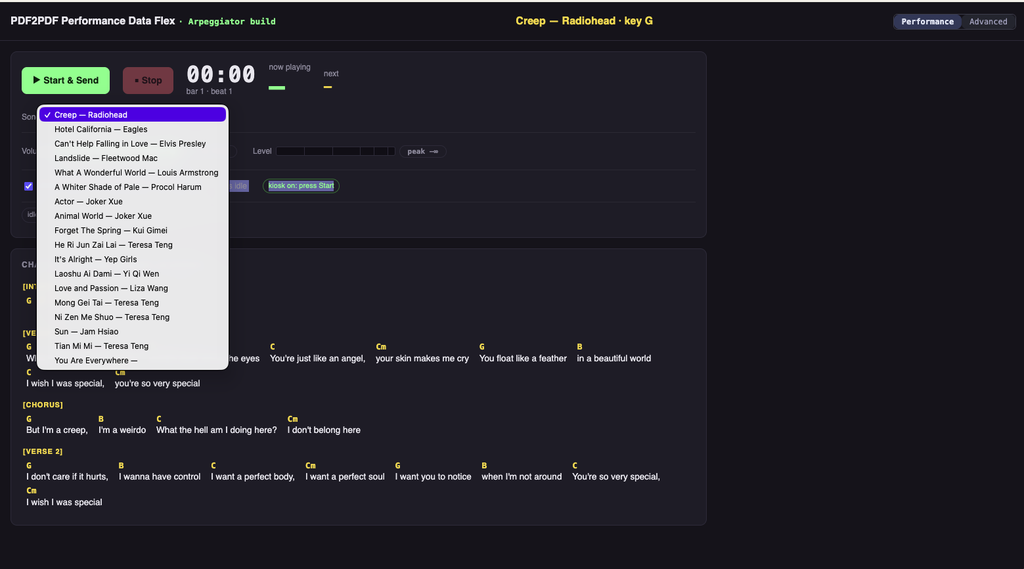
PDF2PDF Performance Data Flex is Athan Billias’s application. The name is a leftover from its first job, turning chord charts trapped in PDFs into something playable; it now reads charts from Ultimate Guitar and iReal Pro as well. It turns a chart into a timed song file and plays it on its own clock. As the song plays, it sends MIDI 2.0 Flex Data in the Universal MIDI Packet — Set Tempo, Set Key Signature, and a Set Chord Name at every chord change — alongside ordinary MIDI 1.0 chord notes and clock for older gear.
PDF2PDF is a demonstration, not a product, and was never intended to become one. It is not for sale and there are no plans to give it away. Athan built it to answer a question: the messages for sending chord information had been sitting in the MIDI 2.0 specification unused, so what would it take to use them, and what would it make possible? As he told the MASSIG group in November, the surprising part was not that it worked, but that nothing stood in the way — the messages were already there, and in his words “anybody could do it.” What is meant to travel from this project is the method, not the application.
Set Chord Name holds the root, the chord type, up to four alterations, and an optional bass note for slash chords, so a receiver can rebuild the exact chord.
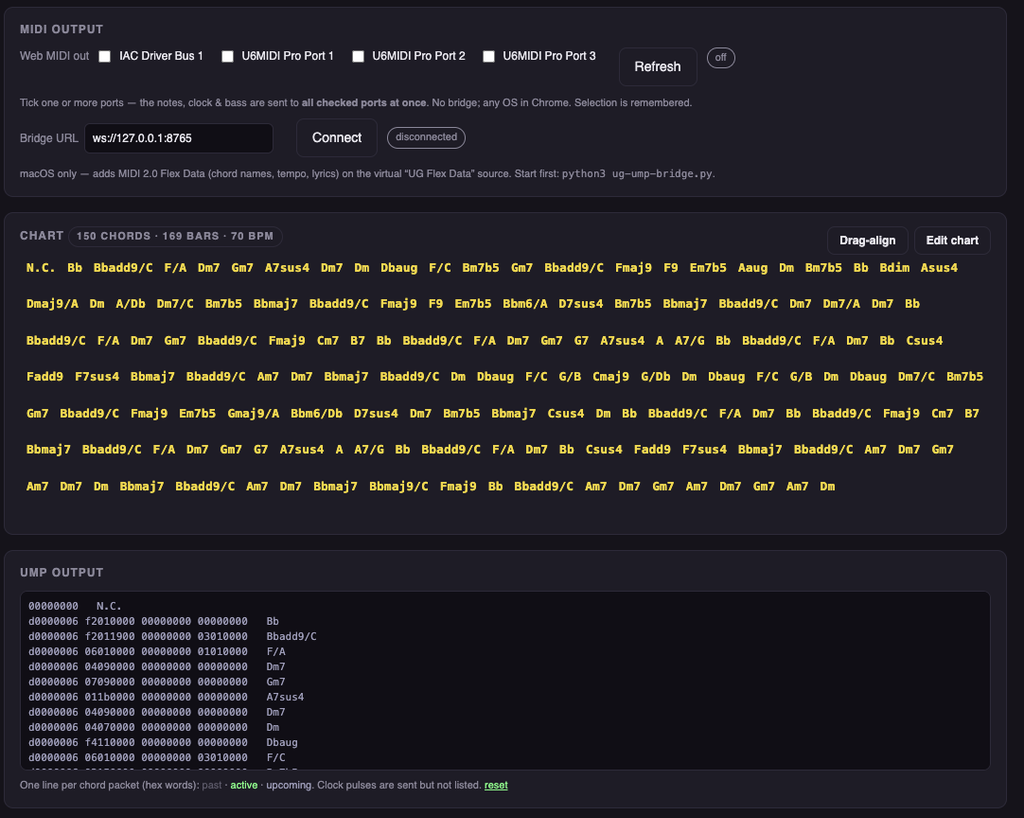
Any application that sends these messages can drive the demo.
How the pieces connect
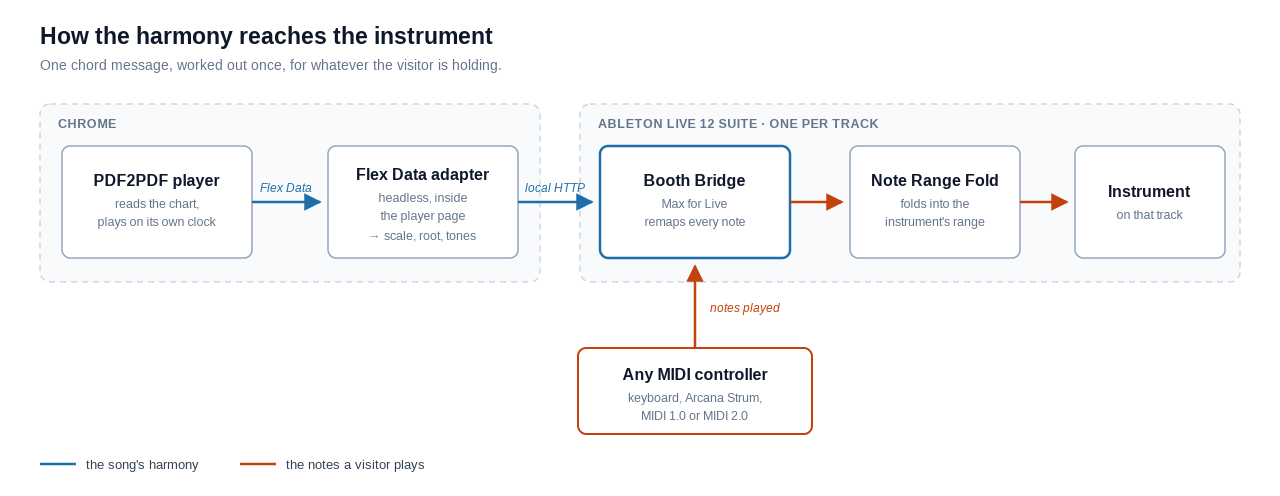
PDF2PDF publishes the harmony. The Flex Data adapter, which I wrote, decodes it: a strict decoder for the Flex Data message type, written against the specification, which turns Set Chord Name and Set Key Signature into a scale, a chord root, and the exact chord tones as pitch classes — that is, the twelve note names, with octave set aside until later.
A chord the adapter’s vocabulary cannot name still arrives as its exact notes, and a 50-millisecond window keeps a chord and its bass note changing together.
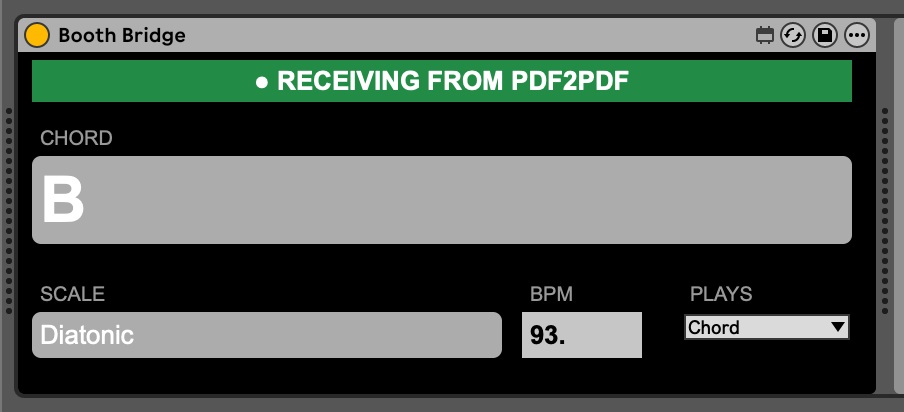
The Booth Bridge, a Max for Live device I built, receives that harmony inside Ableton Live. It sets Live’s own root note and scale through the Live API, so that Live 12’s scale-aware devices follow the song, and it remaps every note a visitor plays before that note reaches the instrument on its track.
What happens to each note
The Bridge listens to the white keys and ignores the black ones, so a hand that lands anywhere on the keyboard plays only chord tones. Middle C plays the lowest tone of the current chord, the next white key up plays the next chord tone, and when the chord runs out the pattern starts again an octave higher. On a C major chord, C, D, and E play C, E, and G, and F, G, and A play the same three tones an octave up. The mapping comes from Tonalign, my MIDI pitch-correction plugin.
The chord tones sit in a fixed octave, sorted upward from C, so when C major changes to A minor, the first two keys keep playing C and E and only the third key moves, from G up to A. Tones that two chords share stay under the same fingers, and the register stays put.
Each device has a second palette for bass parts. In Root mode three white keys in a row play the chord’s root, the next three play its fifth, and the next three the root an octave up. The fifth is whichever chord tone sits closest to a perfect fifth above the root, so a diminished chord gets its flattened fifth, and when the chart calls for a slash chord, the written bass note replaces the root.
Chord changes take the most care, because a visitor is usually holding keys when one arrives. The Bridge keeps a record of every held key, matched by key and channel, and when the harmony changes it re-pitches each held note to its place in the new chord. Note-offs go out before note-ons, and a note that is still correct in the new chord keeps sounding without being struck again, so nothing sticks. Velocity passes through unchanged, so players control their own dynamics.
After the Bridge, Emanuele Parravicini’s Note Range Fold device folds each note into the playable range of the instrument on that track, so a trumpet track stays in a trumpet’s range.
Building the booth
The rule from the first planning meeting was that nothing on the table depends on internet access. The adapter normally runs as a web console that publishes to a shared online room, which is how the LA Laptop Orchestra uses it in concert. For the booth I built a headless version — no interface of its own — that runs inside the player page: the player decodes its own Flex Data stream and posts the harmony to the Bridge over a local connection on the same computer. The whole chain runs with Wi-Fi off, in Chrome and Ableton Live 12 Suite, started from a small launcher script on Windows or Mac.
What ran in Shanghai was one Live set in backing-track mode. The player plays each song’s backing track itself, in sync with its chord clock, and Live supplies the instruments visitors play: eleven tracks, each with a Booth Bridge and a Note Range Fold. Emanuele built that set, gave the player control of Live’s transport, added a volume fader and meter, and re-timed eleven charts to the Hit Trax recordings Athan supplied.
My share of the booth build was a Performance view with only the controls an operator needs, backing-track sync with delay compensation, twelve Chinese songs charted from Hit Trax MIDI files, launchers, a staff guide, and a kiosk mode that starts the song again from the top once the page has been left alone. Kiosk mode is what makes the demo survive a trade show: as Athan put it in the Kakehashi recap, you can set it going and “walk away.”
Where it has run
The kiosk build ran at Music China in Shanghai and again at the Kakehashi MIDI MEETUP in Tokyo. For the accessibility table at ADC in Bristol, Jay Pocknell ran the same Live set on his MacBook, and Tim Yates brought the instruments.
Why it works with any controller
None of the instruments on the table has the song loaded. Each one follows a chord message that the MIDI 2.0 specification defines, so the harmony is worked out once, in the Bridge, for every controller a visitor brings — and for every controller a visitor might bring next year.
That is the part worth copying. The demo is three programs that happen to exist; the message is public, and so is the idea. MASSIG applies the same thinking to the Assistive Text Profile, and the group is open to join.
Afterword: beyond the booth
by Athan Billias
I spent yesterday in a Music Tectonics roundtable where the conversation kept coming back to the same question: where the next revenue actually comes from. The answer the room kept arriving at was connecting fans to artists more directly.
Listening to that, I kept thinking about our booth. What we demonstrated in Shanghai is a person sitting down in front of a song they already love and playing along with it straight away, without making a mistake. Move that from a trade-show counter to a phone, a game, or a karaoke box, and the same mechanism becomes a way for a fan to get inside a record instead of only listening to it.
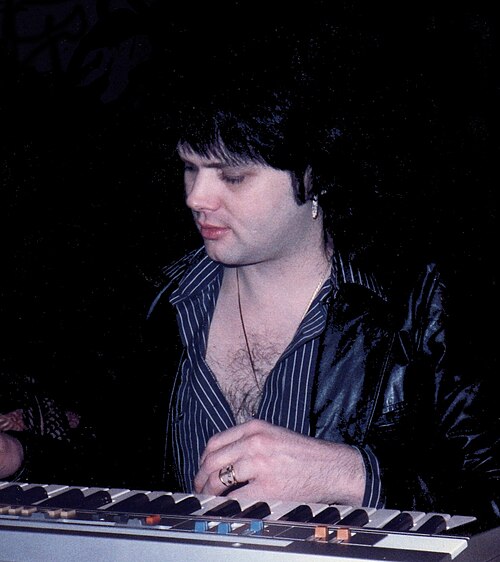
This is not a new dream, and the person who got there first deserves naming. Jimmy Hotz, who died in 2023, spent the late 1980s and the 1990s building the Hotz Box and the Hotz MIDI Translator. Underneath them was a database of chord and scale structures that remapped whatever a player touched into notes belonging to the current harmony, so that no wrong note could be heard — the software reconfigured each pad’s note on the fly, and he patented the technique. By 1996 he was describing HotzTrax, which let you play along with songs by artists you loved, over backing tracks cut by studio musicians, without being able to play a wrong note. That is our booth demo, described thirty years early. What Hotz did not have was any way to hand his harmonic structures to someone else’s instrument. The translation tables were his, inside his software, driving his hardware.
https://www.atarimagazines.com/startv5n2/hotzmidi.html
The industry kept trying to ship the data, too.
In 1990 Warner New Media and Victor developed CD-MIDI, an extension of the audio CD that put up to sixteen channels of MIDI into the subcode channels an ordinary disc leaves empty, so a record could carry performance data alongside the music. It worked. Almost nothing could read it — the Amiga CD32, the CDTV, the WonderMega — and it went nowhere.
The attempts have not stopped. Brian Eno has worked at the edge of the same idea for years, building music an untrained person can shape without getting it wrong. I worked with Stephen Kay of Karma Labs on Guitar Star, which Daiichi Kosho released in Japan at Big Echo karaoke locations: you picked up a plastic guitar, played along with the song, and could not play a wrong note. At Yamaha we shipped Chord Tracker, which analyses the chords in songs in your own music library so that you can play along with them.
And our own MIDI Innovation Awards archive has collected a dozen chord and harmony entries in the past three years alone — Chordjam, Chorda, Fluid Chords, InstaChord, NOPIA, the J-6 Chord Synthesizer, two different Chord Boards.
So the idea has been tried repeatedly, by serious people, for thirty-five years. What was missing each time was not the idea and not the instruments. It was a common way to move the harmony around. Every one of those products had to work the chords out for itself, in its own format, locked inside its own application, and none of it could be handed to anything else.
That is the part that is now solved. Set Chord Name and Set Key Signature are in the MIDI 2.0 specification, any application can send them, and any instrument can act on them. The booth demo happens to be eleven tracks in Ableton Live. It could as easily be a game, a karaoke machine, a streaming app, or an artist shipping a chord track alongside the record. The hard problem was never making one fan sound good. It was agreeing on how to tell every other device what the chord is.
About the work. The Booth Bridge is a free Max for Live device for Ableton Live 12 Suite, available from scalenavigator.com, with source code on GitHub. The Flex Data adapter is on GitHub. PDF2PDF is a demonstration rather than a released application and is not distributed; the booth build in particular carries licensed song charts.
About the author. Nathan Turczan is a composer and music technologist in Los Angeles who builds instruments for playing harmony together. He founded Scale Navigator, a set of tools that share one harmony across DAWs, MIDI instruments, phones, and performers, which grew out of his MFA at CalArts and a NIME 2019 paper on which he is first author. He also directs the LA Laptop Orchestra, designed the interactive music system for Sia and David O’Reilly’s SOULS, and has lectured at Stanford’s CCRMA and CalArts. He is a member of the MIDI Association’s Music Accessibility SIG.
Sources
- Athan Billias, “Music Accessibility and MIDI In Music Education at Music China 2026,” midi.org, 2 November 2026 (Part 2 of five). Link
- Athan Billias, “Music Is For Everyone: MIDI MEETUP 2026 at the Kakehashi Foundation,” midi.org, 6 November 2026. Link
- Athan Billias, “MIDI Assistive Text Takes the Stage at ADC 2026,” midi.org, 16 November 2026. Link
- Sonicstate, “MIDI 2.0 News from MIDI Association – Music China 2026,” 29 October 2026. Link
- AmeNote, MIDI2 Monitor MK2. Link
- MIDI 2.0 Universal MIDI Packet and Flex Data specification. Link
- Craig Anderton, “The Hotz MIDI Translator,” START magazine. Link
- “Jimmy Hotz on Interactive Music,” OMNI Magazine, September 1996. Link
- “Interactive Music,” Music Technology, January 1989 (on CD+MIDI). Link
- Yamaha Chord Tracker. Link
- MIDI Innovation Awards archive, midi.org.