

Part 2 of five. The MIDI Association at Music China, Shanghai, 28–31 October 2026.
Two adjacent displays on the Lab 99 booth were given to the two sides of the same question: who gets to make music, and what is standing in the way.
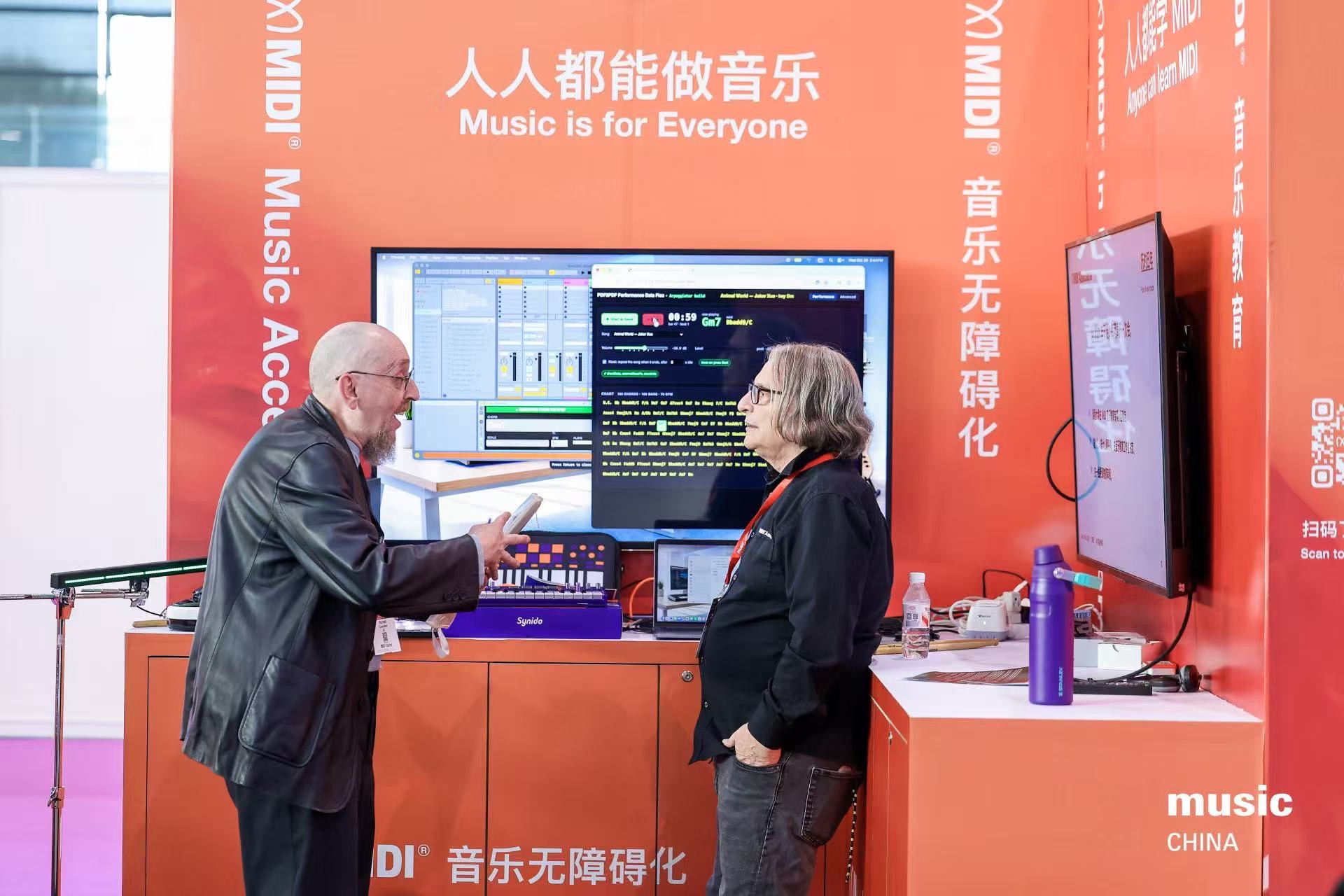
One wall carried Music is for Everyone (人人都能做音乐) and Music Accessibility (音乐无障碍化). Next to it, Anyone can learn MIDI (人人都能学 MIDI) and MIDI In Music Education, with the presentation video running on a loop.
They sat together because the barriers they remove are the same kind of barrier. Accessibility work takes away obstacles that are physical and sensory — you cannot see the screen, or you play with one hand, or you use switches. Education work takes away obstacles that are informational — nobody ever told you what a control change is, and the manual assumes you already know. Both end in the same place: a person who wanted to make music, making music.
Music Accessibility
On the stand
The accessibility corner ran PDF2PDF Performance Data Files into an Ableton Live set, with a Synido keyboard on the counter, an Aracan Strum for the guitar, an Easyplay keyboard with some button for notes and the computer keyboard. Pick a song, and the chart, chords and arpeggiator follow along — so someone who has never played an instrument can walk up, press something, and hear music that works.
That matters more than it sounds. The distance between “I am interested in music” and “I am making music” is usually measured in months of practice. Closing it to about four seconds changes who gets to find out whether they like it.
On the X Stage
Billed as Game Changing Music Accessibility Innovations, the session was built around a single idea: let every instrument say what it is doing.
It opened with the MASSIG one-minute film about musicians with disabilities making music, then went straight to the gap that the Music Accessibility Standard Special Interest Group exists to close.
Software can speak. Hardware cannot.
Apps, plug-ins and recording software announce themselves to a screen reader. A blind producer can work in a DAW because the DAW talks.
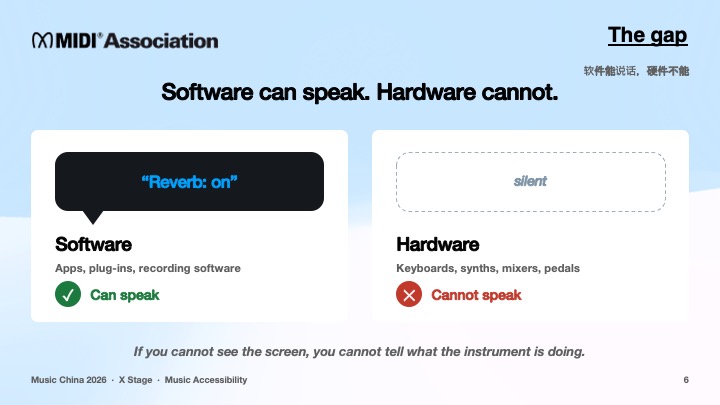
Keyboards, synths, mixers and pedals stay silent. They have screens, menus, LEDs and multi-function controls, and none of it is readable by anything but an eye. If you cannot see the screen, you cannot tell what the instrument is doing.
What Assistive Text would change
The proposal is small and specific, which is what makes it plausible.
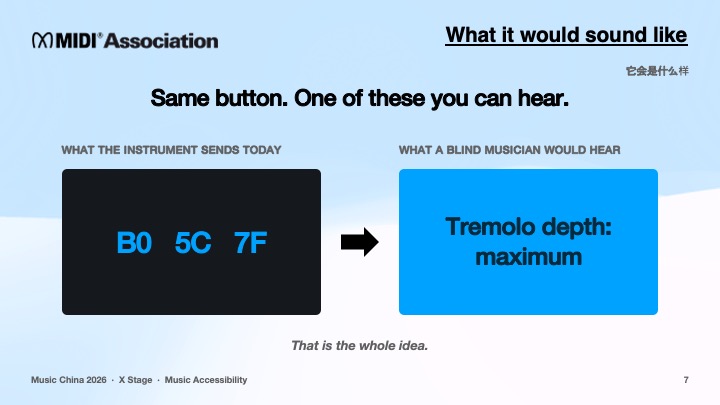
Today, turning a knob sends this:
B0 5C 7FWhat a blind musician should hear instead:
“Tremolo depth: maximum.”
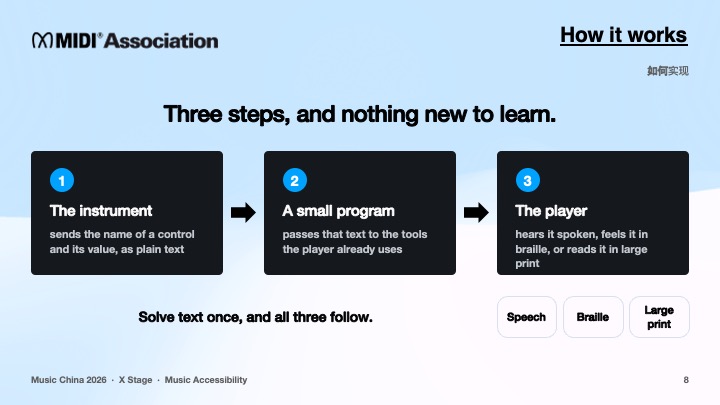
Same button, same message, one of them audible. Three steps get you there:
- The instrument sends the name of a control and its value, as plain text.
- A small program passes that text to the tools the player already uses.
- The player hears it spoken, feels it in braille, or reads it in large print.
Solve text once, and all three follow. No new hardware, no separate accessible product line, no parallel ecosystem to maintain.
One way, not twenty
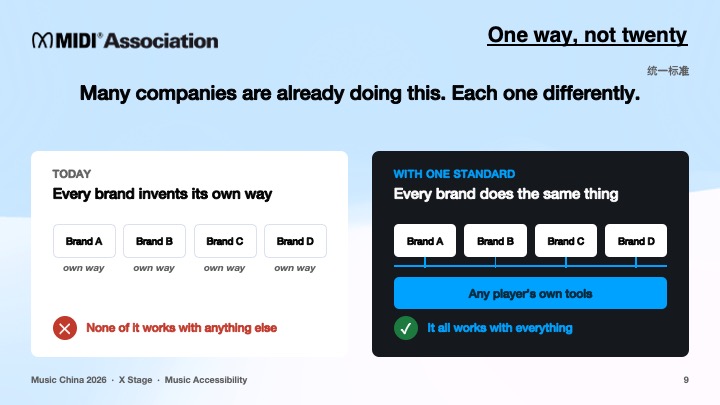
The argument to the industry was about duplication rather than novelty. Several manufacturers already do some version of this. Each one does it differently, and none of it interoperates — so a player who learns one brand’s approach starts again at the next.
With one standard, every brand does the same thing, and it all works with whatever tools the player already has. The hard work gets done once, on everyone’s behalf.
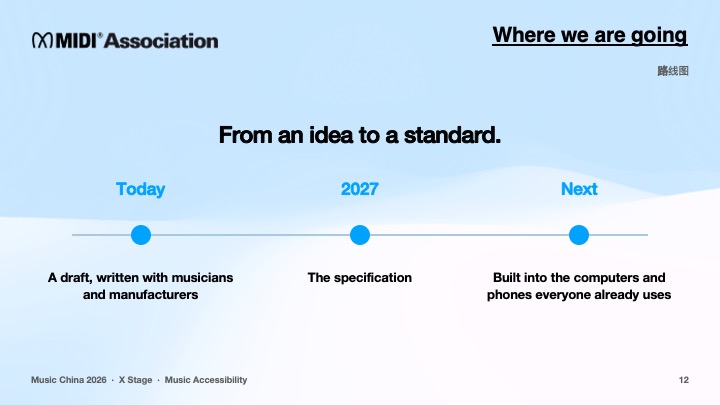
Where it goes next
- Today — a draft, written with musicians and manufacturers
- 2027 — the specification
- Next — built into the computers and phones everyone already owns
MASSIG is public and free to join. No membership is required to start: midi.org.
On the panel
- Mike Kent — AmeNote; Chair, MIDI 2.0 Working Group, The MIDI Association
- Athan Billias — Executive Board, The MIDI Association
- Shi Muyang (时沐阳) — Entropy Music
The session also carried live demonstrations from 2026 MIDI Innovation Awards entrants: instruments built for one hand and for players who use switches, and expression taken from movement and from breath.
MIDI In Music Education
On the stand
The education display ran the presentation video on a loop beside the accessibility wall, under the line Anyone can learn MIDI — which, until this year, was truer in principle than in practice.
On the X Stage
28 October, 13:00–13:20
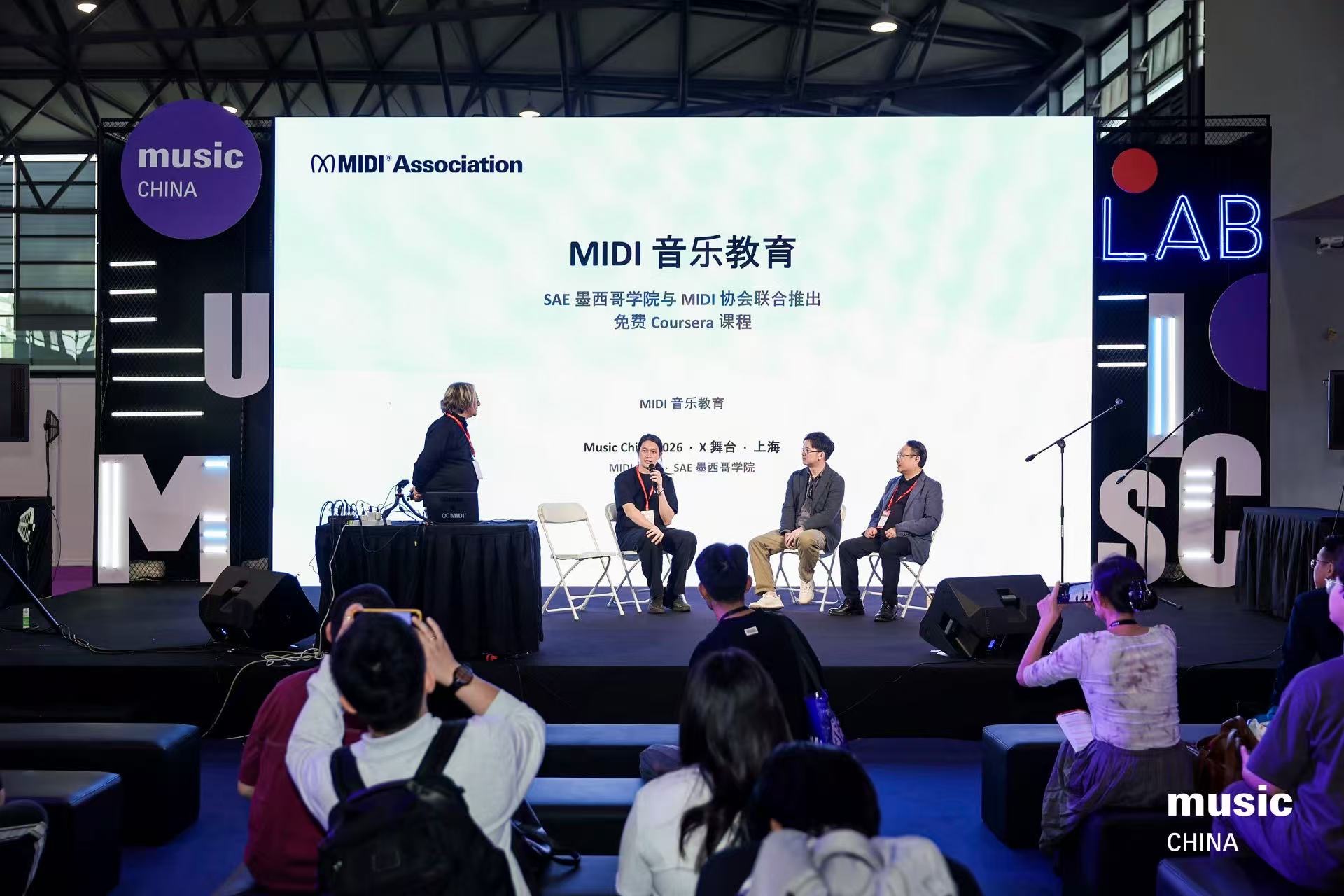
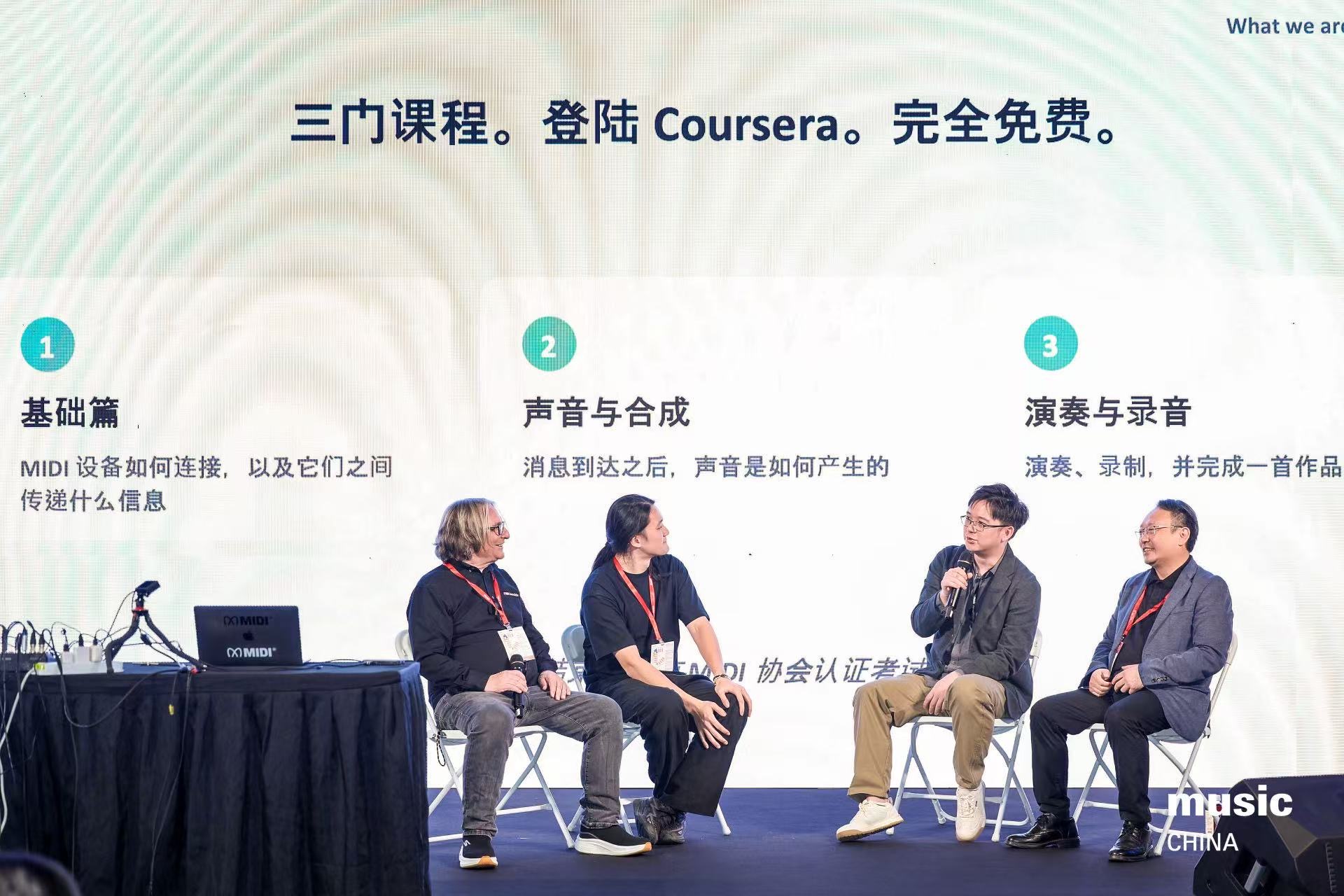
A four-person panel with live interpretation launched the free MIDI curriculum built by SAE Institute Mexico and The MIDI Association.
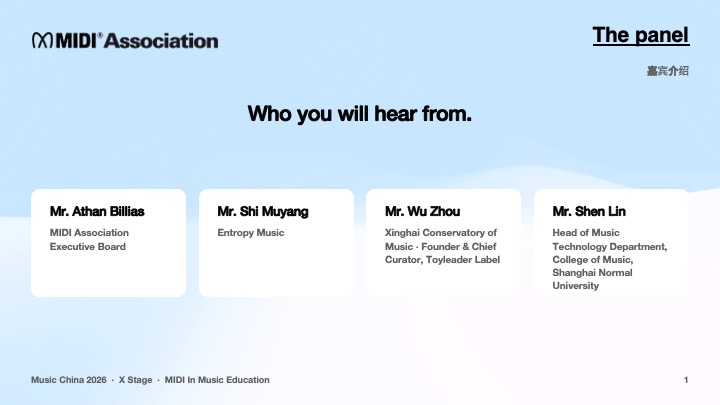
On the panel
- Athan Billias — Executive Board, The MIDI Association
- Shi Muyang (时沐阳) — Entropy Music
- Wu Zhou (吴洲) — Xinghai Conservatory of Music; founder and chief curator, Toyleader label
- Shen Lin (申林) — Head of the Music Technology Department, College of Music, Shanghai Normal University
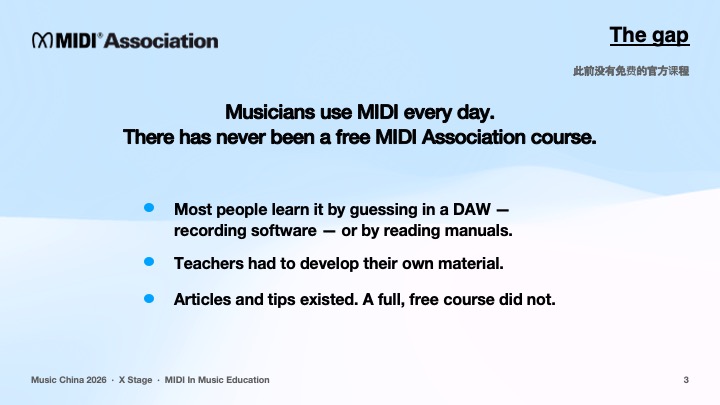
The framing was blunt and fair. Musicians use MIDI every day, and until now there has never been a free MIDI Association course. Most people learned it by guessing inside a DAW or reading manuals. Teachers had to build their own material. Articles and tips existed; a full, free course did not.
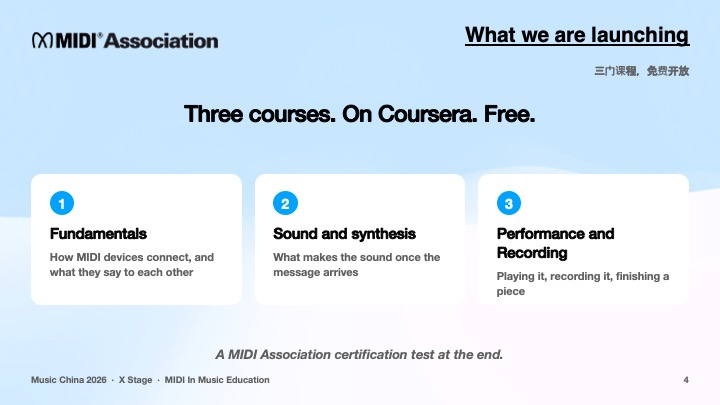
Three courses. On Coursera. Free.
1 · Fundamentals — how MIDI devices connect and what they say to each other. DIN, USB, network and Bluetooth connections; how a MIDI message is built; System Exclusive, MPE, Standard MIDI Files, General MIDI; MIDI 2.0.
2 · Sound and synthesis — what makes the sound once the message arrives. The seven families of synthesis, what each is good at, and why the same MIDI file sounds different on two instruments.
3 · Performance and Recording — playing it, recording it, finishing it. Performing with MIDI instruments and controllers, recording and editing in a DAW, and taking a piece from first idea to finished file.
Who built it
The MIDI Association has maintained MIDI since 1983. SAE Institute Mexico wrote and produced the courses. The work was funded through The NAMM Foundation’s MIDI Fund.
Materials are in English and Spanish, with Course 1 also translated into Chinese — which means any educator in China who wants it can have it now.
Certification
Finish the courses, take the test, get certified. Coursera issues the certificate in the names of both SAE Institute Mexico and The MIDI Association, and it is usable for credit, credentialing and teacher training.
Why these two belong together
The read we took away from this year’s Innovation Awards entries, and the thing worth repeating to manufacturers, is that accessibility is where the design starts now, not an add-on at the end.
The entries that handled it best did not bolt on an accessible mode; they began from the question of who could play the thing, and the answer made the instrument better for everyone.
The same is true of the curriculum. A free course is not a charitable gesture appended to the standard — it is part of what makes the standard real.
A specification that only the people who already understand it can use is not finished.
The rest of this series
- Hall N2, Music X and Lab 99 — the booth, the stage and the Forum
- The MIDI Innovation Awards at Lab 99 — and the VR demo that drew a queue all week
- MIDI 2.0 Innovative Products at Lab 99 — Sleight and MIDISketch
- Today’s MIDI 2.0 Studio — a working studio you could buy this afternoon
Sources
EN_Music-Accessibility_Music-China_no-video_dark-cards.pptxandEN_MIDI-In-Music-Education_Music-China.pptx, session decks- Sonic State, MusicChina26: MIDI Association Latest News, 29 October 2026 — https://sonicstate.com/news/2026/10/29/musicchina26-midi-association-latest-news
- Photos supplied by Athan Billias, 1 November 2026