Accessibility takes an afternoon at ADC
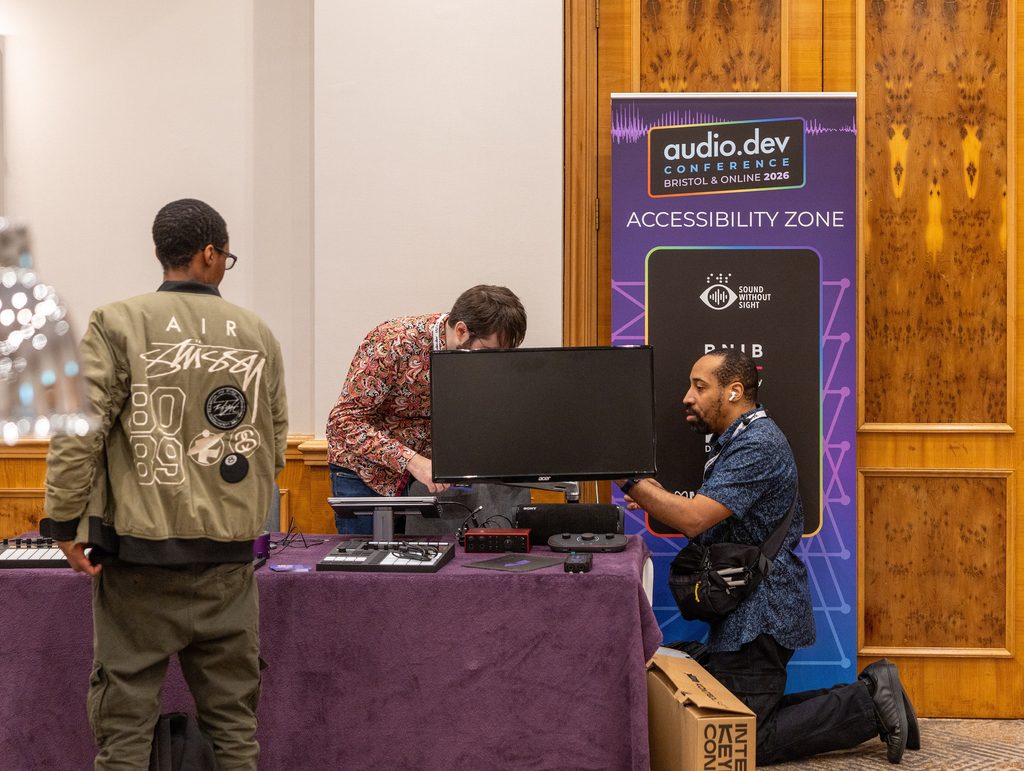
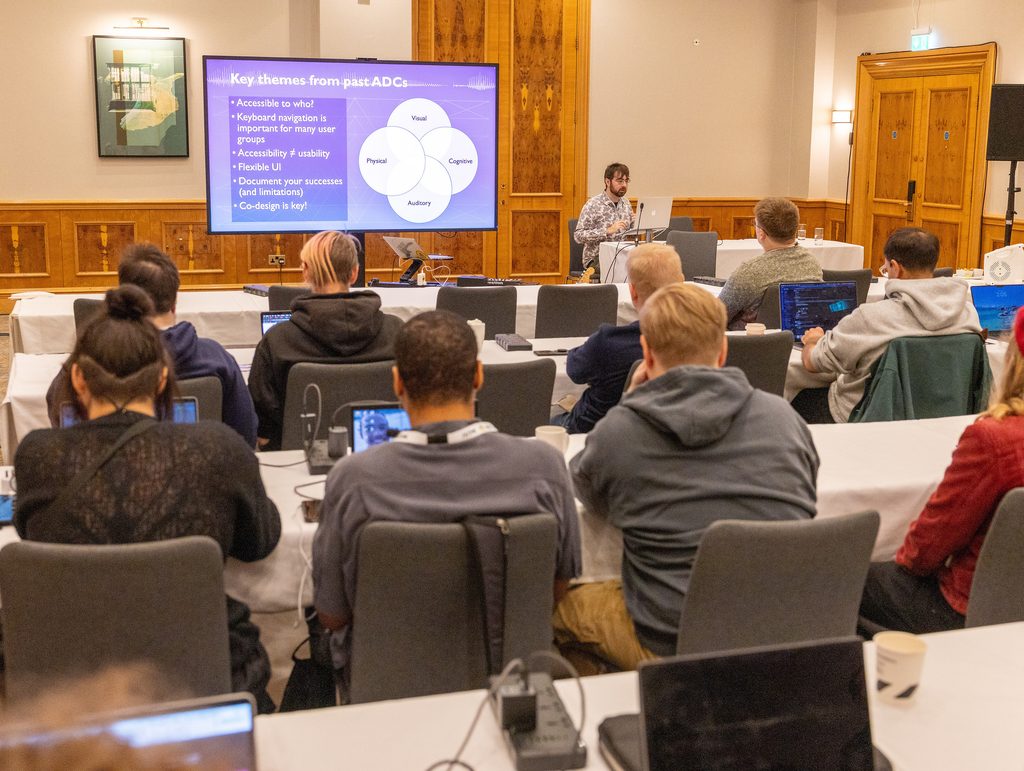
On Monday 9 November, the Audio Developer Conference in London gave three full hours of its programme — 14:00 to 17:00 UTC, in the Empire room — to a single subject: accessible audio technology.
The format was an interactive panel built from lightning talks, with organisations and developers working at the front of inclusive design each taking a short slot, and a Q&A closing each half so the room could steer the conversation. Jay Pocknell — founder of Sound Without Sight, Music Support Officer at the RNIB, and a partially sighted engineer and producer himself — hosted.
For the MIDI community, the headline came after the break.
Giving music hardware a voice
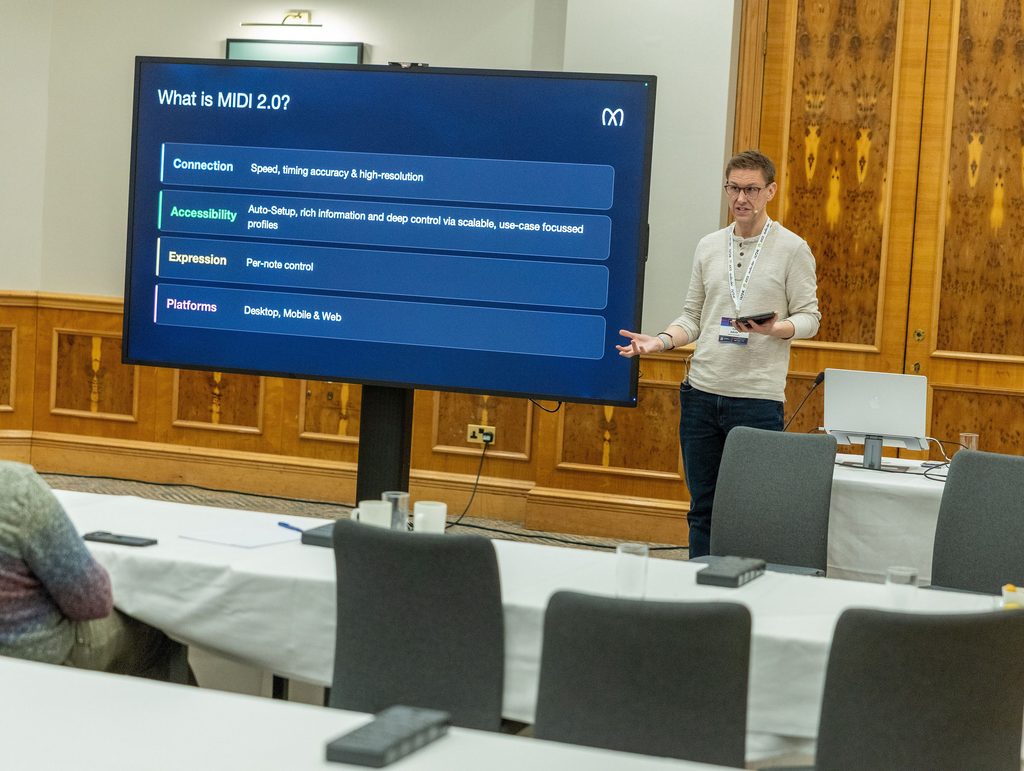
At 16:10, Tim Adnitt took the stage to introduce MIDI Assistive Text, a specification currently in development. Adnitt is President of the MIDI Association and Vice President of Product Management at Native Instruments, where he co-designed the Kontrol keyboard accessibility features — and he has been making the case for accessibility in music technology at NAMM, ADC and Moogfest for years.
The problem he set out is a familiar one for any blind or partially sighted musician who has bought a piece of hardware. A modern synth, controller or groovebox is a dense grid of unlabelled knobs, encoders and menu pages. The computer sitting next to it already has a screen reader — VoiceOver, Narrator, TalkBack — that knows how to speak an interface aloud. But the hardware has no way to tell it what the user is touching. The two devices are in the same room and share a cable, and still the hardware is silent.
MIDI Assistive Text closes that gap. It uses the ability of MIDI 2.0 devices to send text, received by a connected device, to create a bridge between typically inaccessible hardware and the operating system’s own accessibility services. Turn a knob and the instrument describes what that knob is and where it now sits; the connected machine speaks it. The hardware does not need a screen reader of its own — it needs a vocabulary, and a standard way to send it.
Adnitt closed with a tech demo: a prototype MIDI Assistive Text implementation letting an Arcana Strum speak as the user moves through the instrument’s controls.
Why this belongs in a standard
Any one manufacturer could build a proprietary scheme for talking to a screen reader. Several have built partial ones. The reason none of them has solved the problem is that an accessibility bridge only works if both ends agree — and the two ends are owned by different companies.
A working solution has to cross from a hardware instrument to a desktop or mobile operating system, which means the hardware makers and the platform owners have to be reading from the same specification. That is an unusually specific requirement, and it points at an unusually specific kind of organisation: an international standards body whose corporate membership already spans Apple and Microsoft alongside the major music hardware and software companies.
The MIDI Association is one of the few places where those parties are already in the same room, with a process for turning agreement into a published specification and a thirty-year track record of hardware from rival manufacturers interoperating because of it. MIDI 2.0’s capacity to carry text was built in from the start; Assistive Text is a profile that puts it to work.
The rest of the afternoon
The panel was deliberately built so that the specification work sat alongside the musicians and the shipping products.
The social model of disability. John Kelly and Tim Yates opened with the framework that underpins everything else: a model born out of the UK disability rights movement, led by Disabled people, which locates disability in the barriers a society builds rather than in the person. Applied to instrument design, it reframes the question from what a musician cannot do to what a product has failed to make available.
The Kellycaster. Kelly — a performing artist who has played two major Paralympic events and toured with Extraordinary Bodies and Graeae Theatre Company — then demonstrated the bespoke guitar he co-created with technologist Charles Mathews. The design goal was not a simplified guitar but a guitar that keeps the full range of chords available and the full expressiveness intact. He played it live.
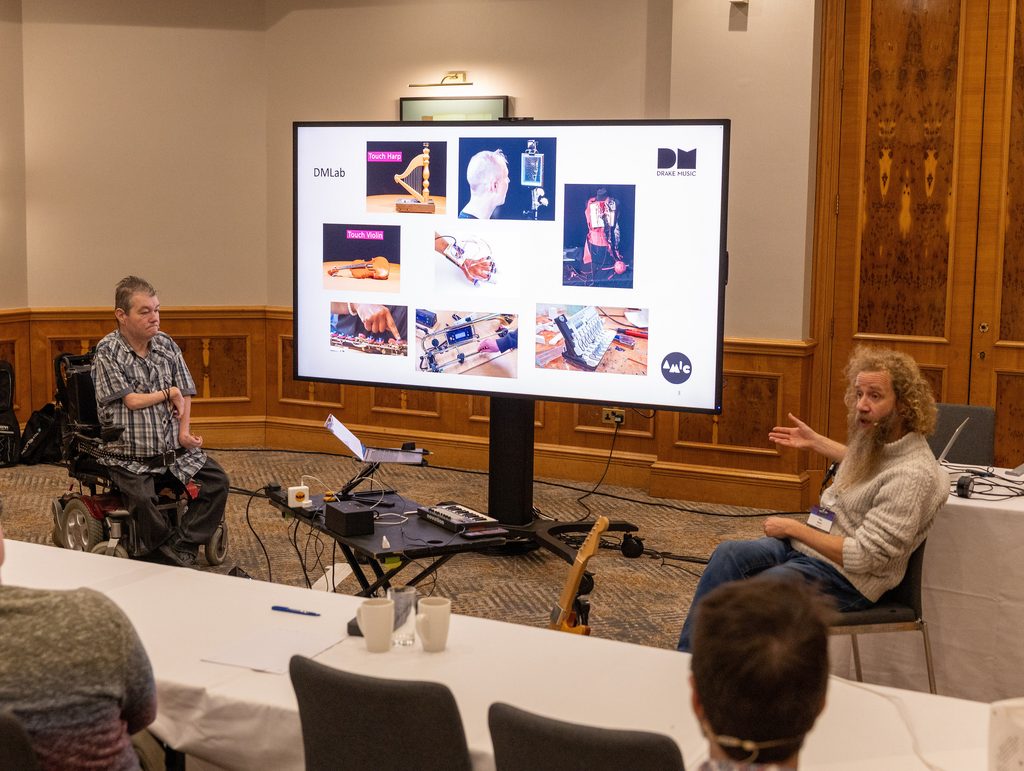
Building an ecosystem for co-design. Kelly and Yates, Research and Innovation Executive at Drake Music, followed with the harder structural question: how musicians, instrument makers and developers find each other in the first place, how successful co-design gets discovered and promoted internationally, and how a Disabled musician is meant to find out whether a given product is usable before buying it. They covered Drake Music’s DMLab programme and the forthcoming Accessible Musical Instrument Collection.
AI and open source accessibility. Scott Chesworth and Jay Pocknell took on generative coding assistants. The training data carries the same biases as everything else, and the intricacies of human accessibility are not well represented in it — so AI alone cannot be trusted to make software accessible. Chesworth drew on experience, good and bad, with community-submitted generative code in OSARA, the widely used open source accessibility extension for REAPER.
Accessible documentation at Roland. Paul McCabe, SVP of Research and Innovation and leader of Roland Future Design Lab, and Pocknell described the accessibility guides previewed this year for the Roland V-Stage Performance Keyboard: detailed usage information written for the requirements of blind users and published in audio, HTML, PDF and Word, with accompanying videos. They shared how the project came about and the feedback so far.
Accessibility inside a plugin. Joni Turunen closed the programme. A software developer at oeksound since 2018, specialising in custom C++ UI frameworks, Turunen was pulled into accessibility work by a single email from a screen reader user about reaching presets through REAPER. He now leads the company’s accessibility effort, and with accessible versions of Soothe3 and Bloom soon to ship, he walked through screen reader compatibility, low-vision considerations and the lessons that could save other plugin developers the same detours.
What happens next
MIDI Assistive Text is still in development, which is exactly the moment when developer input is worth most. The specification has to describe the controls on instruments that have not been designed yet, and the vocabulary it settles on will be lived with for a long time.
If you build hardware and want a say in how your products describe themselves, or you build software on the receiving end of that text, the MIDI Association is where the work is happening. Manufacturers and developers can get involved through midi.org.
The full session details and speaker list are on the ADC 2026 programme page. For resources aimed at blind and partially sighted musicians — including a user testing initiative that gives developers a route to real accessibility feedback on their products — see Sound Without Sight.