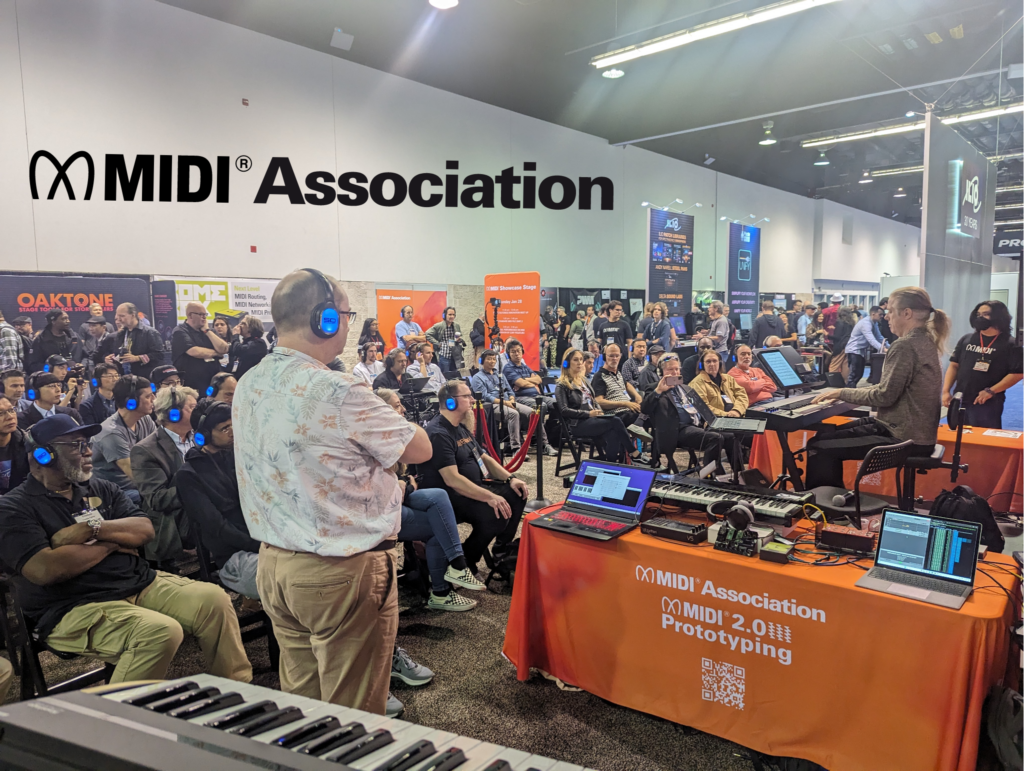
MIDI Association members from Audio Modeling and Sound Without Sight present the Music Accessibility Standard Special Interest Group and their work to make music accessible to everyone. Adapted from the ‘Future of Music Accessibility’ session at the NAMM Show 2024.
Link to sign up for the MASSIG: https://midi.activehosted.com/f/37
Link to Sound Without Sight: https://soundwithoutsight.org/
Video chapters:
00:00 Introduction by Athan Billias and Jay Pocknell.
03:03 Useful definitions.
04:14 Why is accessibility important?
05:37 Why design inclusively?
07:12 Inclusion in music-making: the current situation.
09:05 Breaking the loop: what we can do together.
09:48 Practical inclusive design tips from Tim Yates (Drake Music).
16:32 Which companies are already supporting accessibility?
17:37 What needs to happen next?
19:09 The MIDI Association’s Music Accessibility Standard.
25:13 Q&A with Emanuele Parravicini (Co-Founder, Audio Modeling).
Before we get into Anthony’s presentation at NAMM 2024, I wanted to give a bit of insight about why what he did had such a personal impact on me. I learned synthesis on an Arp 2600!
I started college at Wesleyan University in 1970, the same year that Alvin Lucier , the well respected electronic music composer started teaching there. John Cage had been at Wesleyan only a few years before.
Wesleyan was (and still is) a great, small liberal arts school.
I was studying Jazz with Clifford Thorton, who was in Sun Ra’s Arkestra and Sam Rivers, who had played with Miles.
Wesleyan has an amazing world music program and I was also studying African Drumming with Abraham Konbena Adzenyah, who was both an Associate Professor and simultaneously studying for his GED High School diploma. I would occasionally jam with L. Shankar, the Indian violinist.
John McLaughlin was studying Vina at Wesleyan in the fall of 1970 and used the Wesleyan cafeteria to rehearse his new band , The Mahavishnu Orchestra. For several weeks in a row, I would hang out after lunch and listen for free as Billy Cobham, Jerry Goodman, Jan Hammer, Rick Laird, and McLaughlin rehearsed. McLaughlin and L Shankar would team up later in Shakti.
To say the music scene at Wesleyan at the time was eclectic is an incredible understatement.
Anyway, back to Alvin Lucier. I didn’t know what to expect when I showed up in early September, 1970 for that first class in Electronic Music 101, but it was more surprising then anything I could have imagined. Alvin Lucier introduced himself and it sounded like this. Ma, ma, ma ,ma My,… na, na na, na, name… is Alvin …La, la, lucier and I will ……ba,ba, ba Be your …..Tea, tea, teacher. At that time, Lucier had a horrific stutter and he had just the year before written his signature work ” I Am Sitting In A Room”.
The text spoken by Lucier describes the process of the work, concluding with a reference to his own stuttering:
I am sitting in a room different from the one you are in now. I am recording the sound of my speaking voice and I am going to play it back into the room again and again until the resonant frequencies of the room reinforce themselves so that any semblance of my speech, with perhaps the exception of rhythm, is destroyed. What you will hear, then, are the natural resonant frequencies of the room articulated by speech. I regard this activity not so much as a demonstration of a physical fact, but more as a way to smooth out any irregularities my speech might have.
Alvin Lucier
in October of 1970, I went to a performance of I Am Sitting In A Room at the Wesleyan coffee house. Musicologists often fail to mention Lucier’s stutter, but to me it was the essence of the piece. Lucier sat in middle of the coffee house with a microphone, two tape recorders and speakers positioned around the small room in quad. He started repeating the text of the piece over and over again, with each consonant causing him to stutter.
It was uncomfortable to listen to and watch. But the repetitive stutter was being fed back into the room and doubled by two tape recorders which were slightly out of sync. This created an amazing cascade of stuttered rhythms.
Then after about 10 minutes, Lucier hit a switch and the sound from the speakers stopped. What happened next was magical. He then said perfectly clearly and without any stutter “I am sitting in a room different from the one you are in now.” He then repeated that single phrase and with each repetition, his stutter started to come back.
Then he kicked in the speakers and the whole process started over again. He repeated that process three times over the course of about 40 minutes. You watched in real time as someone with a serious speech impediment used electronic art to fix it, but it couldn’t last, he would always fall back into the halting , uncomfortable pattern of stuttering.
It was both powerful and heartbreaking and one of the most courageous pieces of art I have ever witnessed.
At the Wesleyan Electronic Music Studio, I learned synthesis on two Arp 2600 and an Arp 2500 Sequencer set up in Quad. Students in Electronic Music classes could get the keys to the studio and I spent many nights in my 4 years at Wesleyan creating sounds until the wee hours of morning and then tearing them apart and starting over from scratch to make a new patch. It was there working with the Arp 2600 that I learned the sheer joy of making sounds with synthesizers.
Anthony’s passion for teaching synthesis brought all of that joy back.
The Lifetime Achievement Awards at April NAMM 2023
At the April NAMM show we gave out MIDI Association LifeTime Achievement Awards to the founding fathers of modern synthesise and music production including Alan Pearlman from ARP.
So when Dina Pearlman who runs the Arp Foundation and received the award in 2023 on her father’s behalf came to us at NAMM 2024 and asked for a favor, we couldn’t say no.
She had scheduled a performance by Anthony for the Arp Foundation booth which was only a 5 by 10 booth against the wall at the front of Hall A. We had a much larger booth and headphones for 50 guests.
So even though we had 23 sessions arranged already, we had to say yes and boy are we glad we did!
If you don’t know who Anthony is, he was one of the main people who brought synthesizers to Hollywood.
He was heavily involved with the Synclavier and its development and he and his partner, Brian Banks had notable credits on some of the first films to almost exclusively use synths including: WarGames (1984), Starman (1984), The Color Purple (1985), Stand by Me (1985), Planes, Trains and Automobiles (1987), Young Guns (1988) and Internal Affairs (1990).
Here is a 1979 poster promoting the Synner’s (that’s Anthony and his partner at the time Brian Banks) performances of classical pieces at LA County Museum of Natural History.
Anthony has also been the synthesist on many amazing records including Micheal Jackson’s Thriller (produced by Quincy Jones). There isa link at the bottom of the article to his Youtube page which has a bunch of great videos including his presentation at NAMM 2024 where he invited young people on stage and taught them how to get cool sounds out of the Arp 2600 in a matter of minutes.
His passion for synthesis brought back college memories of discovering the joys of analog modular synths for the first time guided by Alvin Lucier.
Anthony Maranelli’s Presentation of the ARP 2600 at The MIDI Association Booth NAMM 2024
Join us on Youtube for the Piano Profile Demo at NAMM 2024 featuring Roland Artist Scott Tibbs.
At the April 2023 NAMM show, Synthogy and Roland collaborated to showcase the first public demonstration MIDI 2.0 technology.
At the 2024 NAMM show they raised the bar again and showcased a demonstration of the new Piano Profile.
This Profile will make creating performances on one piano and playing them back on another more accurate.
Roland Product Specialist Scott Tibbs performed.
Scott has amassed a large body of music with numerous recording artists such as Beyoncé, Mary J. Blige, Howard Jones, Bruce Springsteen, Nelly, Lil’ Wayne, Jamie Fox, Robin Thicke, Bette Midler, Destiny’s Child, Jazmine Sullivan, Amerie, Jamie Foxx, Teddy Riley, Omar Hakim, Billy Cobham, and more.
Background
The piano is arguably the most important musical instrument in Western music traditions. It is essential to all styles of music from classical to jazz to pop, so when the MIDI Association started to develop Profiles, a Piano Profile was at the top of the list.
This piano Profile is focused on Acoustic Pianos with mechanical key mechanisms driven by MIDI, Digital Acoustic Piano Tone Generators (both hardware and software), and physical MIDI keyboards that send MIDI messages and the most common of all – Digital Pianos which incorporate both Digital Acoustic Piano Tone Generators and physical MIDI keyboard. The Profile does not address electro-mechanical pianos or the extended features of digital ensemble pianos.
Goals
The goal is a Piano Profile that defines the MIDI Messages and bi-directional MIDI-CI communication necessary to allow the performance of an acoustic piano piece on one device that supports the Piano Profile to be accurately rendered on any other device which also supports the Profile.
The Piano Profile defines the MIDI Messages and bi-directional MIDI-CI communication necessary to allow the performance of an acoustic piano piece on one device that supports the Piano Profile to be accurately rendered on any other device which also supports the Profile.
The Profile provides support for remote (over the internet) performance.
The Piano Profile details what information needs to be included in a Standard MIDI File (SMF2) and the mechanisms needed to accurately reproduce a piano performance from a file.
The Piano Profile addresses the following use cases:
Piano + tone generator (the most typical MIDI 1.0 use case)
Online live broadcasting of piano performances
Online lessons with a teacher and student
MIDI Streaming of recorded piano performances
Music production (use of the Piano Profile with DAWs)
There are many orchestral sample libraries in the market, and they are essential for film scoring, game audio, studio, and live MIDI applications. These orchestral libraries have many kinds of articulations.
For example, a string library might have a different set of samples for every articulation including marcato, staccato, pizzicato, etc.
However, there is no industry standard method-the method for selecting these different articulations has been different for each developer. Many developers use notes at the lower end of the MIDI note range for “key switching”, but the actual keys used are different between different developers. Some developers use CC messages to switch between articulations, but again there is no industry wide consistency. Some plugin formats now have the ability for per note selection of articulations, but again the method for inputting that data is different for different applications.
It is the goal of the MIDI-CI Profile for Note On Orchestral Articulation to provide a consistent way to encode articulation information directly in the MIDI 2.0 Note On message, using the Attribute Type and Attribute Data fields.
In arriving at this Profile, a study was made of orchestral instrument families, choir, big band instruments, guitar, keyboard instruments, and various non-western instruments to evaluate the degree to which they share common performance attributes and sound production techniques. Notation symbols and performance indications were also considered to determine, for example, how successfully a violin note marked with a trill might result in a musically meaningful or analogous articulation when the part is copied to an instrument as far afield as timpani—all without the composer having to re-articulate the timpani part, at least initially.
The Profile provides a comprehensive yet concise system of articulation mapping that includes a wide palette of articulation types and supports articulation equivalence across eight instrument categories.
The Profile was designed to offer articulation equivalence — a system of articulation mapping that allows a passage articulated for one instrument to be copied to another track and playedplay back with an equivalent or analogous articulation, regardless of the target instrument type.
When implemented by sample library developers, the Profile will greatly aid composers in highly significant ways.
First, it will simplify the process of substituting or layering sounds from the same or different sample libraries; Second, it will allow composers to quickly audition and orchestrate unison passages by copying an articulated part to other tracks and hear them to play back with equivalent or analogous articulations.
Join us on Youtube for The Orchestral Articulation Profile at NAMM 2024.
Embark on a new creative journey with SWAM technology and our expressive virtual instruments. Combine that with the power of Camelot Pro, and you’ll rediscover the joy of making music.
Add these innovative tools to your arsenal, and experience a fresh approach to music production and performance that awaits you.
Audio Modeling Camelot Pro
Camelot Pro is an application created to address the most complex live performance needs with a simple and guided workflow.
Camelot is a Setlist Manager, a Software Instrument & FX Host, a PDF Music Score reader, a Multitrack Audio Player, and the most advanced Audio/MIDI Patchbay and Router.
Join us on YouTube as Audio Modeling Presents Camelot Pro and SWAM.
MIDI Association member Embodme presents a performance by DeLaurentis, one of the few rare electronic music producers and artists who manage to convey pure emotion by using machines to manipulate the voice.
Her electro-cinematic music is both soft and powerful, clear and obscure: relentlessly effective and bewitching.
Join us for the YouTube Premier of DeLaurentis’ performance at Winter NAMM 2024.
In the last few months, a number of MIDI 2.0 capable products have been released into the market.
Here is an alphabetical list including the company name, product name, type of product and the MIDI 2.0 feature supported.
Company
Product Name
Product Type
MIDI 2.0 Features
Amenote
Protozoa
MIDI 2.0 Development Platform
USB MIDI 2.0 and MIDI 2.0 VCM, MIDI-CI, Property Exchange ProgramList, MIDI 2.0 VCM with Articulations
Apple
Logic
DAW
MIDI 2.0 CVM. Can be passed to AU plugins
BomeBox
Bome
Interface Box
KissBox
UMP2TR
Interface Box
Network UMP / Serial UMP gateway
KissBox
IO3CC / IO8CC
MIDI controller I/O system
Network UMP / CVM
Korg
Keystage
Controller
MIDI-CI, Property Exchange Via Manufacturer Specific Property Exchange, ChannelList
Korg
OPSix Native (v1.1.0)
Standalone App
MIDI-CI, Property Exchange Via Manufacturer Specific Property Exchange, ChannelList
Korg
Wavestate Native
Standalone App
MIDI-CI, Property Exchange Via Manufacturer Specific Property Exchange, ChannelList
MultitrackStudio
MultitrackStudio
DAW
USB MIDI 2.0 and MIDI 2.0 VCM, MIDI-CI, Property Exchange Program List, MIDI 2.0 VCM with Articulations
Native Instruments
Kontrol S-Series MK3
Controller
USB MIDI 1.0 VCM, MIDI-CI, Property Exchange ChannelList
PACE
JUCE
SDK
MIDI-CI
Roland
A88 MKII
Controller
High Resolution Velocity
Sound Magic
Supreme Drums Taiko
AU/VST Plugin
High Resolution Velocity
Steinberg
Cubase 13
DAW
Translates some MIDI 2.0 messages into VST3 format, Ready for MIDI 2.0
With support for high resolution velocity, CC, aftertouch, pitch bend, and poly pressure data, Cubase 13 is ready for the widespread adoption of MIDI 2.0.
Steinberg
Nuendo 13
DAW
MIDI 2.0 support, including high-resolution velocity, CC, aftertouch, pitch bend, and poly pressure data
There are many orchestral sample libraries in the market, and they are essential for film scoring, game audio, studio, and live MIDI applications. These orchestral libraries have many kinds of articulations.
For example, a string library might have a different set of samples for every articulation including marcato, staccato, pizzicato, etc.
However, there is no industry standard method-the method for selecting these different articulations has been different for each developer. Many developers use notes at the lower end of the MIDI note range for “key switching”, but the actual keys used are different between different developers. Some developers use CC messages to switch between articulations, but again there is no industry wide consistency. Some plugin formats now have the ability for per note selection of articulations, but again the method for inputting that data is different for different applications.
It is the goal of the MIDI-CI Profile for Note On Orchestral Articulation to provide a consistent way to encode articulation information directly in the MIDI 2.0 Note On message, using the Attribute Type and Attribute Data fields.
In arriving at this Profile, a study was made of orchestral instrument families, choir, big band instruments, guitar, keyboard instruments, and various non-western instruments to evaluate the degree to which they share common performance attributes and sound production techniques. Notation symbols and performance indications were also considered to determine, for example, how successfully a violin note marked with a trill might result in a musically meaningful or analogous articulation when the part is copied to an instrument as far afield as timpani—all without the composer having to re-articulate the timpani part, at least initially.
The Profile provides a comprehensive yet concise system of articulation mapping that includes a wide palette of articulation types and supports articulation equivalence across eight instrument categories.
The Profile was designed to offer articulation equivalence — a system of articulation mapping that allows a passage articulated for one instrument to be copied to another track and playedplay back with an equivalent or analogous articulation, regardless of the target instrument type.
When implemented by sample library developers, the Profile will greatly aid composers in highly significant ways.
First, it will simplify the process of substituting or layering sounds from the same or different sample libraries; Second, it will allow composers to quickly audition and orchestrate unison passages by copying an articulated part to other tracks and hear them to play back with equivalent or analogous articulations.
At the April 2023 NAMM show, Synthogy and Roland collaborated to showcase the first public demonstration MIDI 2.0 technology.
This NAMM show they are raising the bar and showcasing a demonstration of the new Piano Profile.
This Profile will make creating performances on one piano and playing them back on another more accurate.
Roland Product Specialist Scott Tibbs will perform.
Scott has amassed a large body of music with numerous recording artists such as Beyoncé, Mary J. Blige, Howard Jones, Bruce Springsteen, Nelly, Lil’ Wayne, Jamie Fox, Robin Thicke, Bette Midler, Destiny’s Child, Jazmine Sullivan, Amerie, Jamie Foxx, Teddy Riley, Omar Hakim, Billy Cobham, and more.
Background
The piano is arguably the most important musical instrument in Western music traditions. It is essential to all styles of music from classical to jazz to pop, so when the MIDI Association started to develop Profiles, a Piano Profile was at the top of the list.
This piano Profile is focused on Acoustic Pianos with mechanical key mechanisms driven by MIDI, Digital Acoustic Piano Tone Generators (both hardware and software), and physical MIDI keyboards that send MIDI messages and the most common of all – Digital Pianos which incorporate both Digital Acoustic Piano Tone Generators and physical MIDI keyboard. The Profile does not address electro-mechanical pianos or the extended features of digital ensemble pianos.
Goals
The goal is a Piano Profile that defines the MIDI Messages and bi-directional MIDI-CI communication necessary to allow the performance of an acoustic piano piece on one device that supports the Piano Profile to be accurately rendered on any other device which also supports the Profile.
The Piano Profile defines the MIDI Messages and bi-directional MIDI-CI communication necessary to allow the performance of an acoustic piano piece on one device that supports the Piano Profile to be accurately rendered on any other device which also supports the Profile.
The Profile provides support for remote (over the internet) performance.
The Piano Profile details what information needs to be included in a Standard MIDI File (SMF2) and the mechanisms needed to accurately reproduce a piano performance from a file.
The Piano Profile addresses the following use cases:
Piano + tone generator (the most typical MIDI 1.0 use case)
Online live broadcasting of piano performances
Online lessons with a teacher and student
MIDI Streaming of recorded piano performances
Music production (use of the Piano Profile with DAWs)
MIDI Association members from Audio Modeling, Arturia, Native Instruments, and The Royal Institute for the Blind will discuss the Music Accessibility Special Interest group and their work to make music accessible to everyone