

Over the past year, The MIDI Association’s Music Accessibility work has focused on something very concrete: getting more people to the “I’m making music” moment—faster, with fewer barriers, and with better pathways for developers and manufacturers to build accessibility into products from day one.

At the center of that effort is the Music Accessibility Standard Special Interest Group (MASSIG), a regular meeting forum that brings together disabled musicians, accessibility leaders, educators, developers, and MIDI member companies to share real-world workflows, prototype solutions, and shape practical next steps toward more inclusive music technology.
In this NAMM 2026 recap:
- How MASSIG became a steady engine for collaboration
- Major demos and showcases across events
- Partnerships that connect lived experience to product design
- How the MIDI Innovation Awards are accelerating accessible tools
- What’s next—and how to join
1) MASSIG: Turning Accessibility Conversations Into Repeatable Action
MASSIG exists to make accessibility practical and interoperable. That means focusing on the details that determine whether a tool is usable in the real world: setup friction, discoverability, feedback, consistent control behaviors, documentation, and how devices and software communicate state.
Over the past year, MASSIG’s work has increasingly followed a “loop” that drives momentum:
- Start with real workflows (blind/low-vision creation, limited mobility performance setups, accessible education environments).
- Prototype and demonstrate solutions using MIDI and accessible interaction patterns.
- Share learnings with product teams and the broader community through events, webinars, and award visibility.
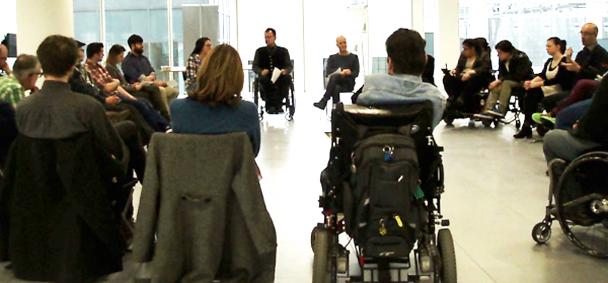
Core idea: Accessibility isn’t a checkbox—it’s an ecosystem of design decisions that either reduce friction or amplify it.
Join Us: MASSIG / Music Accessibility
If you’re a musician, educator, developer, or company building inclusive music tools, we’d love to have you involved.
Learn about Music Accessibility Join The MIDI Association
2) Early-Year Momentum: CES + NAMM Set the “Hands-On” Tone
Early in the year, The MIDI Association used major industry moments to keep accessibility visible in mainstream rooms—where product decisions, partnerships, and adoption pathways happen.
CES: A coordination point for scouting and connection
At CES, the emphasis was on community connection and technology scouting—identifying emerging tools, interfaces, and accessibility-adjacent innovations that could strengthen the ecosystem for musicians and developers.

Some of this investigation inspired ideas for new concepts including developing standardized mechanisms for MIDI hardware devices to send text to a computer.
The operating system’s accessibility interfaces can then be used with this text to enhance user interaction via external outputs such as speech, braille, or other assistive feedback mechanisms. The goal is to increase accessibility for blind and low-vision users, while being broadly useful to all users.

Another area of interest is Haptic feedback for users with accessibility challenges.
NAMM: Accessibility demos that prioritize feedback and control
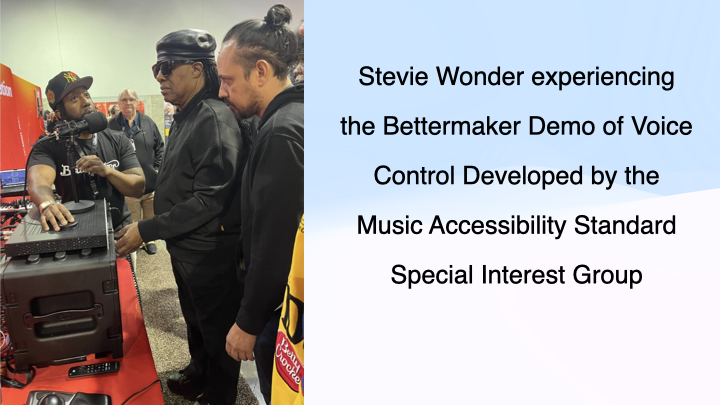
At NAMM, hands-on demonstrations reinforced a recurring accessibility truth: it’s not only about what a system can do—it’s about whether users can confidently understand what’s happening and stay in control. Voice control and accessible feedback patterns featured prominently in prototype conversations throughout the year.
3) Education + Inclusion: Able Assembly (Berklee) Connects Community and Practice
In spring, accessibility work showed up strongly in education-centered spaces—especially the Berklee ABLE Assembly. This matters because accessible music-making doesn’t live in a vacuum: it thrives in classrooms, labs, studios, rehearsal rooms, and performance spaces where inclusive workflows become normal.

ABLE Assembly helped reinforce two big themes that shaped the year:
- Accessibility is creative: inclusive design expands musical expression, not just compliance.
- Accessibility is teachable: educators and institutions can normalize inclusive workflows early, which increases long-term adoption.
4) A Public Checkpoint: The MASSIG Webinar (June 2025)
A mid-year Music Accessibility webinar captured the initiative’s scope: community updates, collaboration highlights, and practical discussion around how MIDI—especially richer two-way communication—can reduce barriers during setup and performance.
Topics featured during the year included:
- Co-design and hackathon models where disabled musicians help define requirements early.
- Community feedback loops from blind/low-vision creators and accessibility leaders.
- Prototyping accessible interaction (including voice control concepts, feedback, and streamlined workflows).
What the webinar made clear: Accessibility progress accelerates when community insight, developer reality, and product roadmaps are in the same conversation.
5) The Demo Table Goes Global: Accessibility You Can Walk Up and Play

If there’s one “signature move” that defined this year, it’s the recurring hands-on setup: a table of accessible instruments and interfaces connected via MIDI so that anyone—regardless of experience level—can immediately participate.
This approach showed up in multiple major environments across the year, consistently proving that accessibility is not a niche: it’s a powerful, human way to invite more people into music-making.
Music China: High-energy engagement and discovery

At Music China, the accessibility demo area became one of the most popular show experiences. The emphasis was on connection—devices working together in ways that make musical sense right away—so visitors could experience inclusive music-making without needing a deep technical explanation first.
Tokyo Gakki Expo: Continuing the story in Japan

Accessibility demos carried into Japan-focused outreach, reinforcing that inclusive music-making is a global priority—and that interoperability and community-driven design patterns travel well across cultures and markets.
Music Tectonics: Accessibility in a startup + innovation room
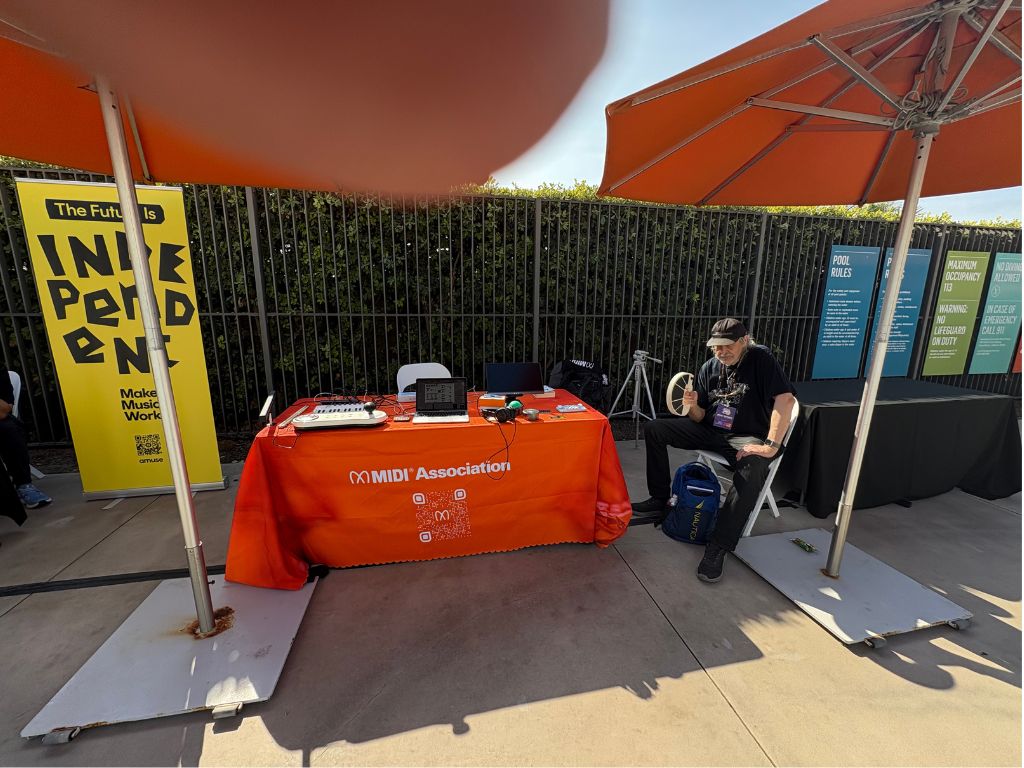
Music Tectonics delivered a mixed audience of music-tech builders, entrepreneurs, and creators. The accessibility setup worked especially well here because it communicated value instantly: even people who don’t “speak MIDI” can feel the point when a system becomes playful, welcoming, and expressive.
6) Developer Enablement: Accessibility at ADC 2025
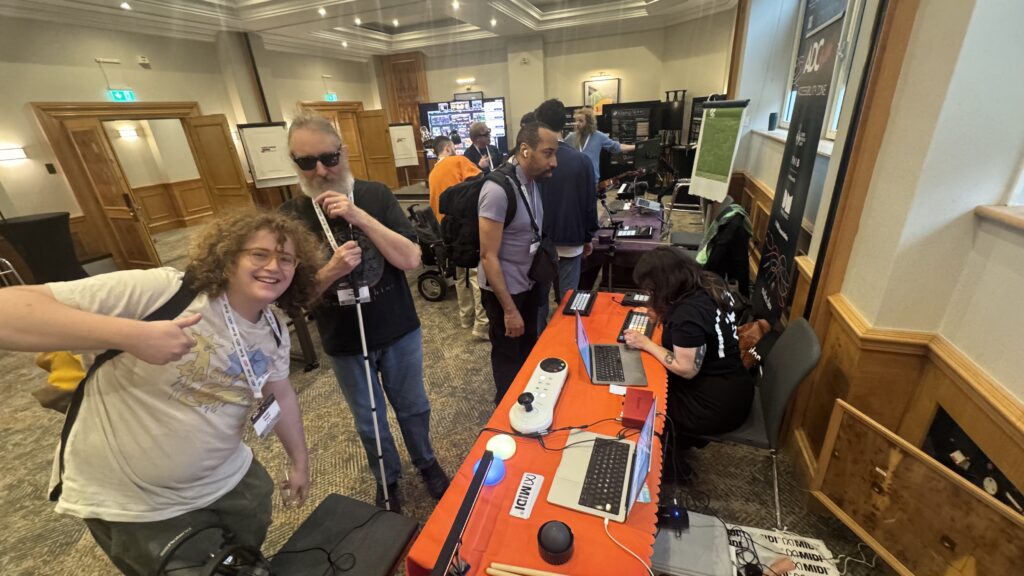
Events aimed at audio developers are crucial because they shape what gets built next. At ADC 2025, accessibility was treated as a first-class design and engineering topic—spanning inclusive design principles, practical implementation frameworks, and the reality of building complex creative UI that remains usable for screen reader users and beyond.
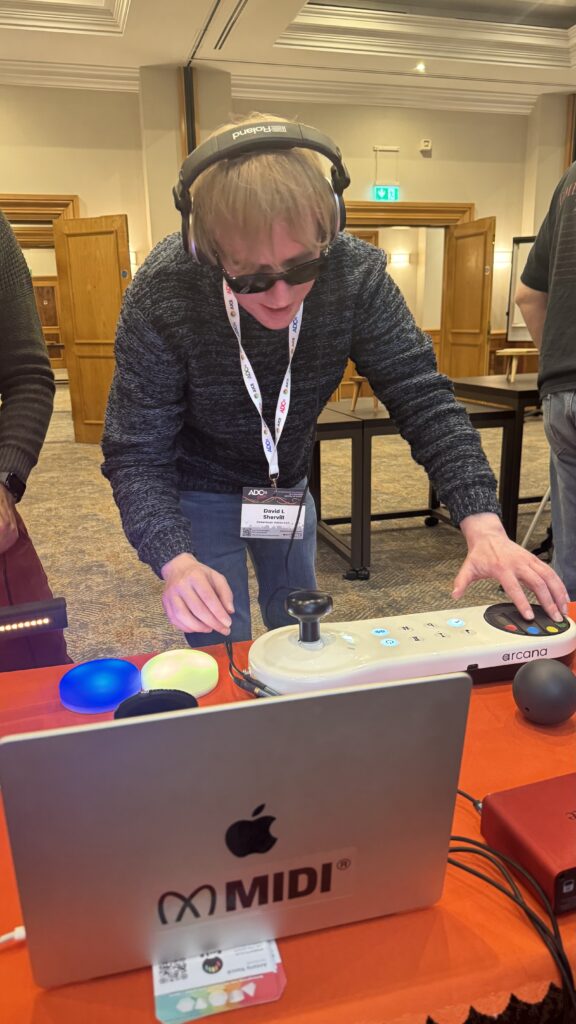
This year’s developer-facing work emphasized:
- Inclusive design principles that can be shared, tested, and applied across tools.
- Real implementation guidance (for example: ARIA/WCAG patterns for sophisticated music software UI).
- Hands-on accessibility zones that complement the talks with lived experience and tangible interaction.

Developer takeaway: Accessibility is not a limitation on creative UI—it’s a set of patterns that makes power usable by more people.
7) Community Infrastructure: Sound Without Sight and the Importance of Feedback Loops

Standards and product roadmaps improve faster when there is consistent, real-world feedback from working musicians. Community hubs like Sound Without Sight play a critical role by sharing tutorials, workflows, tools, and lived experience that manufacturers and software teams can learn from.
Across the year, a repeating theme has been the value of communities that can answer questions like:
- Where do users hit friction first in a workflow?
- What kinds of feedback reduce uncertainty?
- Which UI patterns are “technically accessible” but still inefficient in real sessions?
8) Recognition as Acceleration: The MIDI Innovation Awards and Accessibility

The MIDI Innovation Awards have increasingly become an engine for discovery—helping the industry and the community find projects that are already pushing accessibility forward, and giving those projects a bigger stage.
Over the past year, accessibility-focused entries and winners demonstrated the breadth of what “music accessibility” can mean:
- Inclusive instruments that rethink interaction and ergonomics.
- Accessible production workflows including screen reader-friendly approaches and improved control mapping.
- Multi-sensory feedback (haptics, lighting, tactile interfaces) that helps users stay oriented during performance.
- Voice and alternative control concepts that reduce dependency on visual UI.
Explore the MIDI Innovation Awards
9) Partnerships That Make Accessibility Durable: From Conversation to Product Culture
Two types of partnership strengthened the work this year:
Professional community partnerships
Partnerships that connect working disabled professionals to the tools they rely on help ensure accessibility is shaped by lived experience and professional demands—not assumptions.


Education and outreach partnerships
Partnerships with education and community organizations help normalize inclusive music-making early, creating a future in which accessible workflows are simply “how music tech works.”
Why partnerships matter
Accessibility improves fastest when feedback loops are continuous: musicians share real friction points, developers prototype solutions, educators reinforce inclusive practice, and manufacturers integrate what works into product lines.
10) What This Year Makes Possible at NAMM 2026
Looking ahead to NAMM 2026, the most important outcome of the past year is momentum with a clear shape:
- Accessibility you can experience — hands-on demos that invite anyone into music-making quickly.
- Developer pathways — practical guidance and shared patterns that can be reused across products.
- Ecosystem growth — more tools, more visibility, and more shared language around inclusive design.
At NAMM 2026, The MIDI Association’s Music Accessibility initiative will continue to do what worked best this year: bring people together, demonstrate what’s possible right now, and build practical bridges from community needs to product implementation.
Join Us
Musicians: Share your workflow and what would make tools more usable.
Developers: Bring prototypes, UI patterns, and implementation questions.
Companies: Help shape interoperable approaches that scale across devices and software.
Music Accessibility Initiative Join / Membership Contact Us
The MIDI Association Accessibility Panel
January 24 @ 3:00 pm – 3:30 pm PST
Anaheim Convention Center | Front of Hall A | The MIDI Association Booth 10302
800 W Katella Ave, Anaheim, CA, United States