Plugin Formats Open Source Support for MIDI 2.0


The MIDI Association member companies that develop plugin formats – Apple (Audio Units), Avid (AAX), Bitwig (CLAP) and Steinberg (VST) are working together to  develop open-source software that will enable plugin developers to quickly and easily interface with external MIDI gear without the need for any in depth knowledge of MIDI 2.0 or MIDI-CI.  Another MIDI Association member supporting this effort is JUCE – the most widely used framework for audio application and plug-in development.

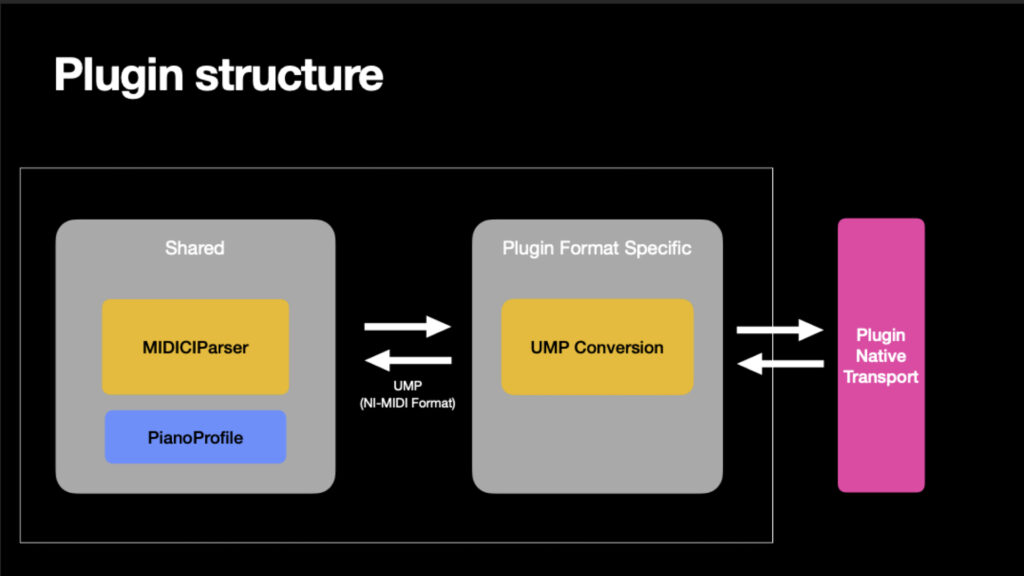
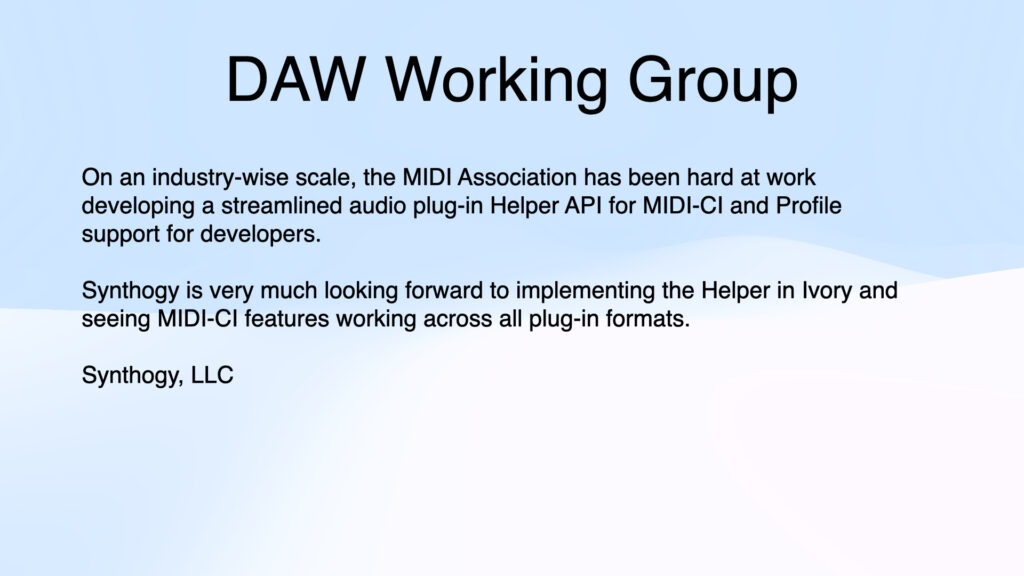
The MIDI Association DAW working group is creating open source software that will look at MIDI 2.0 messages from external devices, extract the information the plugin needs to support Profiles like the Orchestral Articulation, MPE and Piano profiles and translate those MIDI messages into the native plug formats that plugins already understand.

By utilizing this open source software, plugin companies can start supporting MIDI 2.0 external devices with minimal development costs. 

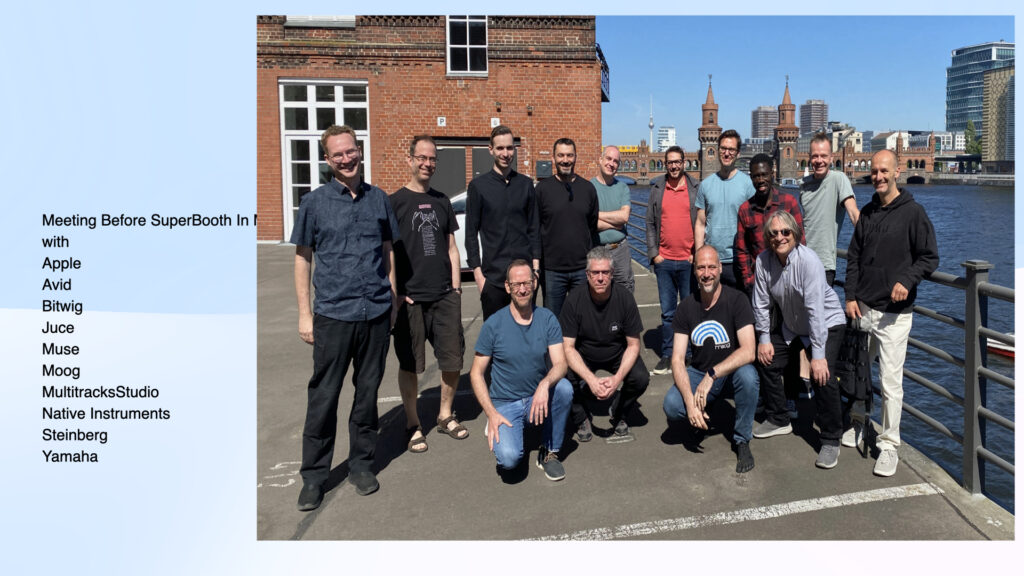
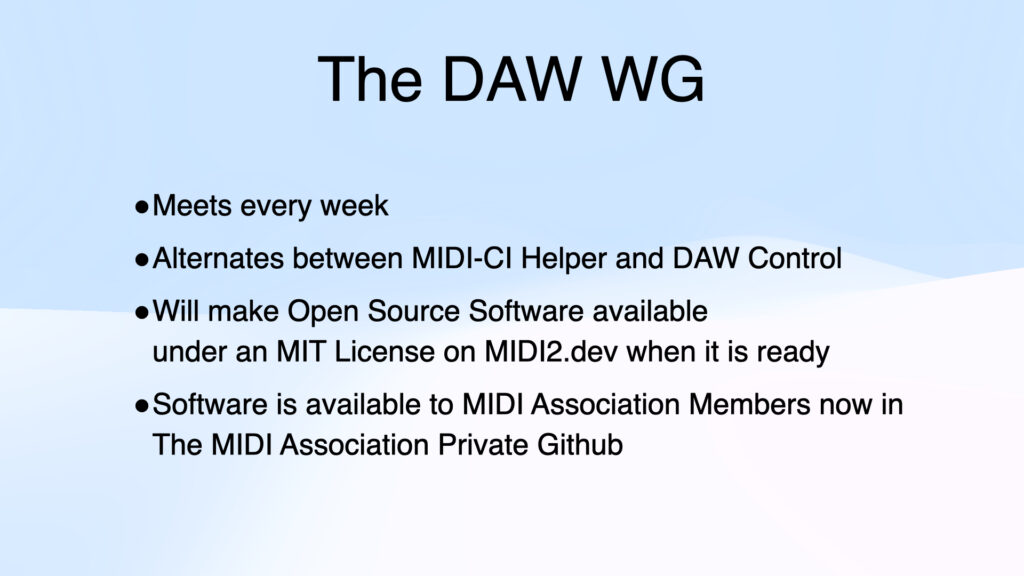
Before Super Booth in May of 2024, The MIDI Association hosted the first meeting of the DAW working group at the Native Instruments office in Berlin, where the companies agreed to work together to develop open-source software available under a permissive MIT license to bridge the gap between external MIDI Devices, Digital Audio Workstations (DAWs), and plugins. That cooperative project is ongoing in the MIDI Association’s DAW Working Group.

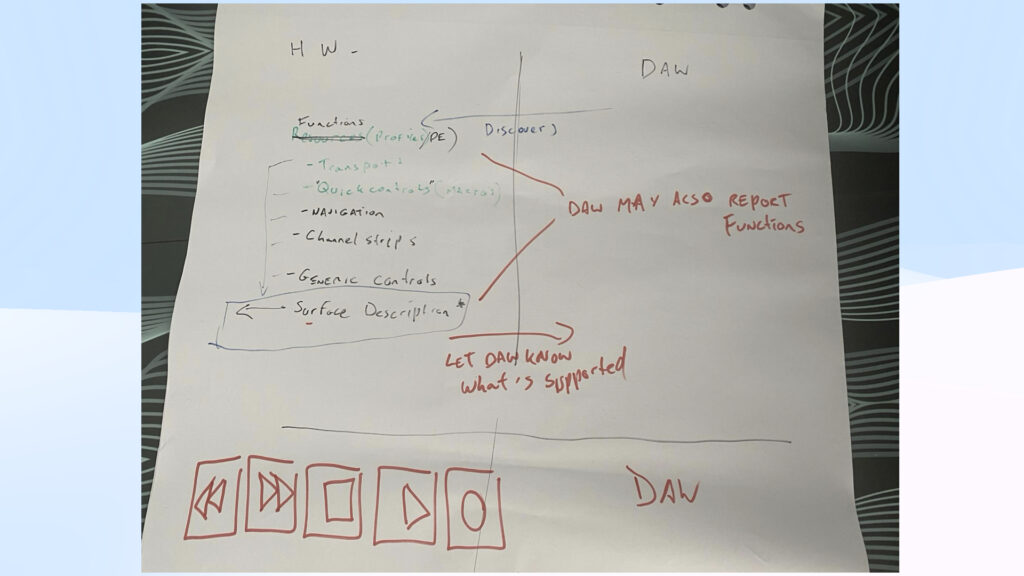
The DAW Working Group is also working on a DAW Control Profile which would supersede proprietary control protocols like Mackie Control and Logic control with a true industry standard for controlling DAWs via external hardware and software.
Text on a blue and white gradient background reads: Plugin Formats Open Source Support for MIDI 2.0.
Slide titled Recreating the MIDI 1.0 Infrastructure for MIDI 2.0 lists four points: Transports (USB and Network), Operating Systems (Apple, Google, Linux, Microsoft), Digital Audio Workstations (Logic, Cubase, Nuendo, MultitrackStudio), and Plugin Formats (question marks).
A group of 15 people pose and smile outdoors by a riverside railing, with brick buildings and the Oberbaum Bridge in the background. A light blue box lists music tech brands like Apple and Steinberg on the left side.
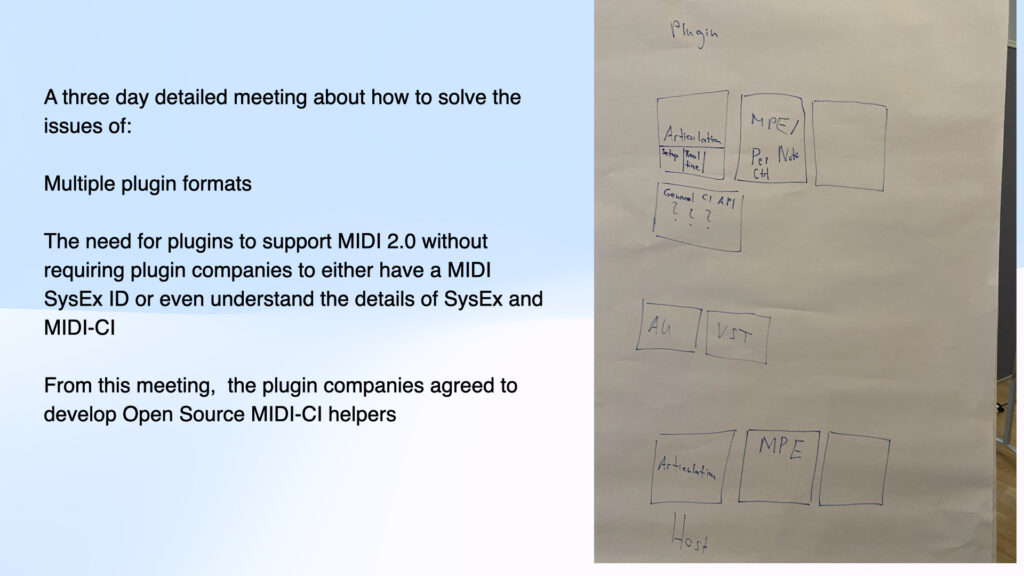
A presentation slide with meeting notes about solving plugin compatibility issues, discussing MIDI 2.0 and open-source MIDI-CI helpers. Next to the slide is a paper with hand-drawn plugin connection diagrams.
A handwritten diagram on paper compares HW and DAW with lists, arrows, and notes. A red arrow links sections. At the bottom, red icons represent media controls like play, stop, and record.
A diagram titled Plugin structure shows two main sections: Shared with MIDICIParser and PianoProfile, and Plugin Format Specific with UMP Conversion. Arrows connect the sections to Plugin Native Transport on the right.
Diagram showing Plugin/Host Structure: On the left, a Plugin box contains MIDCIParser and PianoProfile, connected via Plugin Native Transport (center, pink) to a Host box on the right with MIDCIHostParser and PianoProfilePublic.
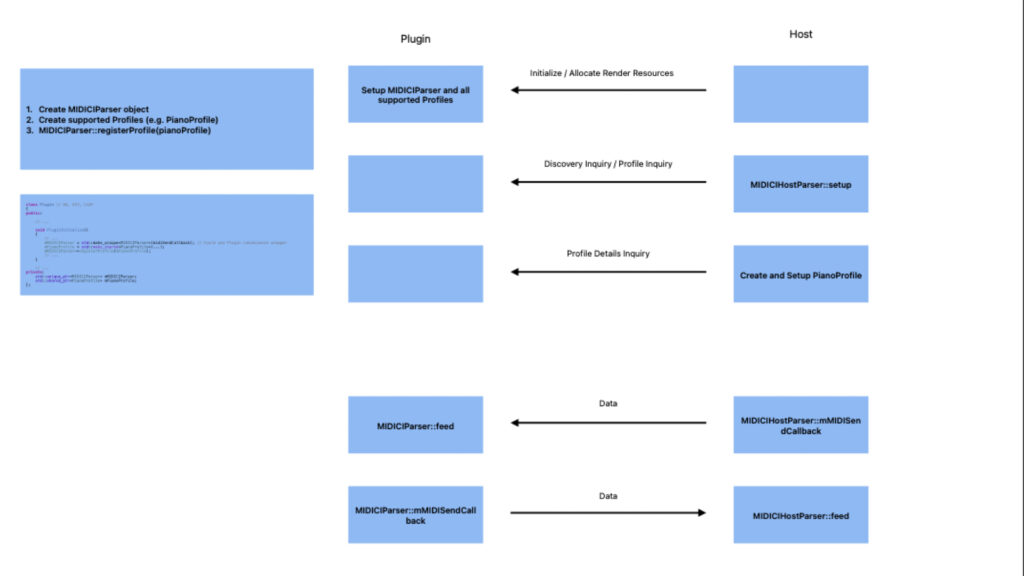
A flowchart showing interactions between a plugin and host for MIDI processing. It details steps: initialization, discovery, profile details, and data exchange, with arrows indicating the direction of communication.
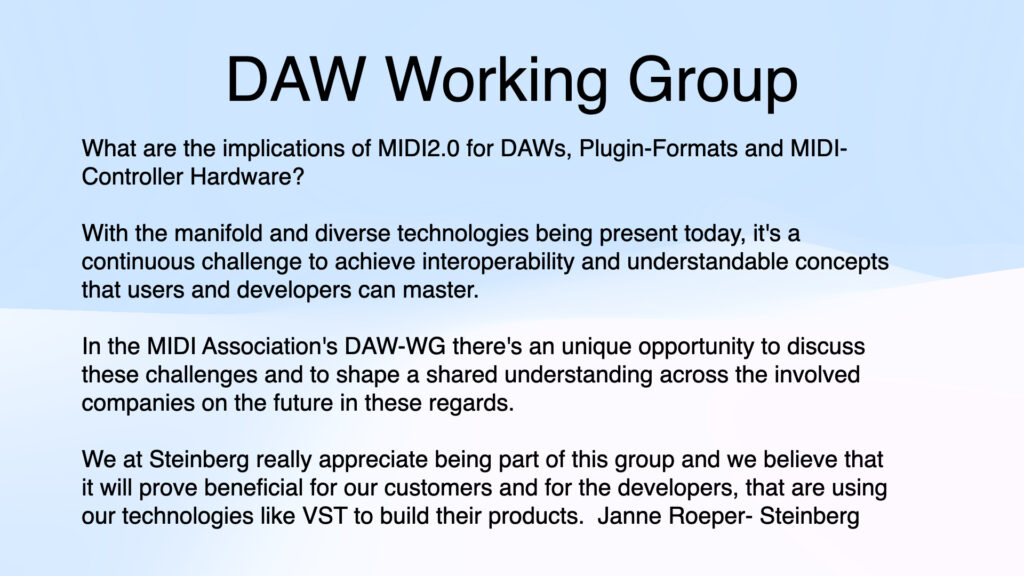
A presentation slide titled DAW Working Group discusses the implications of MIDI 2.0 for DAWs, plugins, and controllers, mentioning interoperability challenges and a quote from Janne Roeper of Steinberg.
Slide titled The DAW WG with bullet points describing weekly meetings, alternating topics, open-source software plans, and MIDI Association member access via private GitHub. Text is on a pale blue gradient background.