

Part 1 of five. Music China, Shanghai New International Expo Centre, 28–31 October 2026.
Music China returned to the Shanghai New International Expo Centre from 28 to 31 October 2026, and once again the centre of gravity for everyone working on music technology was Hall N2, the Music Technology & Innovative Audio Pavilion.
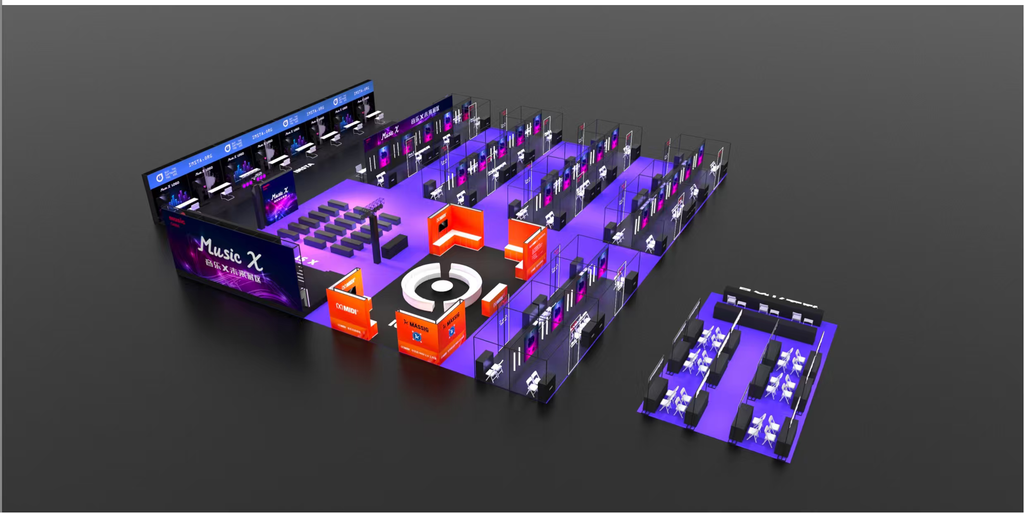
At the heart of that hall is Music X. Launched in 2017 and co-organised by the Music China Organizing Committee, the Future Music Technology Committee of the Chinese Musical Instrument Association, and The MIDI Association, it has grown into the country’s main platform for music technology. Across a 25 by 31 metre footprint it runs four core sections: the MusiX Lab, the MusiX Lab × THE MODULAR COMMUNE joint zone (new this year, co-created with The Modular Commune Festival Beijing), the MIDI Zone, and the X Stage.
The MIDI Zone is the organizers’ exclusive collaboration zone with The MIDI Association. Our booth sat inside it at Lab 99, with the X Stage a few steps away. All the people from Shanghai Intex, the company that help run Music China and the Music X Lab are always incredibly helpful.
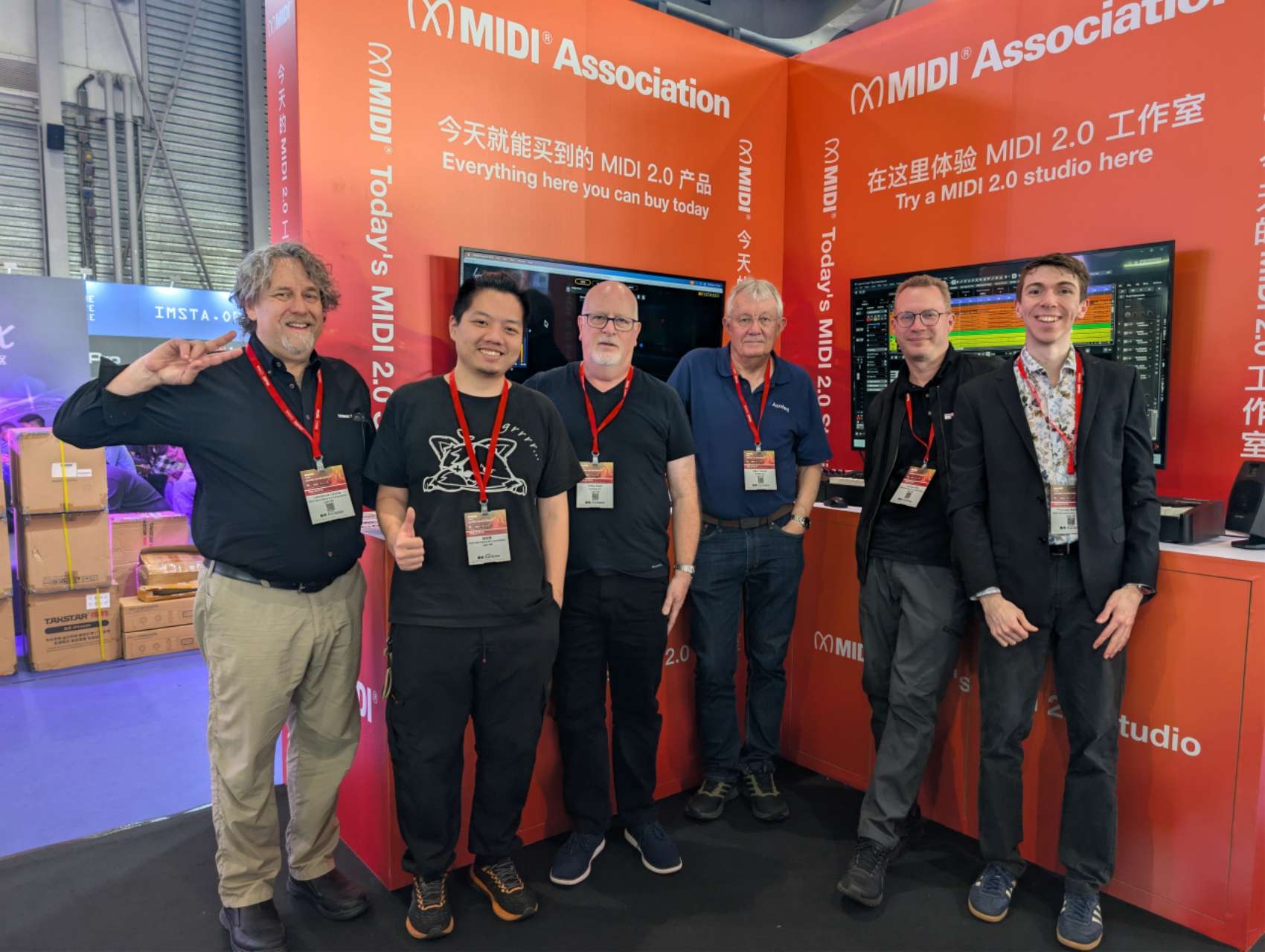
The shape of the stand
The booth was built as a set of orange-walled faces around an open centre, with a ring of white seating in the middle and a screen on each outward face — so the four themes could run simultaneously without anyone queueing behind a single demo, and so there was somewhere to sit down and actually talk.
Each face carried one of the four areas:
- Music Accessibility — 音乐无障碍化, with MIDI In Music Education on the adjacent display, the presentation video running on a loop
- The MIDI Innovation Awards — this year’s entries, with a QR code to the full list
- MIDI 2.0 Innovative Products — new work built on the new specification
- Today’s MIDI 2.0 Studio — 今天的 MIDI 2.0 工作室
The wall copy did the explaining, in both languages and without hedging. Everything here you can buy today (今天就能买到的 MIDI 2.0 产品). Try a MIDI 2.0 studio here (在这里体验 MIDI 2.0 工作室). Music is for Everyone (人人都能做音乐) and Anyone can learn MIDI (人人都能学 MIDI).
Each of the four areas has its own article in this series — links at the foot.
Walk-in demo at the MIDI Association booth — what a visitor met on arriving at Lab 99.
Around us in the lab
Lab 99 sat among the MusiX Lab standard booths, with IMSTA’s wall of software along one side and the Modular Commune zone bringing modular synthesizers, live improvisation, a beginner experience village and an independent developer section into the same hall. The MusiX Lab booths around us covered composition tools, MIDI devices and software, DAWs, synthesizers, effects, audio interfaces and sound cards.
It is worth saying plainly what that proximity means. A third of The MIDI Association’s member companies are now Chinese. Hall N2 is not a window onto a future market; it is where a large part of the membership already works.
The X Stage
The X Stage sits directly alongside the MIDI Zone — a full LED wall, rows of seating, and a programme running in twenty-minute slots across all four days. Over the show we took four of those slots, one for each area of the booth:
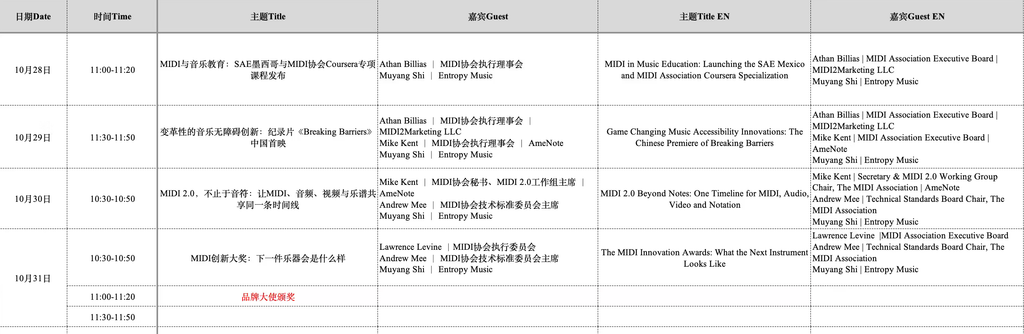
- MIDI In Music Education — 28 October, 13:00–13:20. Launching the free SAE Institute Mexico and MIDI Association Coursera curriculum: three courses, free, with a certification test issued in both names. Covered in full in part 2.
- Music Accessibility — Game Changing Music Accessibility Innovations, and the case for Assistive Text. Part 2.
- The MIDI Innovation Awards — the 2026 finalists, presented one at a time. Part 3.
- MIDI 2.0 — the state of the specification. Part 5.
The MIDI Forum
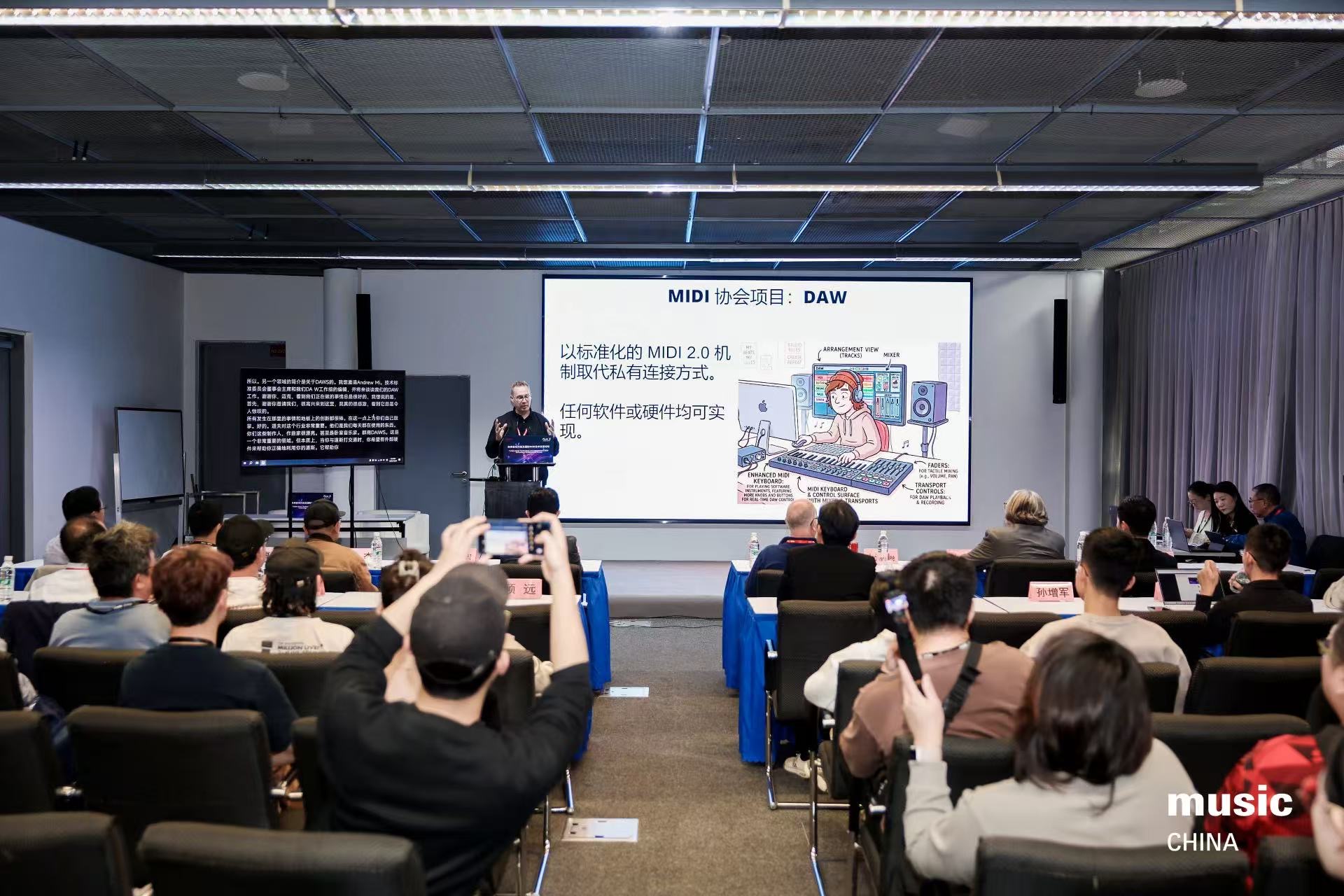
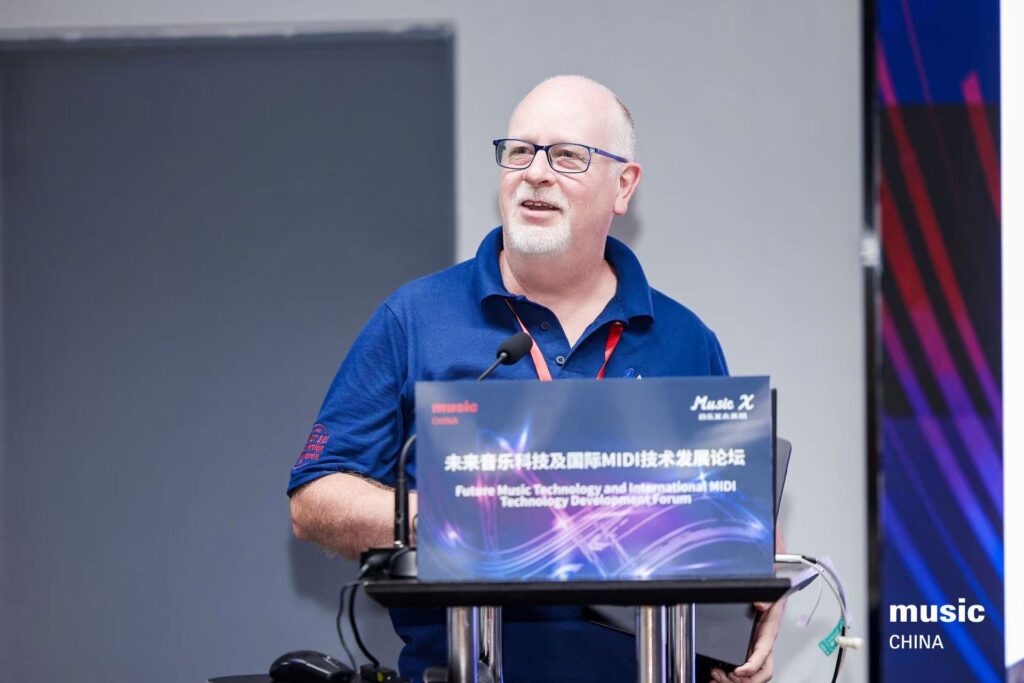
Separately from the X Stage, the Future Music Technology and International MIDI Technology Application and Development Forum returned as part of the Music China fringe programme — a long-running fixture organised with the Chinese Musical Instrument Association, and one The MIDI Association has co-organised for years.
It ran as a half-day programme on 29 October to a full room, with a live Chinese transcription on a screen beside the podium. The wider programme covered MIDI 2.0 standards, AI-driven instrument design and interaction, the digital preservation of traditional Chinese music, and music-based therapy, closing with a roundtable on the future of instruments and music technology in the AI era.
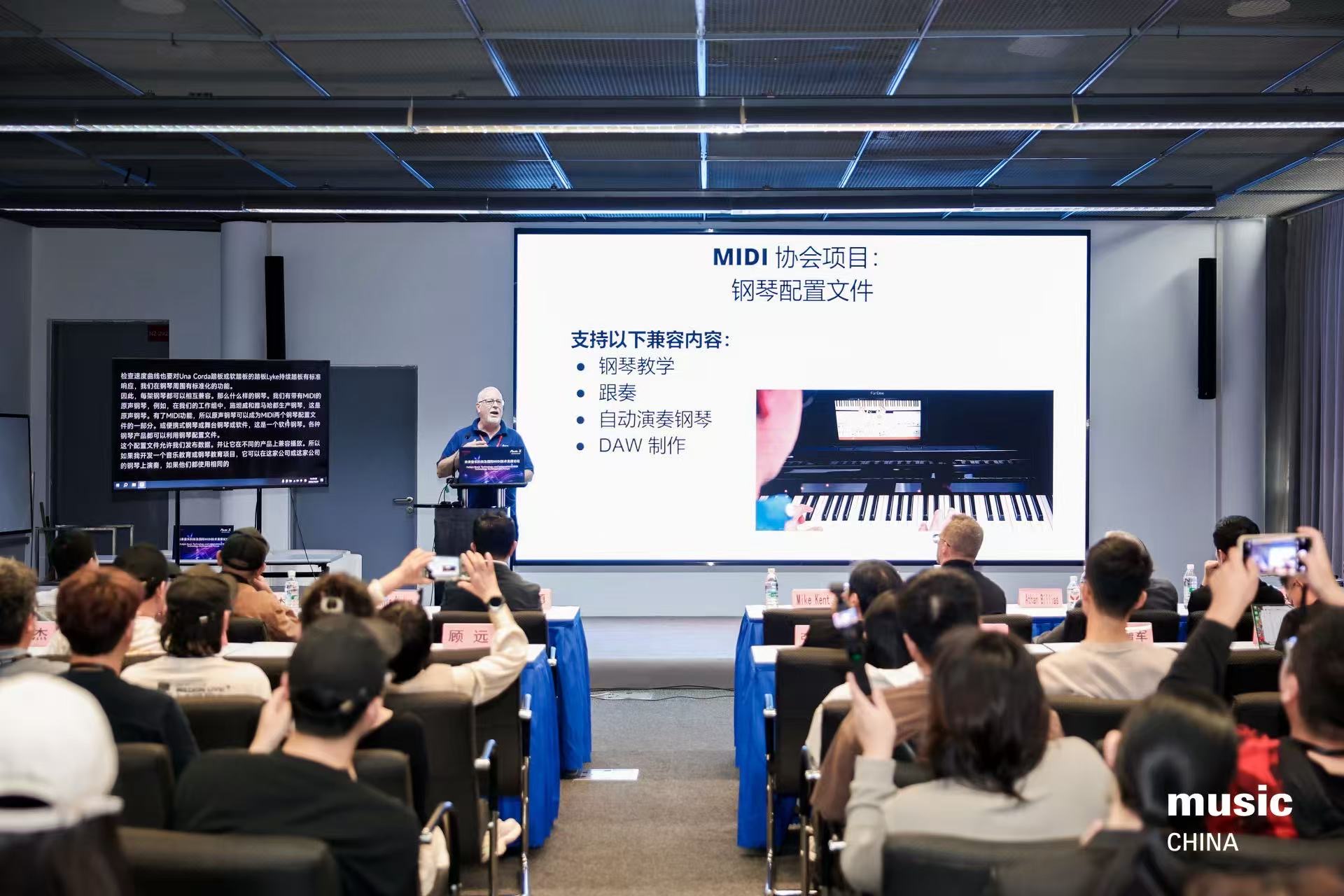
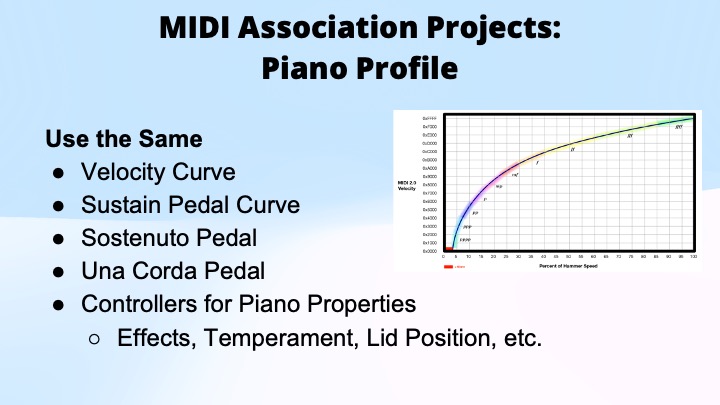
Instrument Profiles — presented by Mike Kent. The Piano Profile standardises velocity curve, sustain, sostenuto and una corda pedal behaviour, and controllers for piano properties such as effects, temperament and lid position, so that MIDI acoustic, digital and software pianos all respond the same way. It enables compatible content for piano education, play-along, player piano and DAW production.
The Note On Orchestral Articulation Profile does the equivalent for orchestral writing.
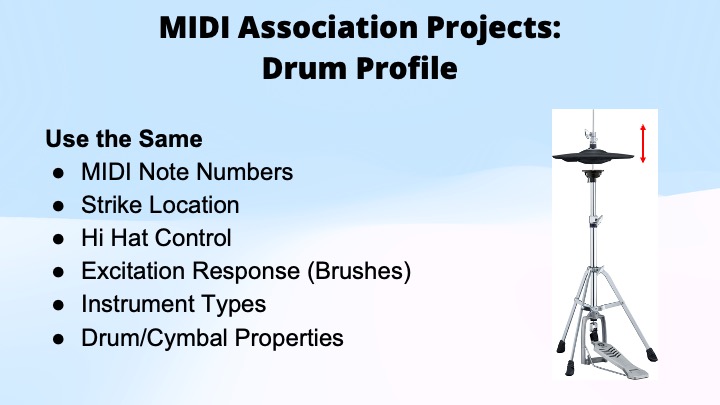
A Drum Profile follows in Q4 2026, standardising note numbers, strike location, hi-hat control, brush response, instrument types and drum and cymbal properties across drum sets, multipads and software. Beyond those sit the MPE Profile, General MIDI 2 Profiles, Drawbar Organ and Rotary Speaker, Default Drum Note Mapping and Default Controller Mapping.
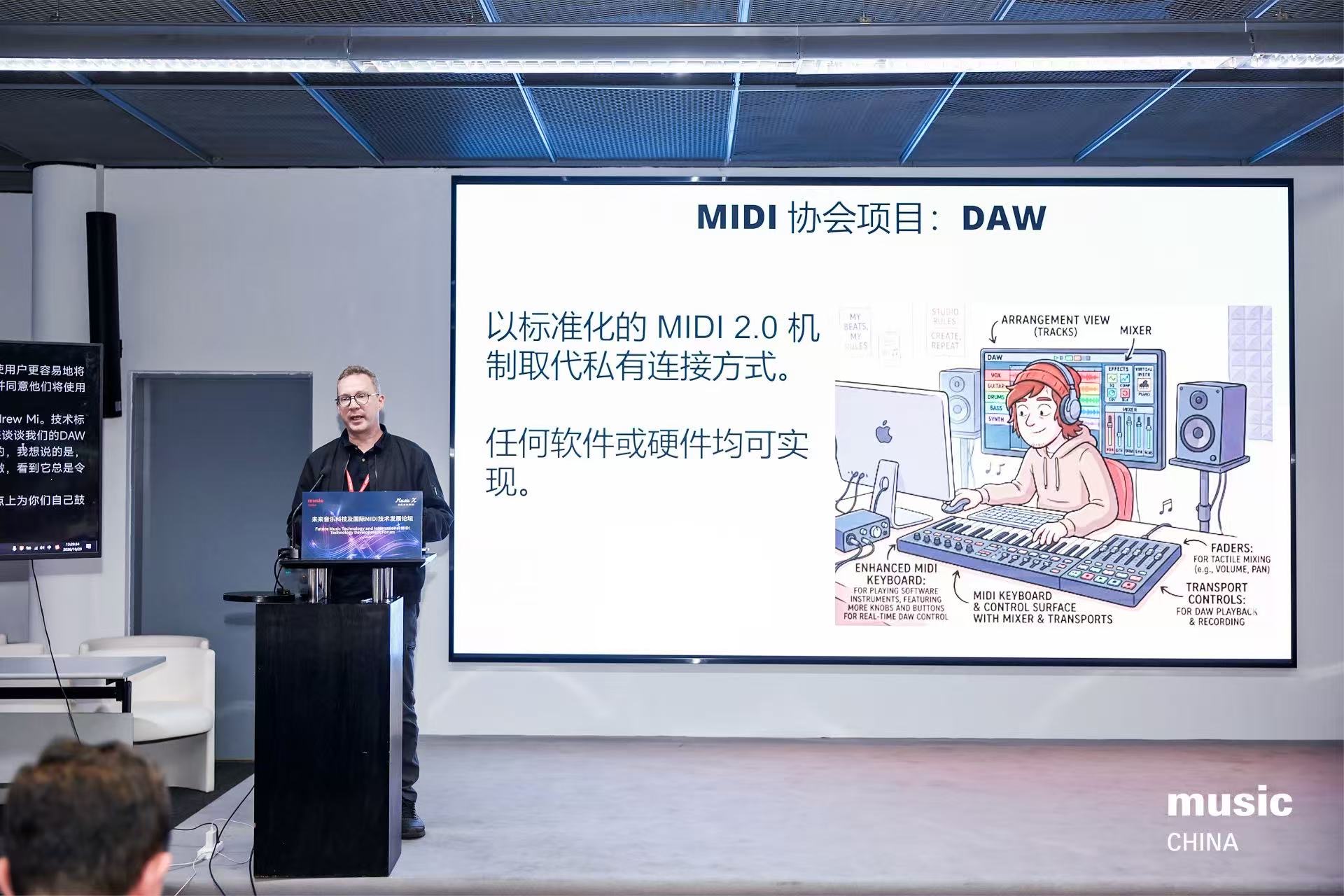
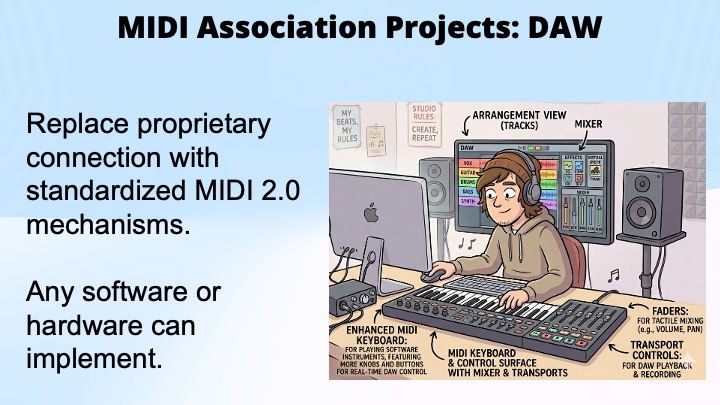
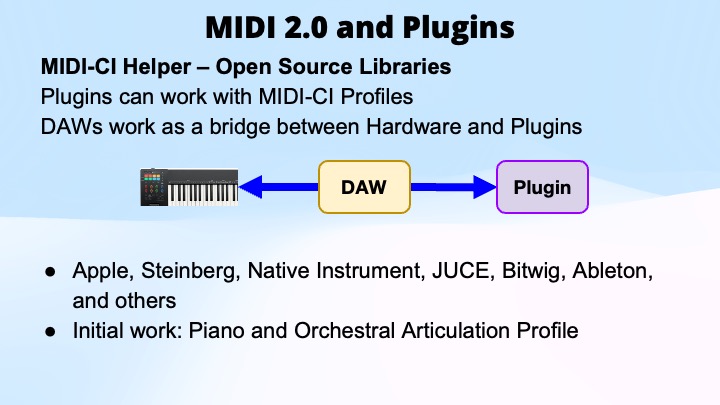
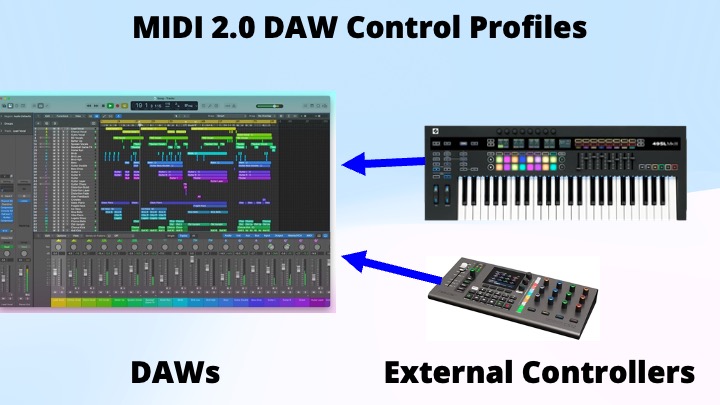
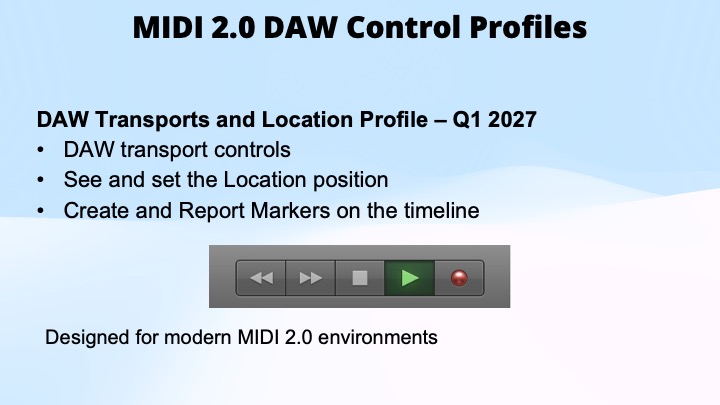
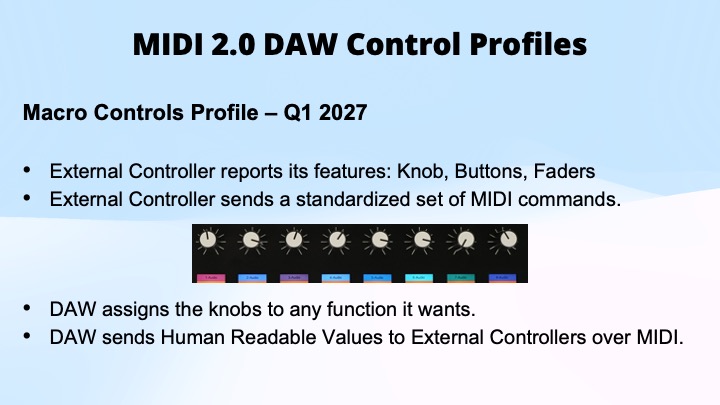
DAWs and MIDI 2.0 — presented by Andrew Mee. Replace proprietary connections with standardised MIDI 2.0 mechanisms that any software or hardware can implement. On the plug-in side, the open-source MIDI-CI Helper libraries let plug-ins work with MIDI-CI Profiles and let DAWs bridge between hardware and plug-ins, with Apple, Steinberg, Native Instruments, JUCE, Bitwig, Ableton and others involved, and the Piano and Orchestral Articulation Profiles as the initial work. On the controller side, the DAW Transports and Location Profile arrives in Q1 2027 — transport controls, reading and setting playback position, creating and reporting timeline markers — alongside a Macro Controls Profile, also Q1 2027, in which an external controller reports its knobs, buttons and faders and sends a standardised set of commands, the DAW assigns them to whatever it likes, and the DAW sends human-readable values back to the controller. Pagination means even a controller with few physical controls can reach every parameter. Mixing functions, detailed plug-in control, navigation and utilities follow later in 2027.
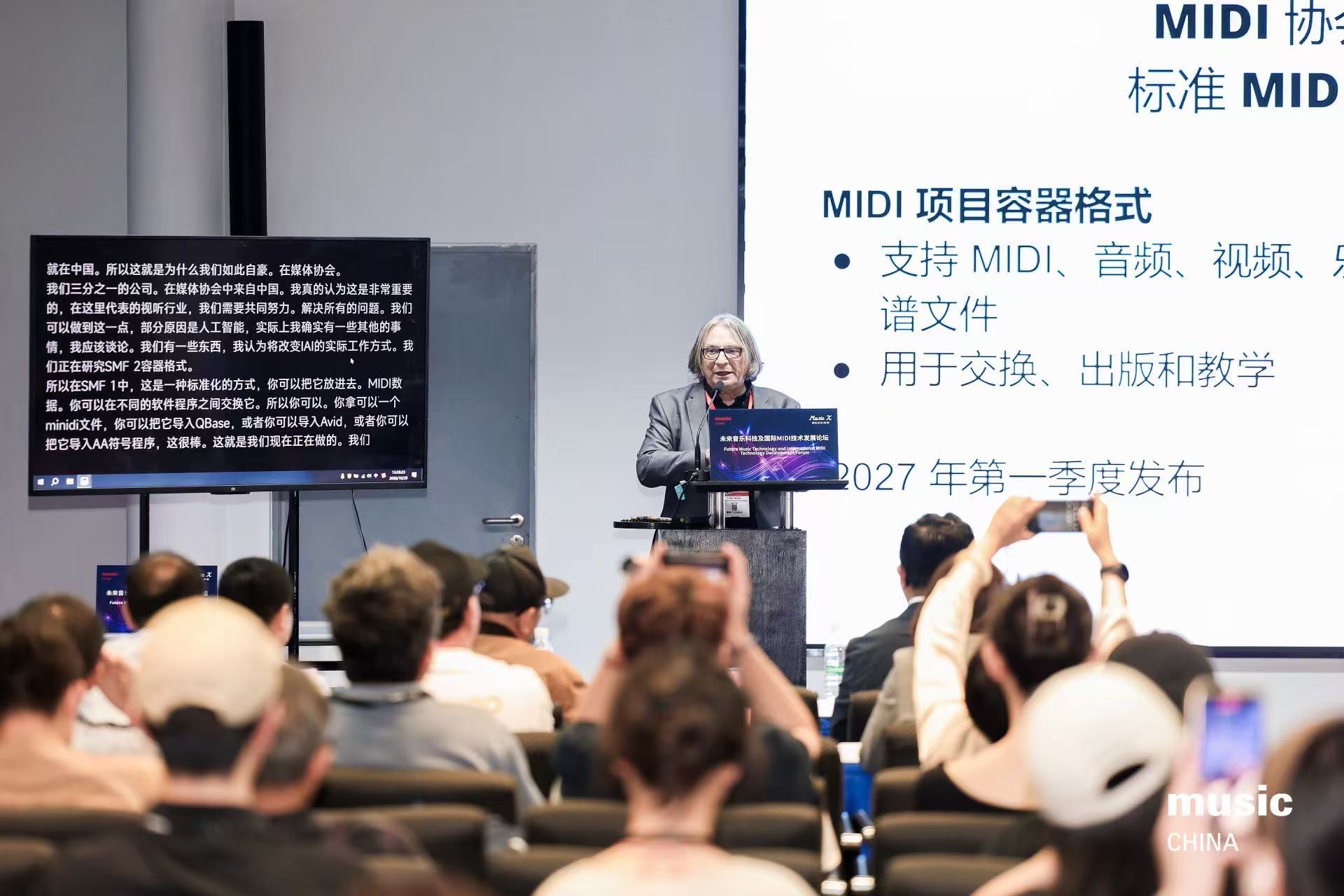
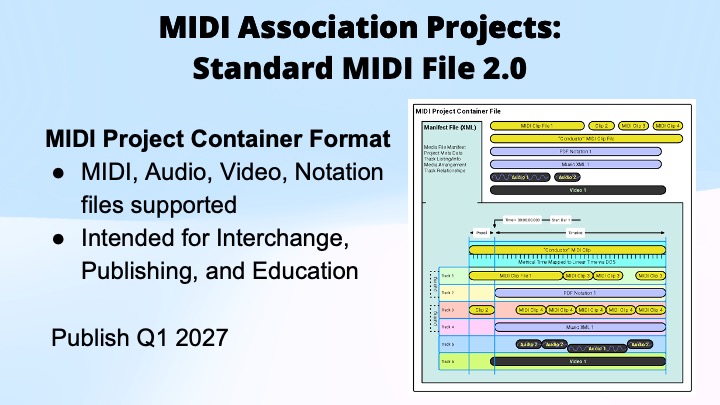
Standard MIDI File 2.0 — presented by Athan Billias. The MIDI Project Container Format holds MIDI, audio, video and notation files together, intended for interchange, publishing and education, so a session can move between different companies’ software — or from a publisher to a classroom — without breaking apart into a folder of loose assets. Publication is set for Q1 2027.
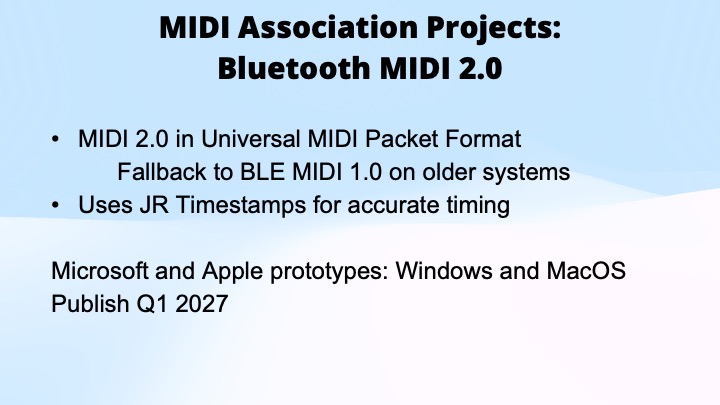
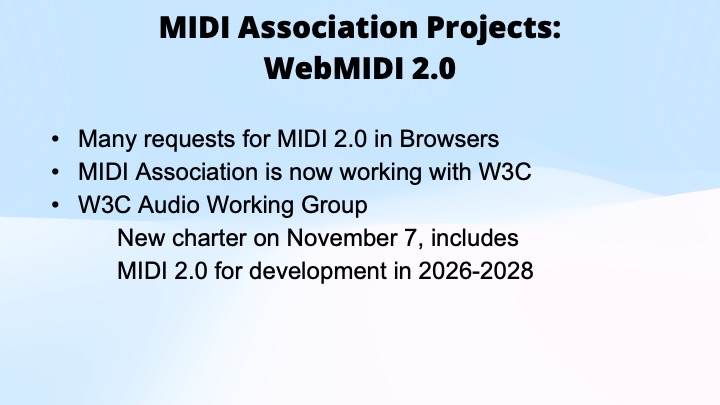
Bluetooth MIDI 2.0 closed the list.
The Brand Ambassadors
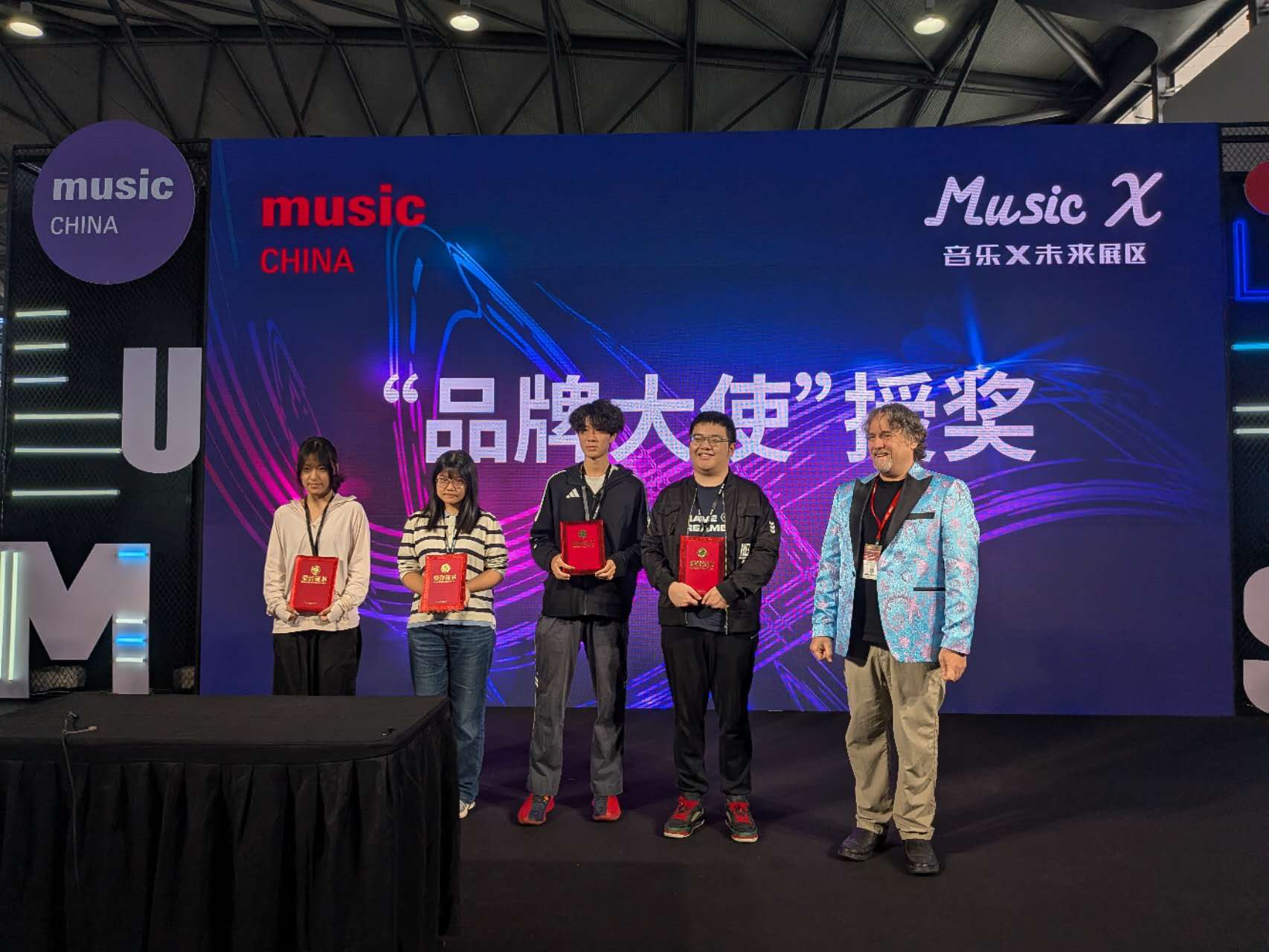
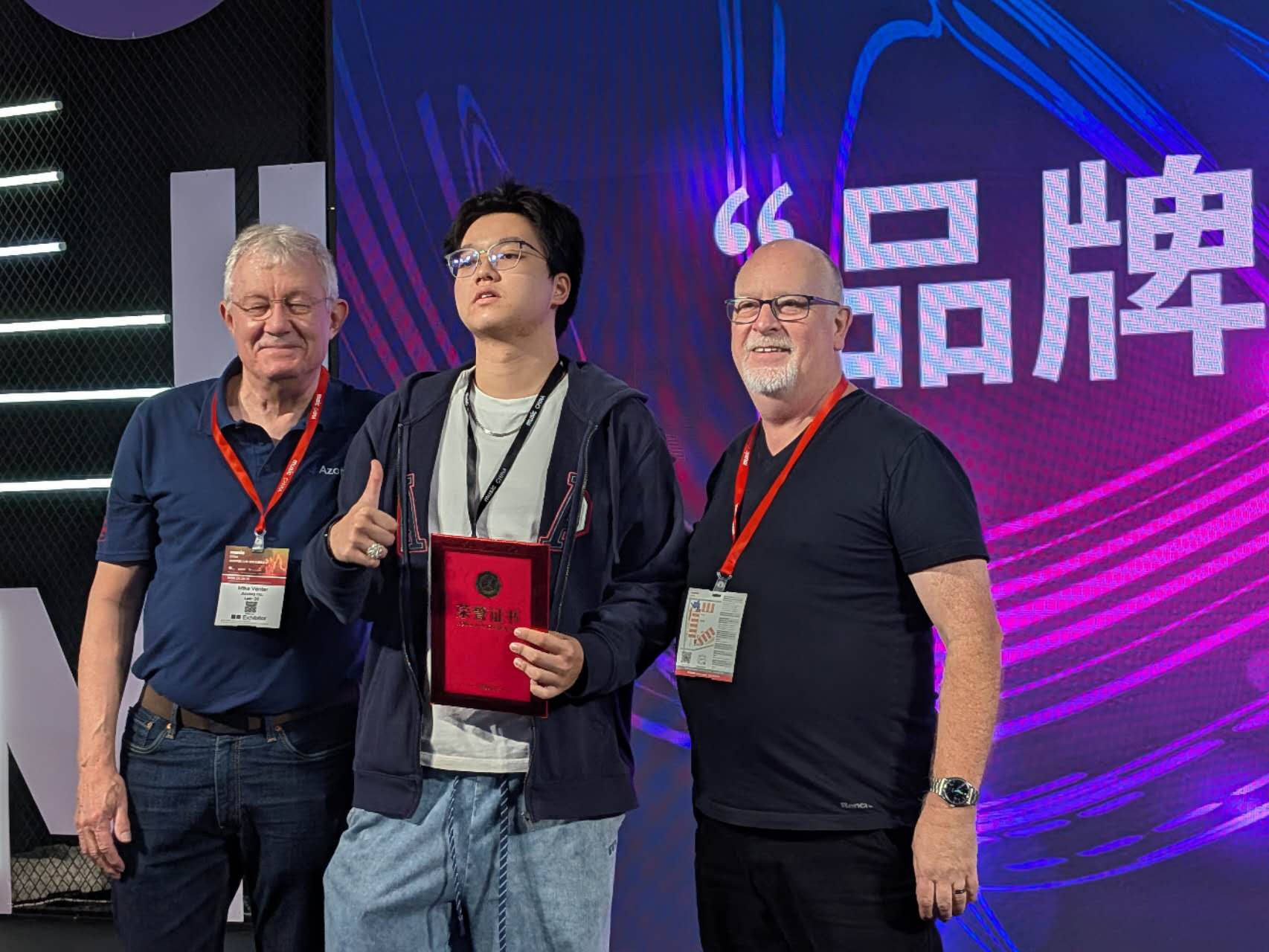
Music China’s Brand Ambassador (品牌大使) certificates were presented on the Music X stage, with the students who had worked the halls over the four days called up to collect them.
Thank you
Music China 2026 ran more than 800 fringe sessions across four days. We were glad to be part of it, and we will be back.
Sonic State Video From Music China
The rest of this series
- Music Accessibility and MIDI In Music Education at Lab 99 — who gets to make music, and what is standing in the way
- The MIDI Innovation Awards at Lab 99 — and the VR demo that drew a queue all week
- MIDI 2.0 Innovative Products at Lab 99 — Sleight and MIDISketch
- Today’s MIDI 2.0 Studio — a working studio you could buy this afternoon
Sources
- EN 2026 Music X 介绍 (organizer deck, June 2026) — Music X founding year, co-organizers, the 25 × 31 m footprint, four core sections, MIDI Zone contents, twenty-minute X Stage slots
EN_MIDI-In-Music-Education_Music-China.pptxandMIDI_2.0_Forum_Presentation_2026.pptx, session decks- Music China press release, Music China 2026 opens tomorrow with 800+ fringe sessions — https://music-china.hk.messefrankfurt.com/shanghai/en/press/press-releases/2026/MUC26_OR.html
- Music China, Music X | Unlocking New Frontiers in Music Technology — https://en.musicchina-expo.com/zhanhuinew/562.html