

Part 4 of five. The MIDI Association at Music China, Shanghai, 28–31 October 2026.
One face of the Lab 99 booth was given to MIDI 2.0 Innovative Products: not the specification, and not the shipping studio next door, but the things people have started building now that the new resolution exists.
Two of them make the same argument from opposite directions, and together they answer the question manufacturers keep asking about MIDI 2.0 — what is the extra resolution actually for?
The answer both give is: expression, on the notes you are already playing, without buying anything new.
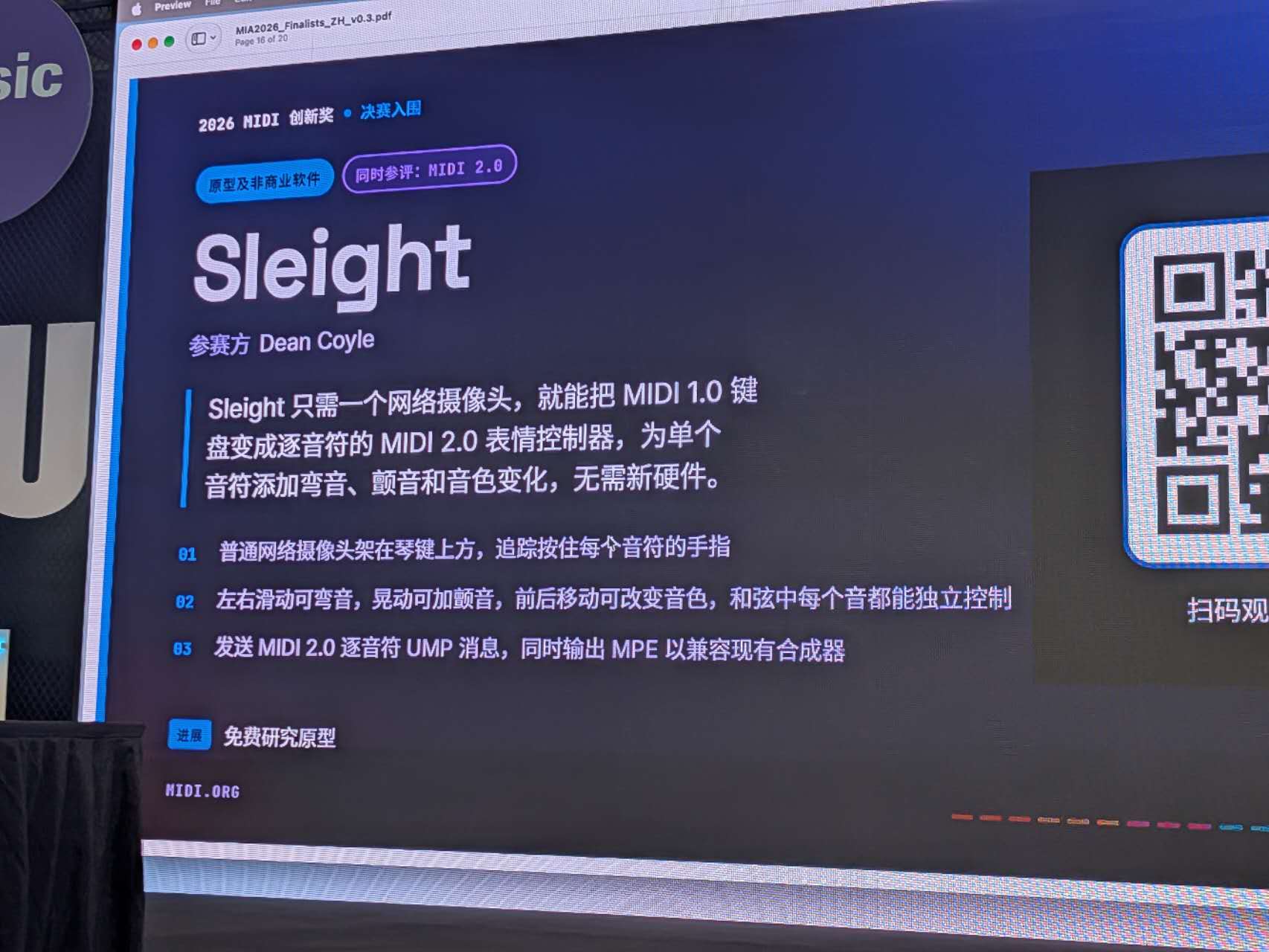
Sleight
Dean Coyle · Prototypes and Non-Commercial Software, also entered in MIDI 2.0
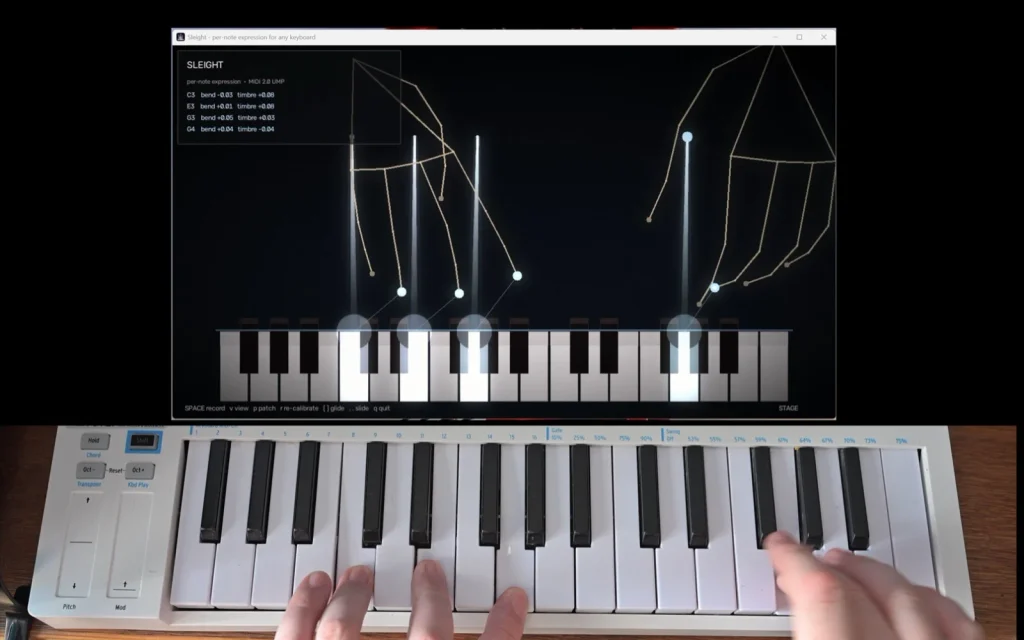
Sleight turns an ordinary MIDI 1.0 keyboard into a per-note MIDI 2.0 expression controller using nothing but a webcam. No new hardware.
An ordinary webcam sits above the keys and tracks the finger holding each note:
- Slide sideways to bend the pitch
- Shake to add vibrato
- Move forward and back to change timbre
Every note in a chord is controlled independently — which is the part that matters, and the part a MIDI 1.0 keyboard has never been able to do. Hold a triad, and you can bend one note of it.
Underneath, it sends per-note MIDI 2.0 UMP messages, and outputs MPE at the same time so existing synthesizers still respond. It is a free research prototype.
The significance is not the webcam trick. It is that the expressive ceiling of a keyboard someone already owns turns out to be a software question, not a hardware one.
MIDISketch
ELIOTONIC · Commercial Software
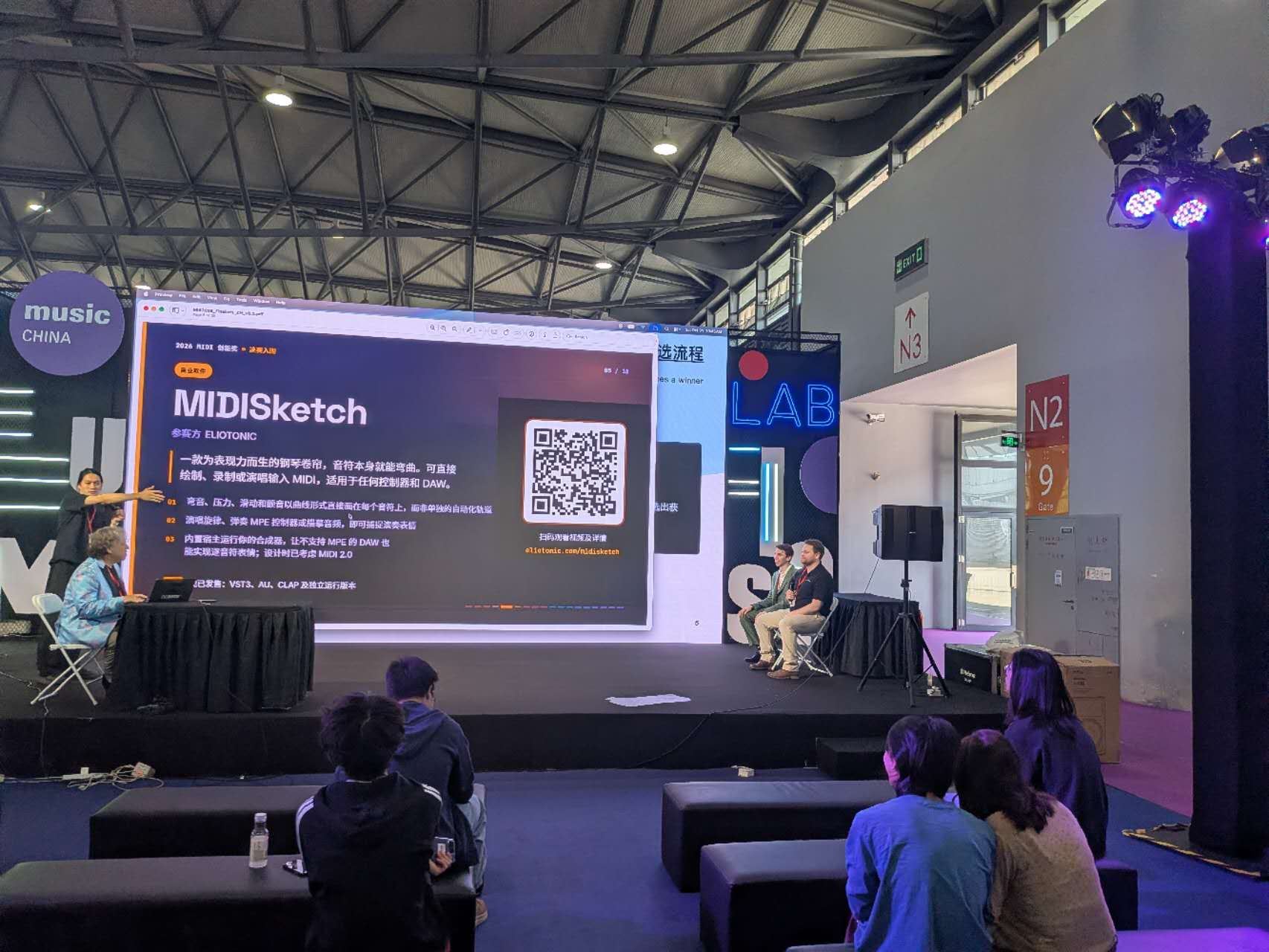
MIDISketch is a piano roll built for expression, where the notes themselves bend.
In most sequencers, expression lives somewhere else — pitch bend on one automation lane, pressure on another, modulation on a third, all of them disconnected from the note they belong to. MIDISketch draws pitch bend, pressure, slides and vibrato as curves directly on each note.
You can get the data in four ways: draw it, record it, play it from an MPE controller, or sing it — the pitch of a sung melody becoming the expression curve.
It also runs your synthesizer inside itself, so a DAW that does not support MPE can still produce per-note expression, and it was designed with MIDI 2.0 in mind from the start. It ships as VST3, AU, CLAP and standalone.
ELIOTONIC was represented at the show by Eliot Jackson.
MIDISketch explained
Why these two sat together
Both are finalists. Both are about per-note expression. Neither asks a musician to replace their instrument.
That is the practical case for MIDI 2.0, and it is a more convincing one than any specification summary: the higher resolution is not a number on a datasheet, it is the difference between a chord where all three notes move together and a chord where each note moves on its own.
For the specification work behind it — Profiles, Network MIDI 2, the Piano and Orchestral Articulation Profiles — see part 5.
The rest of this series
- Hall N2, Music X and Lab 99 — the booth, the stage and the Forum
- Music Accessibility and MIDI In Music Education at Lab 99 — who gets to make music, and what is standing in the way
- The MIDI Innovation Awards at Lab 99 — and the VR demo that drew a queue all week
- Today’s MIDI 2.0 Studio — a working studio you could buy this afternoon
Sources
MIA2026_Finalists_ZH_v0.3.pdf, the finalists deck shown on the X Stage- Photos supplied by Athan Billias, 1 November 2026