

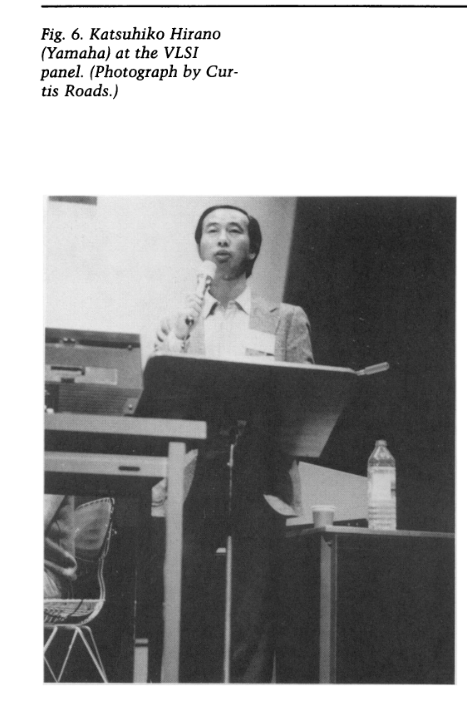
2025 MIDI Association MIDI Lifetime Achievement Award (MLTA) recipient Katsuhiko “Karl” Hirano (平野 勝彦) known by most people in the world of MIDI simply as Karl played crucial roles in the story of MIDI, Yamaha and Korg. He was a quiet, unassuming man who took on jobs assigned to him by his companies without question or complaint.
He was on the Yamaha engineering team of the DX7 along with fellow 2025 MLTA recipient Tetsuo Nishimoto. Then he was tasked with being the face of Yamaha at places like IRCAM, the Institute for Research and Coordination in Acoustics/Music) dedicated to the research of music and sound, especially electronic music.
Yamaha was one of the first companies to develop large scale VLSIs specifically for music and Hirano-san also contributed to those efforts.
But it was Karl’s role not only at Yamaha, but also at Korg that solidified his role in MIDI history.
Oddily that story starts with a bet between Tsutomu Katoh, the founder and chairman of Korg and the author of this article.
In the MIDI history article about 2024 MIDI Lifetime Achievement award winner, Chairman Katoh, I detailed how I ended up working in Japan for Korg as the product planning manager and leading the sound design team for the Korg M1. I was sure the M1 was going to be a big hit.
Chairman Katoh was not so sure. He didn’t have confidence because Korg’s distributors weren’t sure they could sell a relatively expensive synth (MSRP of $2,749). On top of that Korg USA had been complaining that the product category (M1- Music Workstation) was confusing because a workstation was a computer term that had a specific meaning and they didn’t believe that Korg could establish a new instrument category on its own.
So one day, Katoh-san and I were talking about the Kikakushou Daisu (企画書代数), the product planning number for the M1 which was 40,000 units world wide over three years. I said I thought we would sell more than 40,000 n the first year. Katoh-san asked me if I had enough confidence to bet on it and I said yes.
Initially I proposed that Katoh-san would pay me $1 for every M1 we sold over the product planning number, but he realized that would set a bad precedent and offered a counter proposal. We had always joked that as Korg USA was outside of New York on Long Island and Korg Inc. was in Tokyo, the perfect place to have a product planning meeting would be Hawaii.
So Katoh-san and I shook hands that if the the M1 sold over 40,000 in the first year, we would have our next international meeting in Hawaii. Katoh-san was a smart business man and he was wise not to take my first proposal which would have netted me over $320,000 as the M1 went on to sell over 365,000 units over it’s long lifetime.
True to his word, in 1989, Korg held a product planning meeting in Hawaii. The MIDI Patch Boys (the international sound design team of product specialists from all over the world including Ben Dowling, Jack Hotop, Michael Geisel, Steve McNally, Michele Paciulli and Peter Schwartz) all flew in several days early and got to relax on the beach.


The Japanese team took an overnight flight from Narita and arrived at 6 am in the morning for a meeting that started a 9 am in a room with no windows. The meeting went all day and then after the meeting, we would have a wrap up meeting of Japanese staff preparing for the next day’s session. So I managed to go to Hawaii, and never see the sun for three days. The only time I did see the sun on that trip was on our last day. We had an 11 am flight to Tokyo so I woke up the Japanese staff and insisted that we run down to the beach in front of the hotel and jump in the water so we could say we went swimming in Hawaii.
At the second day of the 1989 meeting in Hawaii, Katoh-san announced that he had been to visit the president of Yamaha and found out that Yamaha would soon close the Dave Smith Division of Yamaha. Yamaha had invested 51% in Korg in 1987 and then acquired Sequential Circuits in 1988.
But by 1989, Yamaha was trying to figure out what to do about this group of American engineers and was struggling to effectively utilize them to come out with a product. Katoh said he wanted feedback from the MIDI Patch Boys on whether they thought Korg should hire the engineers from the Sequential Circuits team. Of course, everyone said yes.
The reality is that Katoh-san, (his son and former Korg president) Seiki Katoh-san and Tadashi Umekage-san who was sent to Korg by Yamaha to help with the corporate turnaround had already negotiated the deal with Yamaha.
One of the things that was negotiated in the transaction was that Katsuhiko “Karl” Hirano would be “traded” to Korg from Yamaha for “a player to be named later”. Years later, Karl would joke with me that the player to be named later in that trade was me. Karl went from Yamaha Dave Smith Division to Korg R&D San Jose and after working for Korg for 7 years in Japan, I would eventually go to work for Yamaha Corporation of America in the US.
The team at Korg R&D San Jose went on to develop the Wavestation and many more well received Korg products.
So Karl was an important part of creating the enduring legacy of Dave Smith because he was the interface between Japan for both the Dave Smith Division of Yamaha and then Korg R&D.
By 1991, Karl had been overseas for almost 5 years and was brought back to Japan where he and I worked side by side in Korg product planning for several years until I returned to the US in 1994.
Here is one final Karl Hirano and Chairman Katoh story. The first time Karl Hirano and I went to visit Korg R&D in Anacona, Italy, Katoh remarked that he loved Ancona because three of his favorite things there- wineries, accordions (Korg was founded by Katoh and the accordian player in his nightclub, Osanai-san) and great seafood.
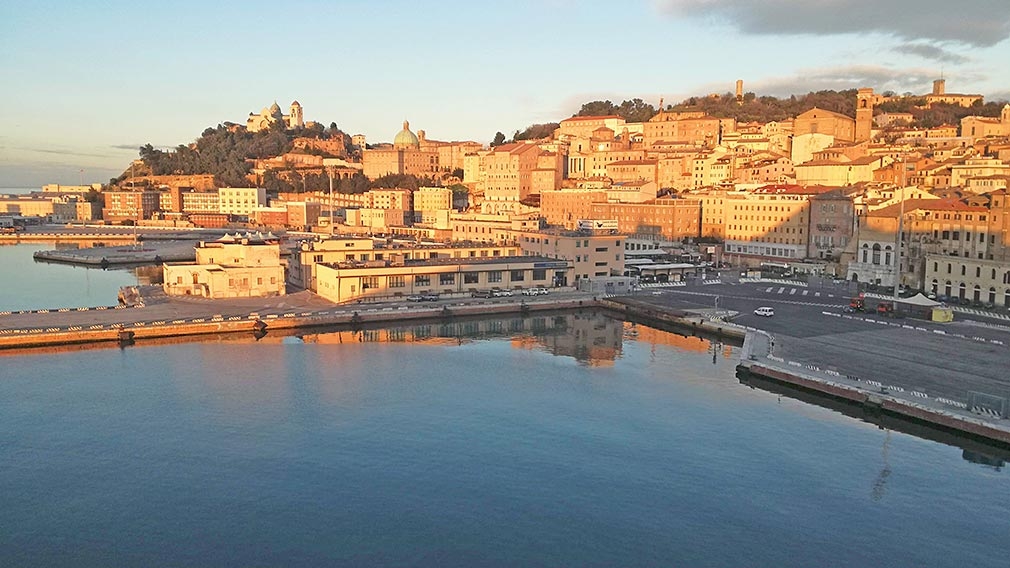
Ancona from Minoan Agencies Srl | Daniele Gaspari
But when Katoh-san saw the palatial Italian villa with a swimming pool where Korg R&D Italy was housed, he leaned over to me and said ” We need to get piranhas for the pool so the engineers will keep working and not spend all summer swimming”.
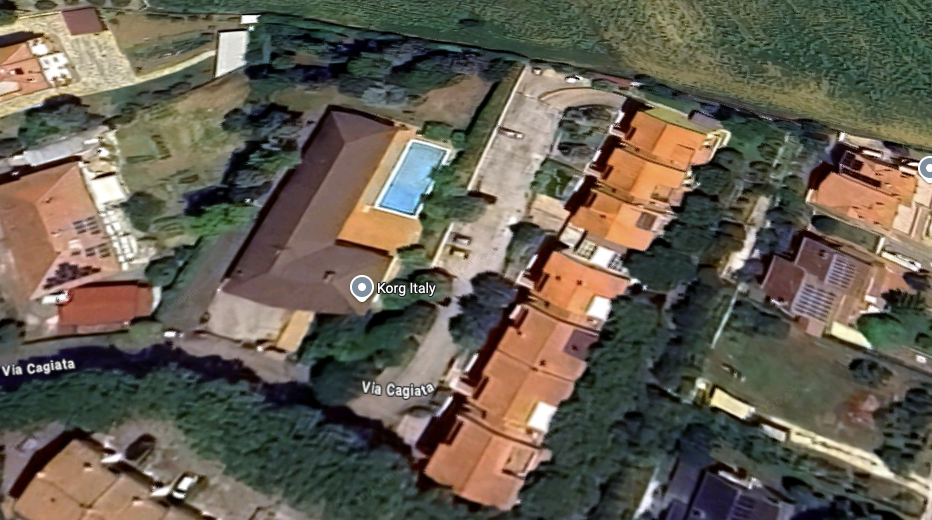
Eventually in 1995, Karl would be asked once again to take a post overseas to manage Korg’s new R&D center in Italy.