

When Gerhard Lengeling accepts the 2026 MIDI Association Lifetime Achievement Award at the NAMM Show, the recognition honors not only a visionary software designer but also one of the most influential contributors to the global history of MIDI. As the co-founder of Emagic, Lengeling helped shape the technical and creative foundations that millions of musicians rely on every day—most notably through Logic, one of the world’s most enduring and widely used digital audio workstations.
From its beginnings as a small German start-up in the late 1980s to its evolution under Apple into a flagship creative ecosystem, Emagic’s story is inseparable from the rise of MIDI-based music production. And at the heart of that story is Gerhard Lengeling: a classically trained musician, a brilliant engineer, and a relentless advocate for empowering creative people through technology.
Youtube Summary Video
Early Foundations: A Musician Who Saw the Future in Code
Gerhard Lengeling came to software development through music. Trained as a classical composer with a deep understanding of harmony, orchestration, and performance practice, he was also part of the first generation of musicians captivated by the arrival of affordable personal computers in the 1980s.
MIDI, introduced in 1983, offered a radically new opportunity: musical gestures could be translated into data, then shaped, reorganized, and orchestrated in ways that extended far beyond traditional instrument techniques.
Gerhard and 2026 MIDI Lifetime Achievement Award recipient Chris Adam ‘s first product together was DX7 Support for C64 in 1983, a bank loader and editor. One unique feature perhaps worth mentioning was an “Easy Page“ which allowed modification of existing DX7 sounds using a small, for most users much more approachable UI inspired by classic subtractive synthesizers with parameter sections like “VCF”, “VCA” and “ADSR”.

Lengeling quickly became fascinated with the idea of using computers as instruments of composition—tools that would augment, not replace, human creativity.
His early experiments in software sequencing for Atari computers led to the development of programs such as C-Lab Notator (which he and Chris Adam contributed to), one of the most sophisticated notation-and-sequencing hybrid environments of its time. Notator’s reputation for musical depth, elegant timing, and advanced MIDI editing established Lengeling as one of Europe’s leading minds in music software.
C-Lab software was a distributor for the products that Gerhard and Chris developed between 1983 and 1991.
C-Lab Creator — A Detailed History and Technical Overview
C-Lab Creator was one of the earliest and most influential MIDI sequencing environments ever developed. Released for the Atari ST in 1986, Creator became a foundational tool for musicians across Europe and beyond, helping to define how MIDI-based composition and editing were performed during the late 1980s and early 1990s.
Below is a detailed breakdown of Creator’s origins, design, features, innovations, people, and long-term impact.
1. Origins and Context
The Atari ST Advantage

Creator was developed specifically for the Atari 520/1040 ST, a computer that became the first major mainstream platform for MIDI sequencing because it shipped with:
- Two built-in MIDI ports (In/Out)
- A Motorola 68000 CPU suitable for real-time tasks
- A highly responsive GUI system (GEM)
- Low cost compared to Apple Macintosh systems

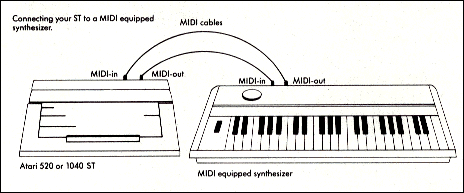
This made the Atari ST the preferred machine for professional musicians in Europe.
You can find that intriguing story of why the Atari had MIDI Ports here.
https://midi.org/craig-andertons-brief-history-of-midi
C-Lab’s Background
C-Lab was a German distribution company based near Hamburg. C-Lab distributed music software, most importantly those developed by:
Gerhard Lengeling (lead programmer)
- Classically trained composer
- Co-founder of Emagic and creator of Logic
Chris Adam
- Business partner and co-founder of Emagic
- Expert in classical notation and MIDI processing
Creator’s release was a milestone not just for C-Lab, but for what would become the entire Logic product family.
2. What Made Creator Different from Other Sequencers
At the time, competing MIDI sequencers included:
- Steinberg Pro-24
- Dr. T’s KCS
- Hybrid Arts SMPTE Track
- Roland MC-series hardware sequencers
Creator distinguished itself through four key philosophies:
(1) A Musical Approach
Rather than focusing purely on step-entry or event lists, Creator presented musical phrases as patterns, which could be arranged and repeated like building blocks.
(2) The Track–Pattern–Structure Concept
Creator used a hierarchical structure:
- Tracks = instruments or MIDI channels
- Patterns = musical ideas, loops, or phrases
- Structure = arrangement view (song mode)
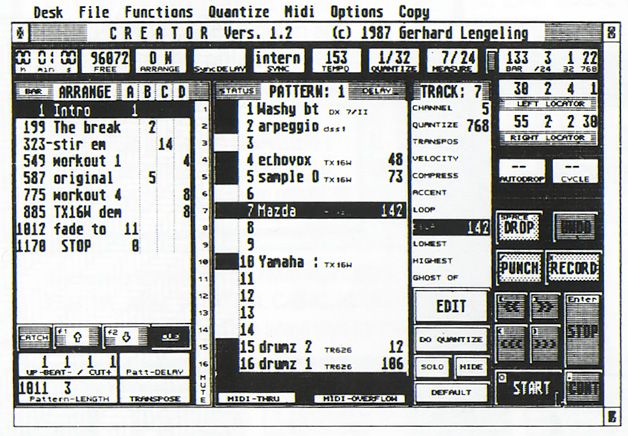
This was highly intuitive and became influential in later DAWs.
(3) Real-Time MIDI Processing
Creator featured tight timing, flexible quantization, and powerful transform tools.
(4) A Deeply Programmable Environment
Unlike other sequencers of the time, Creator included advanced tools allowing users to:
- build custom operations,
- modify MIDI streams in real time,
- apply conditions and constraints to MIDI data.

This made Creator popular among experimental musicians and film composers.
3. Key Features of C-Lab Creator
The Arrange Window
Creator provided a clean layout with patterns displayed horizontally. Musicians could quickly:
- trigger patterns,
- loop sections,
- mute/unmute patterns during playback,
- move blocks in song mode.
This visual metaphor influenced future DAWs, including Cubase and Logic.
Real-Time Quantize
Creator introduced some of the earliest implementations of:
- real-time quantization,
- iterative quantize,
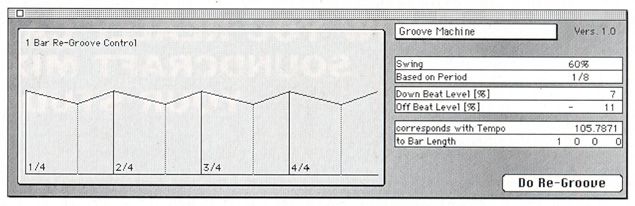
- shuffle/swing feel,
- advanced sync options.
Musicians could audition rhythmic variations instantly.
The Event Editor
Creator allowed detailed editing of:
- note on/off
- velocity
- controllers
- pitch bend
- aftertouch
- program changes
The event list editor was extremely efficient, especially compared with Pro-24’s simpler interface.
Pattern-Based Composition
Patterns could be:
- reused
- transposed
- repeated
- “ghosted” (linked copies updating together)
This workflow encouraged fast composition and remixing.
Advanced MIDI Processing Tools
Creator included:
- Transform operations (if/then processing for MIDI data)
- Groove quantize templates
- Keyboard splits and layers
- MIDI echo and routing filters
These features were years ahead of most competing systems.
Synchronization
Creator supported:
- MIDI Clock
- SMPTE (with optional hardware)
- FSK sync for drum machines
This made it a powerful tool for hybrid analog/digital setups.
4. Creator vs. Notator — What Changed?
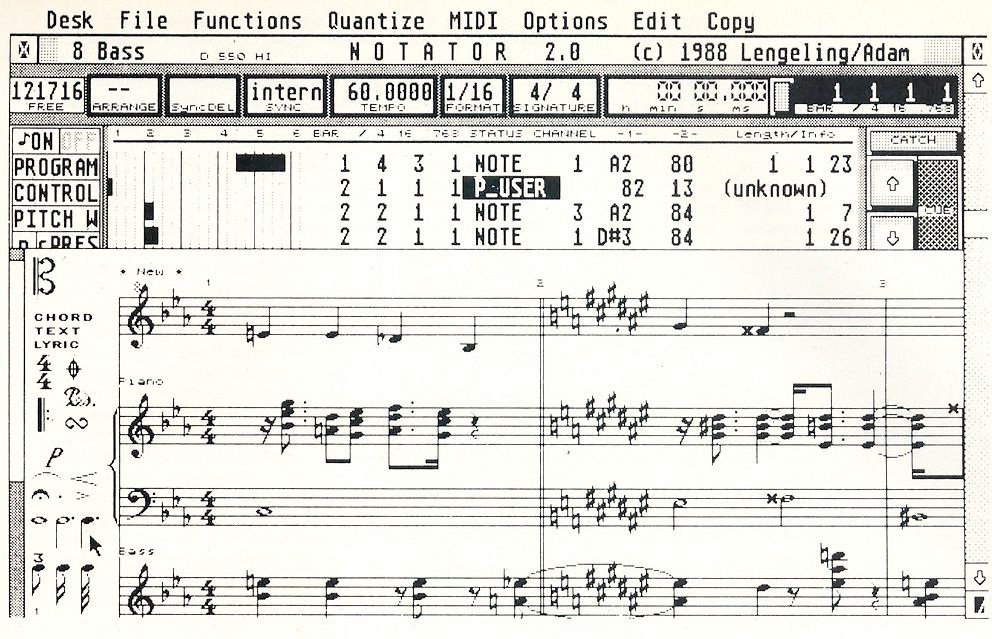
Starting in 1987 Chris and Gerhard created Creator and Notator. These introduced the unique ability to edit the content including notation in realtime during playback. In contrast to most other notation software, Notator’s notation was based on MIDI data, using interpretation algorithms to turn this into readable notation in real-time, even while recording. Notator was originally marketed as “Creator with Notation”, but it quickly surpassed Creator in functionality.
Notable additions in Notator included:
- Full real-time notation display
- Score editing and printing
- Environment-like object processors (articulators, delays, arpeggiators)
- Support for the Unitor and Export hardware expanders

Notator became so popular that Creator was eventually phased out by the early 1990s.
5. Influence and Legacy
Logic’s Architecture Is Built on Creator’s Concepts
Notator Logic (1993) inherited the:
- track → region → arrangement hierarchy,
- MIDI processing philosophy,
- transform tools,
- hyper editing concepts,
- Environment-like routing (from Notator SL).
Creator is effectively Logic Pro’s grandfather.
Creator Dominated European Music Studios
Creator and Notator were particularly prominent in:
- Germany
- France
- UK
- Scandinavia
They were widely used by:
- electronic musicians,
- film composers,
- pop producers,
- arrangers needing notation (when they upgraded to Notator).
Creator Influenced Competing DAWs
Cubase’s arrange window and track-based editing arrived after Creator and were shaped partly in response to it.
Creator Established the Atari ST as the Musician’s Computer
Without C-Lab, the Atari ST may never have become the standard platform for MIDI sequencing.
6. Who Used Creator?
Creator and Notator were widely used by influential musicians and producers, including:
- Jean-Michel Jarre
- Alan Parsons
- Pet Shop Boys
- Vangelis (via Notator)
C-Lab Hardware: Unitor, Export, and Human Touch
Alongside its groundbreaking Creator and Notator sequencing software for the Atari ST, C-Lab developed a small but influential range of hardware devices. These units extended the Atari’s MIDI capabilities, improved synchronization, and added expressive “humanizing” features that set C-Lab’s ecosystem apart from many competitors of the era.
Unitor and Unitor-2
Unitor was C-Lab’s flagship expansion box, designed to enhance the Atari ST’s MIDI and sync capabilities for professional studios using Creator or Notator.
Key features included:
- Additional MIDI outputs for multi-port setups without long daisy chains,
- SMPTE timecode support for film, TV, and post-production work,
- MIDI routing and Thru enhancements tightly integrated with C-Lab’s software, and
- Very accurate timing via direct communication with M-ROS (C-Lab’s MIDI Real-time Operating System).
Unitor-2 refined the original design with improved reliability and extended sync options. It became a standard accessory in high-end Notator studios, especially for composers using multiple Atari ST systems in parallel.
Export
Export was a more affordable MIDI expansion unit focused on increasing the number of available MIDI ports without the additional sync features of Unitor.
It offered:
- Three extra MIDI outputs for larger multi-instrument rigs,
- Tight multi-port integration directly recognized by Creator and Notator, and
- A cost-effective way to build complex MIDI setups when SMPTE sync was not required.
Export made professional multi-port MIDI configurations accessible to a wider range of studios and live performers.
Human Touch (HT)
Human Touch was one of C-Lab’s most innovative performance-oriented accessories. Instead of focusing on I/O expansion, it was designed to add expressiveness and realism to MIDI sequences.
Human Touch provided:
- Micro-timing variations that introduced subtle rhythmic fluctuations,
- Velocity shaping to simulate natural dynamic changes, and
- Groove and “humanization” algorithms that altered timing and dynamics across patterns.
Long before “humanize” and groove engines became standard in modern DAWs, Human Touch offered an early hardware-based approach to making MIDI performances feel less mechanical and more like a live musician.
Hardware and MIDI:A Tight Integration
What made C-Lab’s hardware especially powerful was its tight integration with the MIDI engine that underpinned Creator and Notator. This combination provided:
- Low-latency, multi-port MIDI transmission under heavy loads,
- Deterministic timing critical for dense arrangements and film scoring, and
- Reliable SMPTE and clock sync for hybrid analog/digital studios.
Together, Unitor, Export, and Human Touch helped turn the Atari ST into one of the most precise and dependable MIDI sequencing platforms of its time.
Historical Sidebar: From C-Lab Hardware to Logic’s AMT Technology
The design principles behind C-Lab’s hardware for the Atari ST directly influenced later developments in Emagic’s and Logic’s MIDI timing technologies.
When C-Lab’s core team, including Gerhard Lengeling and Chris Adam, went on to form Emagic, in 1992 they brought with them a deep understanding of what professional users expected from a MIDI sequencing system:
- Multiple independent MIDI ports,
- Very tight and predictable timing, and
- Close integration between hardware and software layers.
On Macintosh and Windows, the Atari ST’s built-in MIDI ports no longer existed. To achieve similarly precise timing on general-purpose operating systems, Emagic introduced AMT (Active MIDI Transmission).
AMT applied many of the same ideas that had made C-Lab’s environment so reliable:
- Scheduling MIDI events ahead of time to reduce jitter,
- Offloading timing-critical tasks to dedicated hardware or driver-level processes, and
- Maintaining consistent timing across multiple MIDI ports and interfaces.
In effect, AMT was the cross-platform, modern successor to the tight software–hardware integration pioneered by C-Lab’s Notator/Creator + Unitor/Export systems on the Atari ST.
This lineage can be traced clearly:
- C-Lab Creator/Notator + Unitor/Export on Atari ST
- → Emagic Logic on Mac/Windows with AMT for tight MIDI timing
- → Logic Pro in the Apple era, building on that same focus on precise timing and integrated hardware support.
From C-Lab’s hardware boxes to Logic’s AMT architecture, the underlying goal remained the same: deliver MIDI timing that musicians could trust, even under demanding professional conditions.
7. Why Creator Ended
Creator’s discontinuation was due to several factors:
- The Atari ST market collapsing in the 1990s,
- The transition to cross-platform development,
- The founders forming Emagic to launch Logic for Mac & Windows.
Creator’s DNA continues—directly—in Logic Pro.
8. In Summary
C-Lab Creator was one of the most important MIDI sequencers in history.
It introduced:
- pattern-based sequencing,
- advanced MIDI transforms,
- real-time quantization,
- modular processing concepts,
- efficient notation integration (in its Notator successor).
Creator → Notator → Notator Logic → Logic → Logic Pro
A clear evolutionary line that still shapes music production today.
But the world was already shifting. The Atari platform, hugely popular with musicians in the 1980s due to its built-in MIDI ports, was beginning to fade. Lengeling recognized the need for a new, platform-agnostic, future-proof generation of tools.
This vision would lead to the founding of Emagic.
Emagic: A New Company for a New Era

In 1992, Gerhard Lengeling co-founded Emagic GmbH in Rellingen, Germany, together with Chris Adam. They hired a small team of talented developers who shared his commitment to musical sophistication and technological precision. The new company’s mission was bold: create a next-generation sequencer for Mac and Windows that combined the strengths of notation, track-based sequencing, and emerging digital audio recording.
The result was Notator Logic, soon renamed simply Logic.
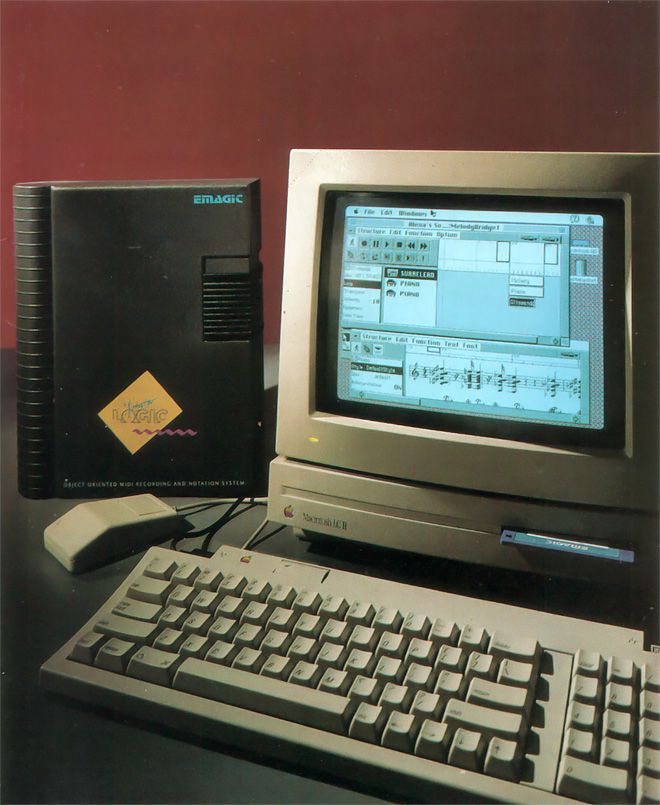
From its earliest versions, Logic stood out. While many sequencers borrowed metaphors from tape machines, Logic treated the computer itself as a compositional environment—structured, modular, and open-ended. Early innovations included:
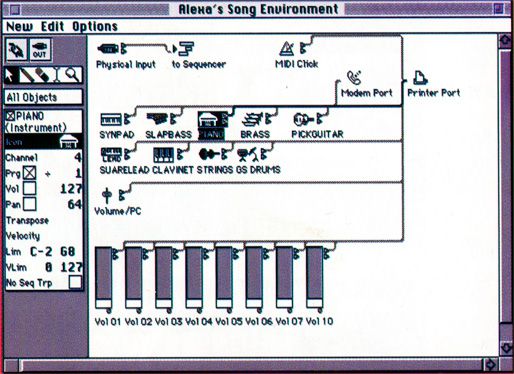
- The Environment, a modular patching system allowing users to build custom MIDI processors, arpeggiators, layers, and control schemes years before modular software became fashionable.
- Object-based editing, which treated every region of a composition as a flexible, independent entity.

- Hyper Editing, providing detailed control of MIDI events through graphical lanes.
- Seamless integration of notation and sequencing, honoring Lengeling’s classical roots.

In 1993–94, as Logic matured, it quickly gained traction among power users, film composers, and experimental musicians. Its depth was unparalleled, and Lengeling’s musical instincts permeated the workflow: every feature felt designed to serve composers, arrangers, and performers, not just technicians.
The Dawn of Digital Audio and the Rise of Logic
By the mid-1990s, digital audio recording was becoming essential. Emagic embraced this shift aggressively. With Logic Audio, the company fused MIDI sequencing with multitrack audio recording, editing, and processing—blurring the line between sequencer and full DAW.
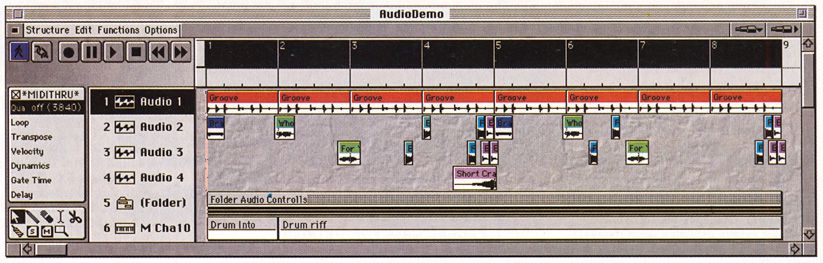
This period saw several landmark developments:
- Emagic’s proprietary audio engine, renowned for efficiency and stability.
- Integration of third-party plug-in formats, enabling composers to work with new generations of virtual instruments.
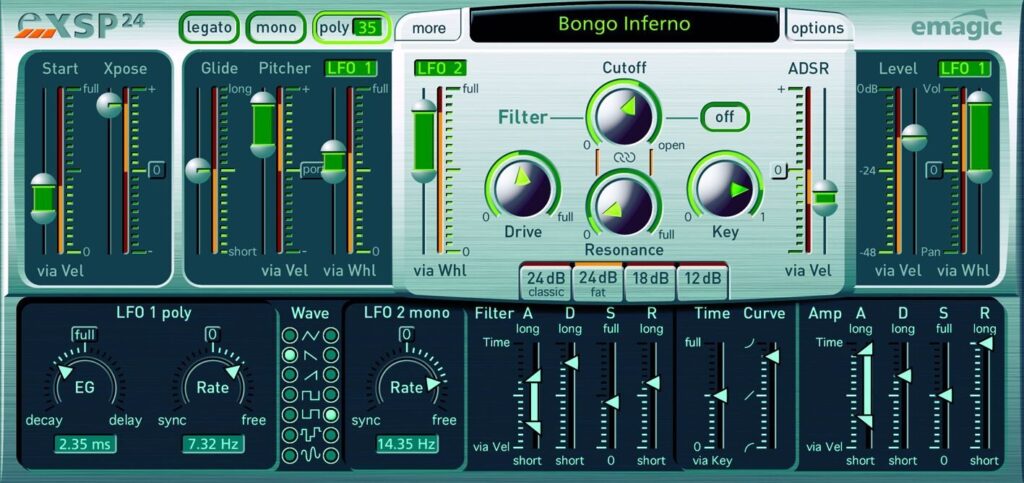
- ES1, ES2, and EXS24, Emagic’s own synthesizers and sampling engines, which helped establish the modern soft-synth and sampler paradigm.
- The concept of a holistic “virtual studio” ecosystem, long before the term became industry standard.
Throughout this explosive decade of innovation, Lengeling served as a guiding force—balancing deep musicality with a rigorous engineering culture. Emagic grew from a tiny start-up into one of Europe’s most respected audio-software companies, with offices in Germany, the U.S., and the U.K., and with Logic used by leading composers from Hollywood to Hamburg.
Apple’s Acquisition: A Turning Point in Music Technology
In July 2002, Apple acquired Emagic, making it the first audio software company ever purchased by a major global tech firm. The acquisition was historic for several reasons:
- Logic became the only Apple-owned DAW, eventually positioning it alongside Apple’s growing multimedia suite.
- It marked the end of Logic for Windows, solidifying Apple’s strategy around Mac-based creative workflows.
- It brought Gerhard Lengeling and key Emagic engineers into Apple, where their innovations would help shape the future of music production for decades.
Under Apple’s umbrella, Logic underwent a dramatic evolution. Lengeling and his team contributed to:
- The complete modernization of Logic’s user interface
- The introduction of Logic Pro 7, 8, 9, and later Logic Pro X and Logic Pro on Apple silicon, each expanding the creative toolkit,
- Integration with GarageBand, shaping how millions of new creators first encountered MIDI and multitrack production,
- Development of MainStage, empowering performers with flexible real-time control

- Expansion of Logic’s library of virtual instruments, effects, and creative tools.
Lengeling became a key figure in Apple’s Music Applications Group, helping guide design philosophy and long-term vision while ensuring that Logic retained its identity as a musician’s tool.
Gerhard Lengeling’s Influence on Modern MIDI and DAW Culture
Few individuals have contributed as much to the evolution of MIDI in the computer age as Gerhard Lengeling. His work impacted nearly every stage of the ecosystem:
MIDI Editing Paradigms
Tools like Hyper Draw, the Environment, and object editing shaped how musicians visualize and manipulate MIDI data.
Composer-Driven DAW Design
Logic’s blend of notation, sequencing, audio, and synthesis set a template for today’s integrated production workflows.
Modular Thinking and Flexibility
The Environment foreshadowed today’s modular hosts, nodal workflows, and MIDI FX architectures used across the industry.
Large-Scale Creative Ecosystems
Lengeling’s work at Apple helped tie hardware, operating systems, and music applications into a unified creative platform.
Across genres—from classical composition to EDM, film scoring, pop production, and sound design—Logic has been a foundational tool for millions of artists. Its continued success is inseparable from the musical and technical values Lengeling embedded from the beginning.
Emagic’s Legacy Today
Though Emagic as a company no longer exists, its DNA is everywhere:
- In Logic Pro, now available on both Mac and iPad,
- In GarageBand, which brought MIDI and multitrack workflows to the masses,
- In Apple’s expanding creative ecosystem, from MainStage to Logic Remote, and
- In design paradigms adopted and adapted by almost every major DAW.
The spirit of Emagic—musical, precise, inventive, and user-focused—remains embedded in every new update.
And at the center of that legacy is Gerhard Lengeling.
Honoring a Pioneer at NAMM 2026
As the MIDI Association presents Gerhard Lengeling with its Lifetime Achievement Award at the 2026 NAMM Show, the global music community recognizes a pioneer whose work enabled an entire era of computer-based music creation.
He helped invent one of the world’s most important DAWs.
He shaped how musicians interact with MIDI.
He bridged classical tradition and future-facing technology.
And he empowered millions to turn musical ideas into expressive realities.
Gerhard Lengeling’s contributions are not just historical—they continue to define the present and inspire the future of music creation.
Editor’s Note- The images from this article are from https://www.muzines.co.uk/. They have digitized and perserved the articles from many UK music magazines from the 1970, 1980 and 1990s.
Another important resource was https://www.soundonsound.com/ who The MIDI Association partners with for The MIDI Innovation Awards.
Here are links to the historical articles used for researching this article.
https://www.muzines.co.uk/articles/c-lab-creator/2538
https://www.muzines.co.uk/articles/c-lab-notator-v3-0/7408
https://www.muzines.co.uk/articles/a-touch-of-magic/10580
https://www.muzines.co.uk/articles/c-lab-human-touch/5689
https://www.soundonsound.com/daw-software/logic?f%5B0%5D=node%253Afield_section%3A6970