

At the Music Hackspace Boston Hackathon in June 2026, composer and technologist Rob Jaret received the MIDI Association-sponsored Most Accessible Product award for Emotional Magenta, an innovative project that explores how facial expressions and emotional input can be used to create and shape music.
Emotional Magenta is based on Google DeepMind’s Magenta Realtime 2 Collider, but Jaret’s version adds a new layer of human expression. The project uses facial analysis to assess changes in a user’s emotional state. When the detected emotion changes, that information is sent to an altered version of Collider, where an Emotional Input node changes the musical prompt and influences the generated music.
The result is a compelling example of how AI, accessibility, and music technology can work together. Instead of requiring a traditional keyboard, mouse, instrument, or controller, Emotional Magenta suggests a future where someone with severe physical or verbal limitations could express themselves musically through facial expression and emotion.
From Film Scoring to Accessible Music Technology

Rob Jaret is a Boston-based contemporary composer who writes primarily for film, dance, theater, games, and other collaborative arts. He has written and orchestrated music for more than fifteen PBS productions and independent films, including Edgar Allan Poe: Buried Alive, Henry Ford, War of the Worlds, The Wall: A World Divided, and Our Mockingbird.
His background also includes music for theater, dance, video games, commercials, and documentary film. Jaret studied film scoring and jazz piano at Berklee College of Music, studied classical composition at Longy School of Music, and holds a degree in physics with a minor in astronomy from Rensselaer Polytechnic Institute. That combination of music, science, and collaborative media made him especially well suited to explore the expressive possibilities of AI-driven music tools.
How Emotional Magenta Works
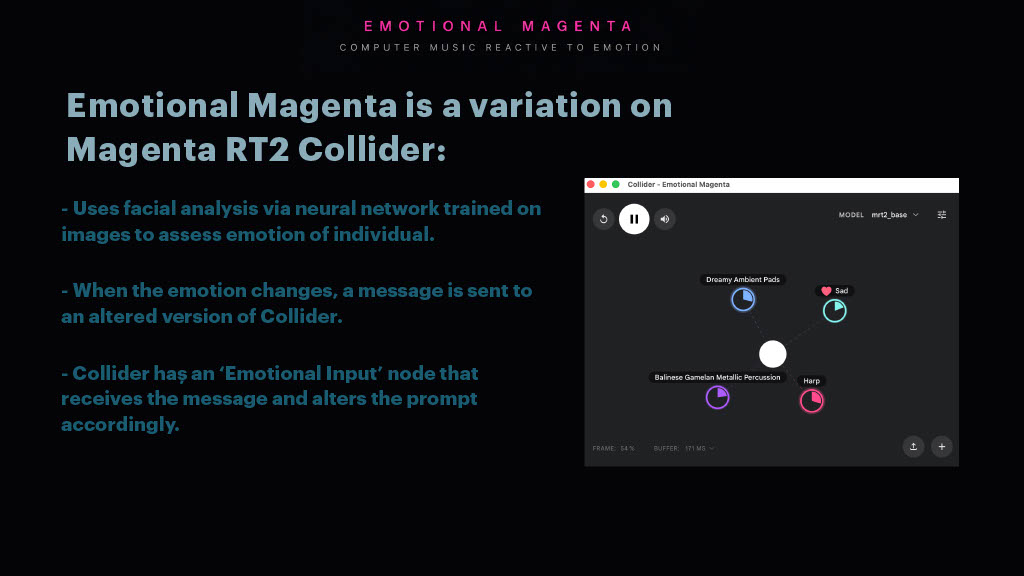
In the Emotional Magenta prototype, facial analysis is used to identify emotional changes in the performer or participant. Those changes are translated into messages that affect the generative music system. The system does not simply play a fixed piece of music. Instead, it reacts to the emotional input and changes the musical direction through prompt-based control.
This is important because many alternative controllers focus on parameters such as pitch, tempo, genre, or triggering sounds. Emotional Magenta points toward a different kind of control: direct influence over the emotional character of the music. A performer might not need to press a key, move a fader, or speak a command. A change in facial expression could become a meaningful musical gesture.
A New Path for Accessible Musical Expression
The accessibility implications are significant. For musicians or music lovers with limited mobility, limited speech, or other barriers to traditional music-making interfaces, Emotional Magenta suggests another path into creative participation. Facial expression and emotional response could become part of the performance interface.
The project also raises interesting possibilities for music therapy. Rather than simply mirroring a user’s emotional state, a future version could guide the user through a musical journey. For example, the system might respond to a negative emotional state by gradually shifting the music through a series of carefully designed prompts, helping the listener or participant move toward a calmer or more positive state.
Reading the Room
Jaret’s presentation also describes another possible application: using emotional input from multiple people in a performance space. Some facial-expression analysis systems can detect multiple faces from one camera. In a future live performance environment, a performer, DJ, or “prompt jockey” could use aggregated emotional information from different parts of a room to guide the music.
In that scenario, the audience becomes part of the musical feedback loop. The system could help the performer understand how people are responding in real time and use that information to shape the experience. This points to a new kind of interactive performance where audience emotion is not just observed after the fact, but becomes part of the creative process.
The MIDI Association and Music Accessibility
The MIDI Association sponsored the Most Accessible Product prize at the Music Hackspace Boston Hackathon to encourage projects that make music creation more inclusive. Emotional Magenta was selected because it shows how accessible design can lead to new musical ideas, not just adaptations of existing ones.
This is central to the mission of the MIDI Association’s accessibility work. MIDI has always been about connection: connecting instruments, computers, controllers, software, and people. As music technology evolves, accessibility must be part of the design process from the beginning. Projects like Emotional Magenta show that when accessibility is treated as a creative driver, the result can benefit everyone.
Emotional Magenta demonstrates a powerful idea: the future of music technology is not only about faster systems, smarter models, or more realistic sounds. It is also about creating new ways for more people to express themselves through music.
Why This Matters
AI music tools are often discussed in terms of automation, productivity, or content generation. Emotional Magenta reframes the conversation around access, agency, and human expression. It asks what happens when a music system responds not only to notes or commands, but to the emotional signals of the person using it.
For the MIDI Association, this is exactly the kind of experimentation that helps define the next generation of music technology. The goal is not to replace musicians, but to expand who can participate in music-making and how musical ideas can be expressed.
Congratulations to Rob Jaret on winning the MIDI Association’s Most Accessible Product award, and to Music Hackspace, Berklee, and the hackathon organizers for creating a space where artists, engineers, researchers, and accessibility advocates could build the future of music technology together.