
Curated MIDI 2.0 Resources For Developers
The following list resources is not exhaustive but gives a thorough sampling and indication of where to start as a MIDI 2.0 Developer.
After you develop a MIDI 2.0 product, you may want to apply to use the MIDI 2.0 logo displayed above.
The MIDI 2.O Logo Is Available To Any company that:
- Is either a corporate member in good standing of The MIDI Association or pays the requisite fee for non-member usage
- Determines a product qualifies for the MIDI 2.0 logo
- Signs the MIDI Association Logo Licensing Agreement
- Self-certifies that the product meets the MIDI 2.0 logo requirements
- Completes and Submits the MIDI 2.0 Logo Implementation Checklist for the Product
Can companies and individuals make MIDI 2.0 products without signing the logo license agreement?
- You do not need a license to create a MIDI 2.0 product, only to use The MIDI Association’s logo and to be listed on The MIDI Association’s website
- Yes, The MIDI Association provides all of the MIDI 2.0 specifications on our website at no charge
- MIDI is free to use and always will be
- There are free open source resources available to help
Specifications
- Core Specs (Contains following specifications)
- MIDI 2.0 Specification Overview
- MIDI Capability Inquiry (MIDI-CI)
- Common Rules for MIDI-CI Profiles
- Common Rules for MIDI-CI Property Exchange
- Universal MIDI Packet (UMP) Format and MIDI 2.0 Protocol
- MIDI Clip File Specification (Standard MIDI File format for UMP)
Blog Posts
- All MIDI 2.0 Developer Blog Articles
- MIDI2.dev: Open-Source Resources for MIDI 2.0 Developers (Includes discussion and links)
- MIDI Workbench
- AmeNote ProtoZoa
- AM_MIDI2.0LIB
- NI-MIDI2
- AmeNote TUSB_UMP Device Driver for TinyUSB
- USBMIDI2DESCRIPTORBUILDER
- Building a USB MIDI 2.0 Device
MIDI 2.0 in Operating Systems
Microsoft Windows MIDI 2.0 Information
Developer Discussions: http://aka.ms/mididiscord
Developer Downloads: https://github.com/microsoft/MIDI
Apple MIDI 2.0 Information
https://developer.apple.com/documentation/coremidi/midi_services/incorporating_midi_2_into_your_apps
Android MIDI 2.0 Information
https://developer.android.com/reference/android/media/midi/MidiUmpDeviceService
Linux MIDI 2.0 Information
https://docs.kernel.org/sound/designs/midi-2.0.html
MIDI 2.0 in DAWs and Plugins
MIDI 2.0 in Cubase
MIDI 2.0 in Logic
MIDI 2.0 In MultitrackStudio
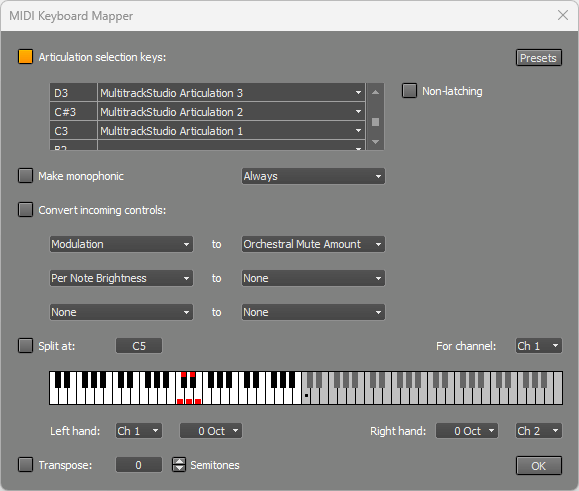
https://www.multitrackstudio.com/version10.php
The DAW WG, Plugins and MIDI 2.0
The MIDI Association Helps Connect DAWs and Plugin Developers
Plugin developers benefit from industry alliances
The MIDI Association member companies that develop plugin formats – Apple (Audio Units), Avid (AAX), Bitwig (CLAP) and Steinberg (VST) are working together to develop open-source software that will enable plugin developers to quickly and easily interface with external MIDI gear without the need for any in depth knowledge of MIDI 2.0 or MIDI-CI. Another MIDI Association member supporting this effort is JUCE – the most widely used framework for audio application and plug-in development.
The MIDI Association DAW working group is creating open source software that will look at MIDI 2.0 messages from external devices, extract the information the plugin needs to support Profiles like the Orchestral Articulation, MPE and Piano profiles and translate those MIDI messages into the native plug formats that plugins already understand.
By utilizing this open source software, plugin companies can start supporting MIDI 2.0 external devices with minimal development costs.
Before Super Booth in May of 2024, The MIDI Association hosted the first meeting of the DAW working group at the Native Instruments office in Berlin, where the companies agreed to work together to develop open-source software available under a permissive MIT license to bridge the gap between external MIDI Devices, Digital Audio Workstations (DAWs), and plugins. That cooperative project is ongoing in the MIDI Association’s DAW Working Group.
The DAW Working Group is also working on a DAW Control Profile which would supersede proprietary control protocols like Mackie Control and Logic control with a true industry standard for controlling DAWs via external hardware and software.
The MIDI Association will report on the weekly meetings of the DAW Working Group at Music China 2024, ADC 2024, and NAMM Show 2025.