
When the MIDI Association recognizes Chris Adam for his lifetime contributions to music technology, the honor celebrates one of the most influential—and often understated—figures in the history of computer-based music creation. As a co-founder of Emagic, Adam helped build the software foundations that shaped professional MIDI sequencing, notation, and digital music production for more than four decades.
Youtube Summary Video
His career is inseparable from one of the most important creative partnerships in MIDI history: his collaboration with Gerhard Lengeling. Together, Adam and Lengeling formed a rare balance of musical insight, technical rigor, and long-term vision—one that carried them from university experiments in Hamburg to tools used by millions of musicians worldwide.

Their story is not only about products like Notator and Logic, but about how collaboration, trust, and shared values can shape an entire industry.
A Meeting of Minds in Hamburg
Chris Adam and Gerhard Lengeling met as university students in Hamburg in the early 1980s, a period when personal computers were just beginning to enter creative spaces. Hamburg, with its strong musical traditions and growing interest in electronic music, provided fertile ground for experimentation at the intersection of music and computing.

Both Adam and Lengeling were musicians with strong technical instincts. They were drawn to the idea that computers could do more than calculate or display text—that they could become tools for composition, performance, and musical thought. This shared curiosity quickly turned into collaboration, and then into friendship.
Their earliest work together reflects the spirit of that moment: exploratory, ambitious, and deeply musician-focused.
Early Software and the Commodore 64
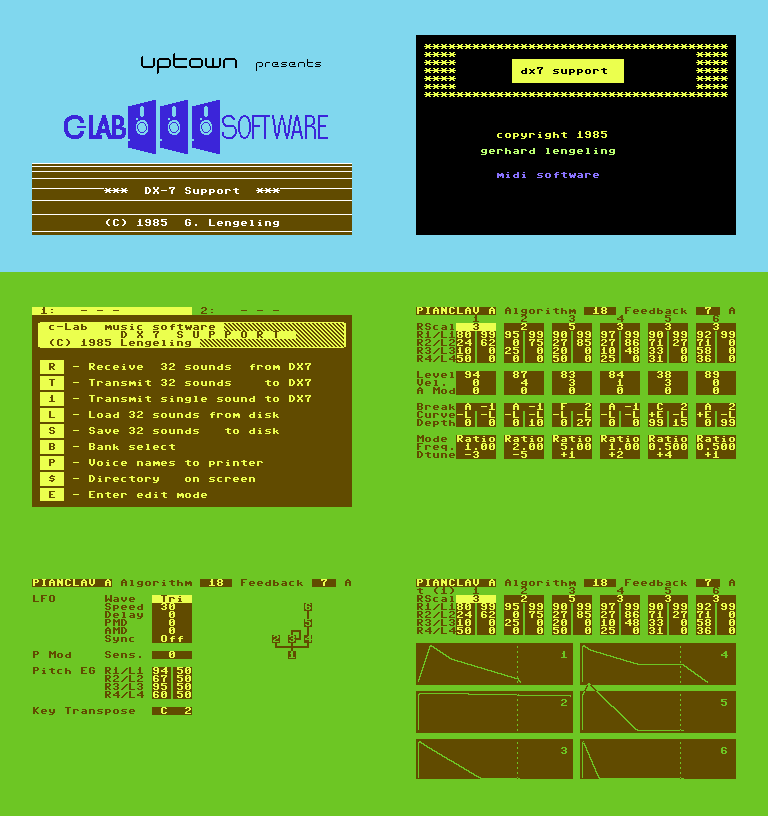
In 1983, the same year the MIDI specification was introduced, Adam and Lengeling developed their first commercial application together: DX7 Support for the Commodore 64. Designed to help musicians manage and organize patches for Yamaha’s revolutionary DX7 synthesizer, the software addressed a real and immediate need.

At the time, manufacturer-supplied tools were limited, and patch management was cumbersome. DX7 Support demonstrated Adam’s practical mindset: identify a musician’s problem, then solve it with software that was reliable, efficient, and approachable.
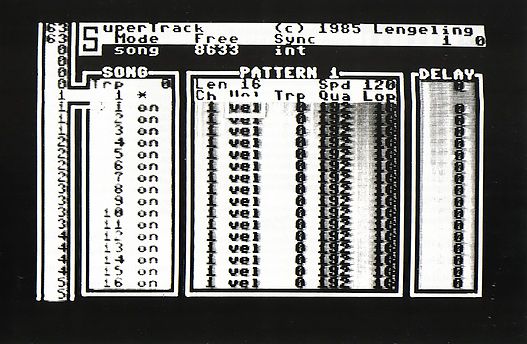
This was followed by additional Commodore 64 applications, including Supertrack, which explored early ideas around sequencing and notation. Even at this stage, Adam’s influence was evident in the careful engineering and usability of the tools, while Lengeling’s musical background shaped how musical structure was represented in software.
These early projects established a pattern that would define their careers: Adam focusing on robust systems, scalability, and implementation, while Lengeling concentrated on musical architecture and creative workflows.
C-Lab and the Atari ST Era
The partnership reached a new level with the rise of the Atari ST, whose built-in MIDI ports made it the platform of choice for musicians across Europe. Through C-Lab, Adam and Lengeling were able to deliver software that took full advantage of the Atari’s capabilities.
Among their most important achievements during this period was Notator, a sophisticated sequencing and notation environment that evolved from earlier C-Lab products. Distributed by C-Lab, Notator became a cornerstone of professional MIDI composition throughout the late 1980s and early 1990s.
For Notator, Lengeling’s sophisticated Creator sequencing was combined with a real time notation system developed by Adam.

Notator’s success depended not only on its musical intelligence, but on its reliability under demanding conditions. Film composers, arrangers, and studio professionals relied on it for timing accuracy, synchronization, and stability—areas where Adam’s technical leadership was critical.
Behind the scenes, Adam helped ensure that C-Lab’s software was:
- Efficient on limited hardware
- Stable under heavy MIDI loads
- Capable of supporting expanding professional workflows
This technical foundation allowed Lengeling’s musical ideas to flourish in real-world studio environments.
From C-Lab to Emagic: A Strategic Leap
As the Atari platform began to decline in the early 1990s, Adam and Lengeling recognized that the future of music software lay beyond any single computer system. Rather than adapting incrementally, they chose to start fresh.
Together, they co-founded Emagic, carrying forward the core ideas of their work distributed by C-Lab while redesigning the software for Macintosh and Windows platforms. This was not a simple porting exercise—it required rethinking architecture, timing, and scalability in far more complex operating environments.

Adam played a crucial role in this transition, helping guide Emagic’s engineering direction as the company built a new generation of software capable of operating across platforms without sacrificing timing accuracy or flexibility.
The result was Notator Logic, soon renamed simply Logic.
Logic and the Modern MIDI Environment
Logic quickly distinguished itself from other sequencers of the era. Its modular design, deep MIDI processing, and object-based architecture reflected years of accumulated insight from the C-Lab period.
Features such as:
- The Environment, allowing users to design custom MIDI routing and processing
- Advanced transformation tools
- Flexible object-based editing
- Integration of MIDI sequencing with emerging digital audio workflows
all depended on a strong technical foundation—one that Adam helped shape.
While Lengeling is often credited with Logic’s musical vision, Adam’s contribution was essential in turning that vision into a scalable, professional-grade product. His work ensured that Logic could grow from a powerful sequencer into a full digital audio workstation without losing the precision that professional users demanded.
A Partnership Built on Trust and Complementary Strengths
One of the most remarkable aspects of Adam’s career is the longevity of his collaboration with Gerhard Lengeling. From their first university projects to the creation of Emagic, their partnership spanned decades—a rarity in the fast-moving world of technology.
Their success came from complementary strengths:
- Lengeling brought deep musical knowledge and a composer’s perspective
- Adam provided classical notation expertise, engineering discipline, system thinking, and long-term technical strategy
Together, they created tools that were both expressive and dependable—qualities that earned lasting trust from the professional music community.
Apple and a Global Impact
In 2002, Apple acquired Emagic, recognizing the strategic importance of music creation software within its ecosystem. For Adam and Lengeling, the acquisition marked the culmination of years of work building tools that had reshaped MIDI production.
Under Apple, Logic evolved into Logic Pro, reaching an even wider audience and influencing products such as:
- GarageBand, which introduced MIDI workflows to millions of new users
- MainStage, extending Logic’s concepts into live performance
- Logic Pro for iPad, bringing professional MIDI tools to new platforms
The architectural decisions made during the Emagic years—many shaped by Adam’s technical leadership—continue to underpin these tools today.
A Lasting Legacy in MIDI History
Chris Adam’s contributions to MIDI are not always visible on the surface, but they are everywhere beneath it—in the stability of professional sequencing systems, in the scalability of modern DAWs, and in the confidence musicians place in software that “just works” when it matters most.
As a co-founder of Emagic, and as a lifelong collaborator with Gerhard Lengeling, Adam helped define what professional MIDI software could be.
Honoring Chris Adam
As the MIDI Association celebrates Chris Adam’s lifetime achievements, it honors:
- A co-founder whose technical leadership enabled groundbreaking musical tools
- A collaborator whose partnership shaped entire generations of software
- A pioneer who set the standard for MIDI notation software and helped carry MIDI from its earliest days into the modern era
Chris Adam’s legacy lives on in every Logic project, every MIDI workflow, and every musician who relies on the tools he helped build—often without ever knowing his name, but always benefiting from his work.