Artware hub KAKEHASHI MEMORIAL, Tokyo — Tuesday 3 November 2026.
MIDI MEETUP 2026 “Music is for Everyone” 〜 すべての人へ音楽の体験を 〜
Date: Tuesday, 3 November 2026, 15:00–18:00
Venue: Artware hub KAKEHASHI MEMORIAL, 3-14-3 Nishi-Waseda, Shinjuku-ku, Tokyo
Admission: Free, by invitation, ticketed through teket
Organisers: Kakehashi Arts and Culture Foundation, the Association of Musical Electronics Industry (AMEI), and The MIDI Association
Theme: Music Accessibility
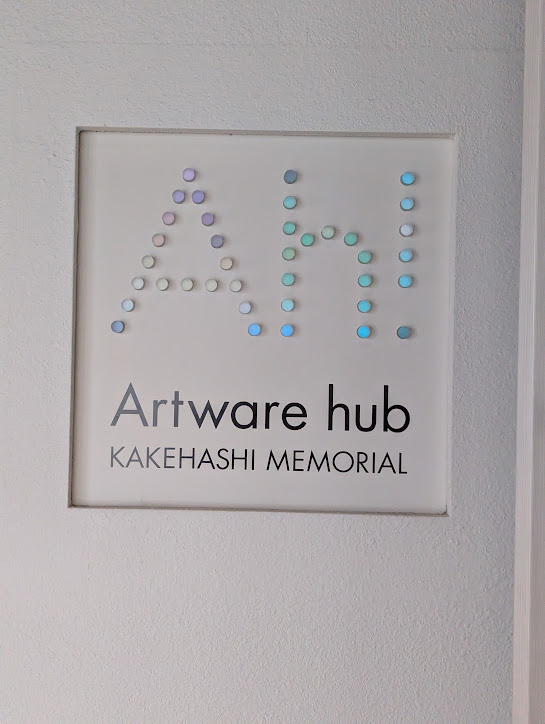
The sign on the wall at Artware hub spells out the building’s initials, AH, in a grid of small raised dots. It reads as braille before it reads as letters.
Nobody put that sign up for this event — it has been there for years. But it was a fitting thing to walk past on 3 November, because MIDI MEETUP 2026 was the first edition of this event built entirely around music accessibility.
MIDI MEETUP has become a fixture of the Tokyo autumn. The MIDI Association, AMEI and the Kakehashi Arts and Culture Foundation run it together at Artware hub each year, and the shape of the week is by now familiar: Music China closes in Shanghai, the Tokyo Gakki Expo follows, and then everyone converges on Nishi-Waseda.
What changed this year was the subject. In 2025 the room was full of MIDI 2.0 products, with engineers from Korg, Roland and Yamaha explaining them and an AMEI presentation on where the specification was heading. Accessibility was present, but as one table among many — Haim Kairy of Arcana Instruments showing the Strum, the Oddball, the Cosmos Dots and the Drum Beam.
In 2026 accessibility was not one table. It was the entire event.
The three organisations settled the theme in August and gave it a title that doubles as an argument: Music is for Everyone 〜 すべての人へ音楽の体験を 〜. The invitation that went out in September, in Japanese and English, put the reasoning in two sentences:
Music is the universal language of the world and MIDI is the universal digital language of music. Everyone should be able to experience the joy of making music.
Ikuo Kakehashi called this edition 最初の試み — a first attempt.
A ramp, and a lowered stage
The most instructive thing about MIDI MEETUP 2026 happened six weeks before the doors opened.
In mid-September, Yuichi Nagata of InstaChord — who works with Sony on percussion for people with hearing impairments — asked whether he could bring an accessibility adviser from his development team who uses a wheelchair. His note included a piece of arithmetic that anyone who has organised an event ought to read twice: a wheelchair user needs two assistants, so with me that’s four people.
The Foundation’s answer came the same day. The entrance to Artware hub is a ramp. For this event the stage would not be raised, so the room would be flat. The one drawback was the toilets, which are out of the hall and round past the entrance reception — the same route as for any event there. And then:
“A situation where it is difficult for wheelchair users to take part in an accessibility event ought not to exist, so I think it will be fine.”
Choosing a theme decides what goes on the walls. Lowering the stage decides who can get onto it. On the day, presenters worked from tables on the flat floor, at the same level as the audience.
On the floor
Exhibition tables opened at 15:00, an hour before the presentations, and stayed open afterwards until 18:00. Nothing was behind glass; the point was to put hands on things.
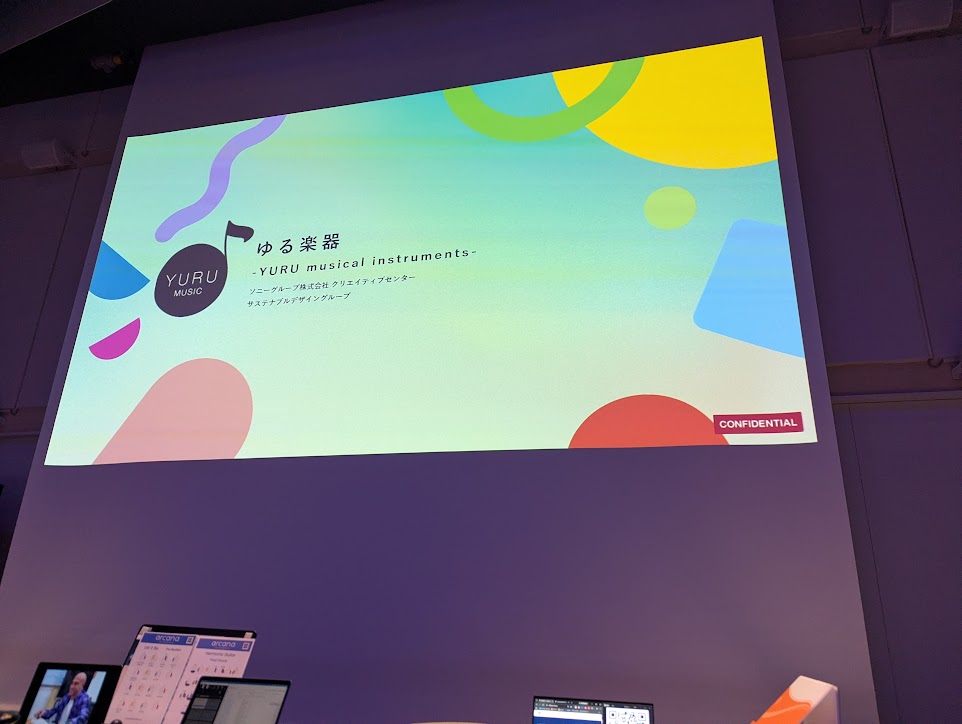
Sony brought ゆる楽器 — the YURU musical instruments developed by the Sony Group Creative Center’s Sustainable Design Group — including the Hug Drum, a percussion instrument co-developed so that people with hearing impairments can play it. Sony had asked specifically to bring working units rather than slides: “we could talk about our work so far, demo the actual units, and let visitors try them.”
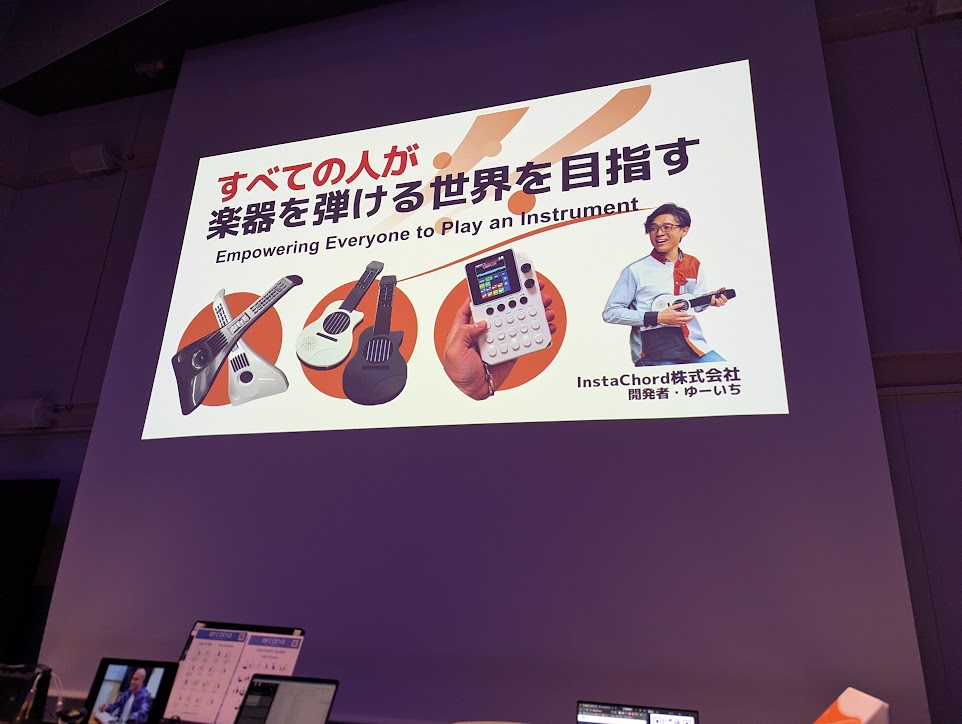
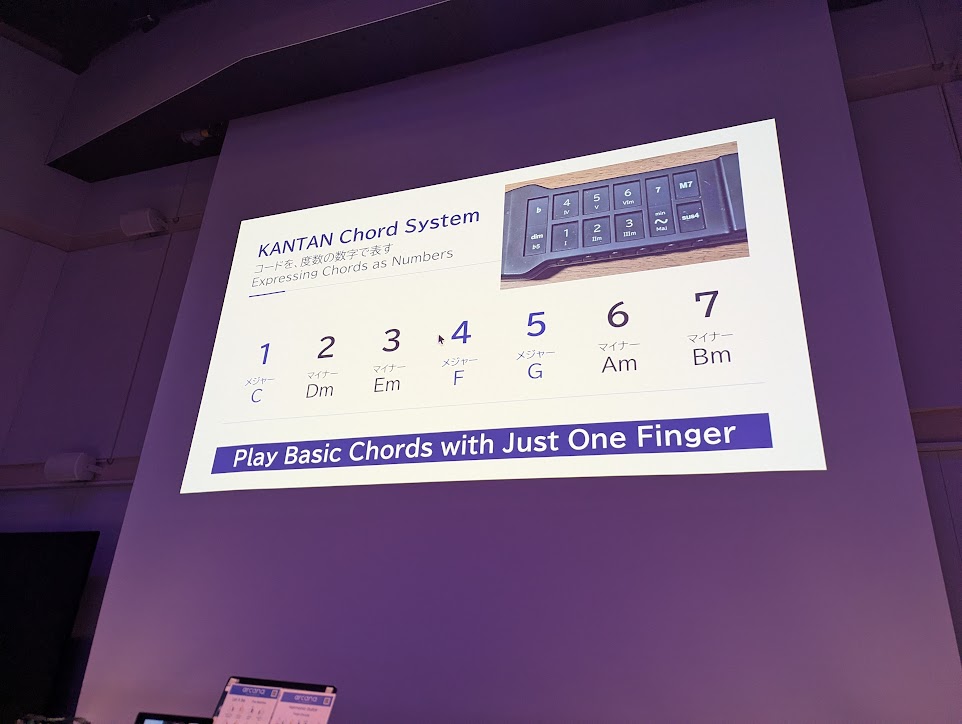
InstaChord came with a slide that could have been the event’s own title card: すべての人が楽器を弾ける世界を目指す — “Empowering Everyone to Play an Instrument.” Alongside the InstaChord itself, developer Yuichi showed the KANTAN Chord System, which expresses chords as scale degrees rather than names — 1 through 7 standing in for C, Dm, Em, F, G, Am, Bm — so that basic chords can be played with one finger, and Strummo.
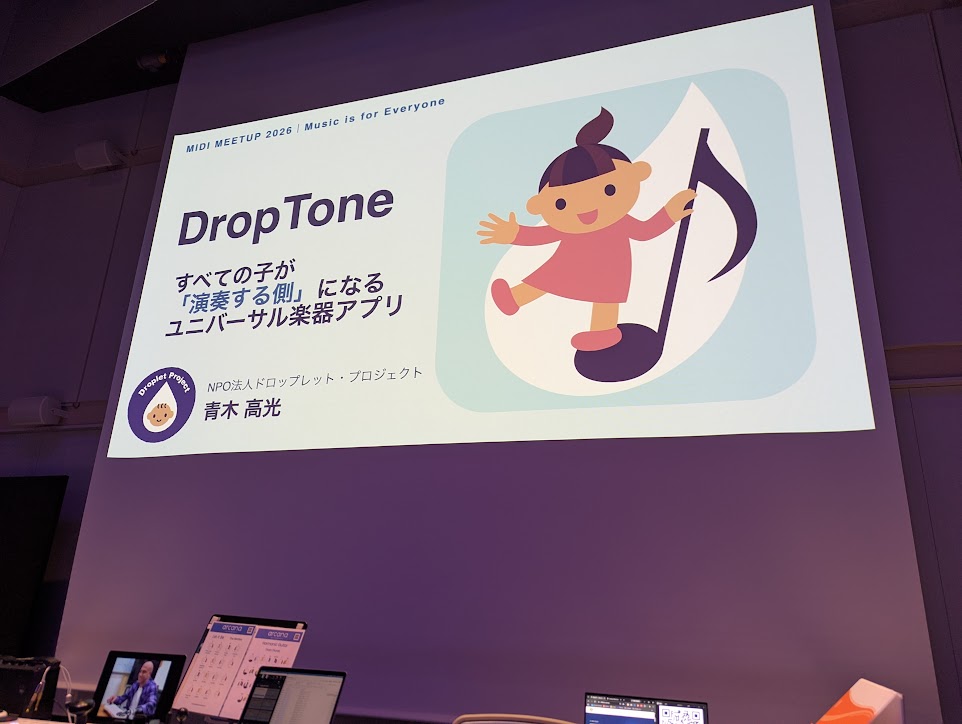
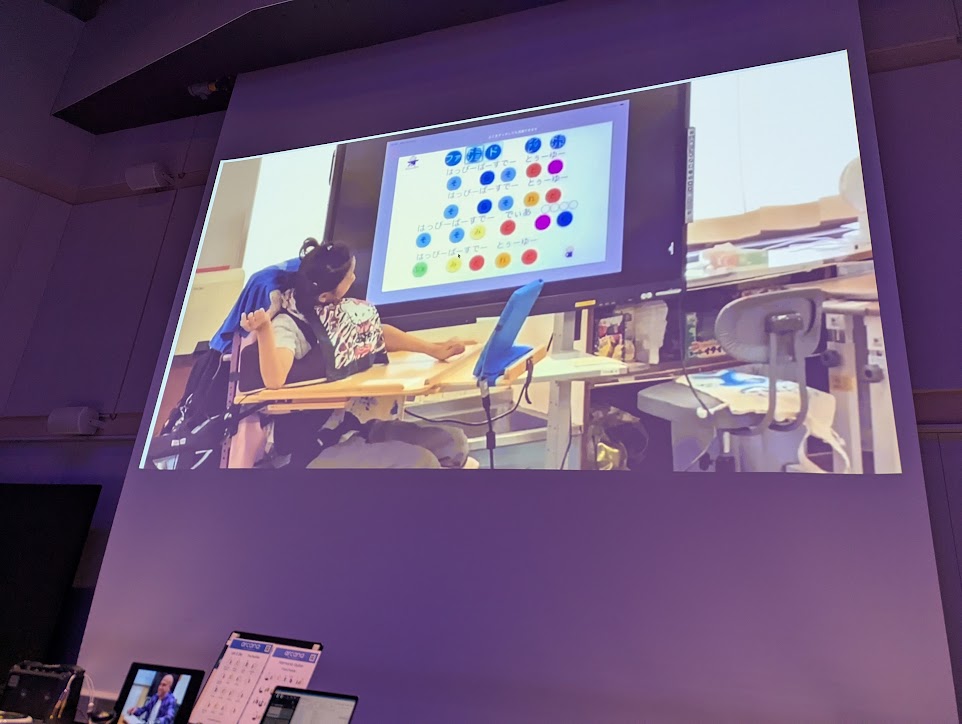
The NPO DROPLET PROJECT, based in Nagano Prefecture, showed DropTone, presented by Takamitsu Aoki and billed as すべての子が「演奏する側」になるユニバーサル楽器アプリ — a universal instrument app that puts every child on the performing side. The slide that made the case was not a product shot but a photograph of a child at a classroom desk, supported in a standing frame, playing a grid of coloured cells on a screen.
Yamaha brought だれでもピアノ — Anyone’s Piano — which has the clearest origin story of anything in the room. It began in 2015 as a collaboration between Yamaha’s R&D division and the Inclusive Arts research group at Tokyo University of the Arts, led by Professor Okiko Arai, who gave it its name. It was built for one person: a high school student with a physical disability who wanted to play Chopin’s Nocturne.
The system pairs a Disklavier with performance tracking and a pedal-driving mechanism. The player picks out the melody with one finger; the instrument follows their timing and tempo, fills in the left hand, and works the pedals. It is not a backing track — it is an accompanist that listens. Patented in 2020, it has since turned out to be just as useful for beginners as for the student it was designed for, which is the pattern this whole event was about.
Yamaha’s だれでもピアノ — Anyone’s Piano
Arcana Instruments returned with the Arcana Strum, Haim Kairy having travelled from Israel by way of Shanghai.
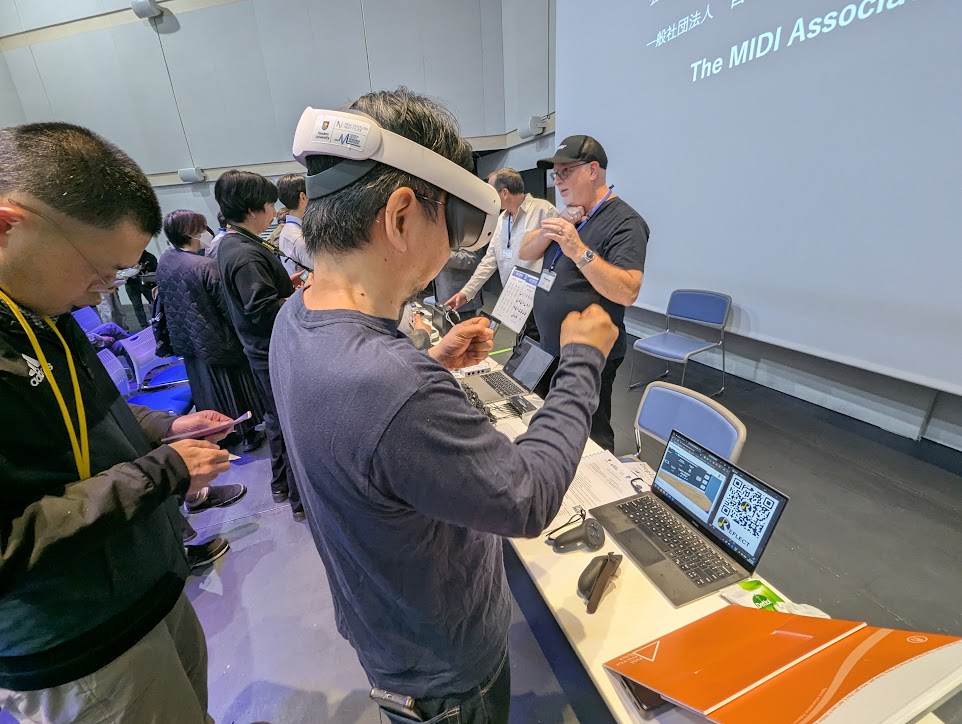
The MIDI Association ran the accessibility system it had been running at Music China the week before — Nathan Turczan’s kiosk build of Connect Through MIDI with the PDF2PDF Performance Data Files setup alongside — and brought REFLECT, the VR project by Thomas Beltrame of Flinders University, which turns arm and hand movement into music as a game built on clinical evidence for people recovering movement. Two headsets ran all afternoon, and the table stayed busy.
The kiosk build matters more than it sounds. It lets a demo run unattended — as Athan Billias put it, you can “use either Connect Through MIDI or the PDF2PDF setup at a trade show and walk away without needing anyone to constantly select songs.” A demo that needs a minder is a demo that stops the moment the minder starts talking to someone.
From the stage
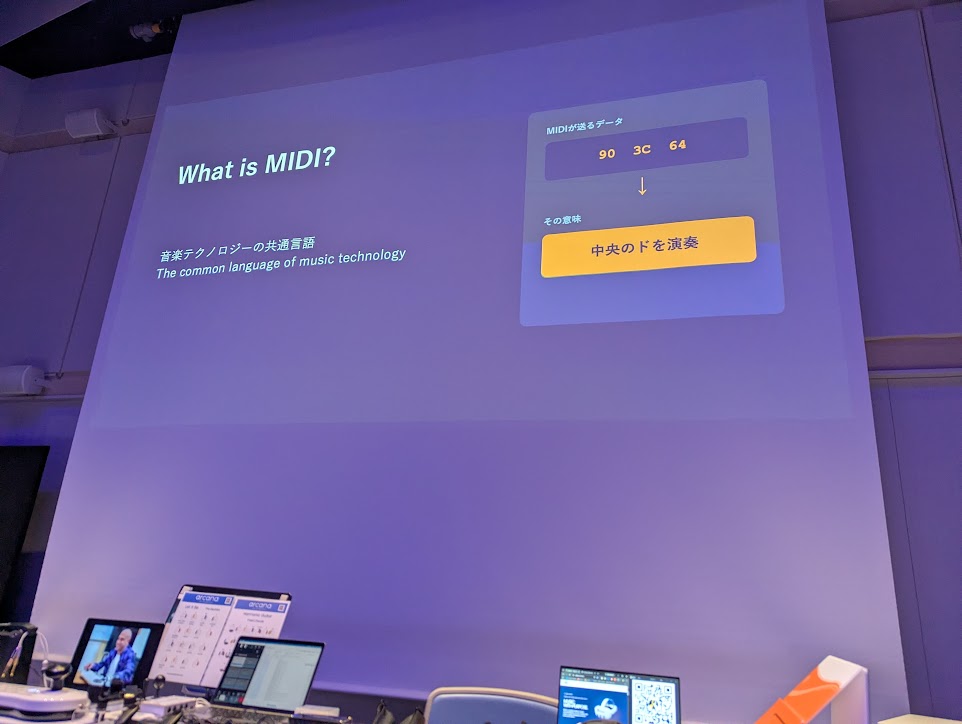
The presentations began at 16:00 with an opening from the Kakehashi Foundation, followed by a deliberately short, deliberately non-technical introduction to MIDI itself, delivered by Takayuki Tomisawa of Roland on behalf of AMEI from a bilingual deck prepared by The MIDI Association.
It made its point with three bytes. On screen: 90 3C 64. Underneath, what those bytes mean — 中央のドを演奏, play middle C. MIDI as 音楽テクノロジーの共通言語, the common language of music technology.
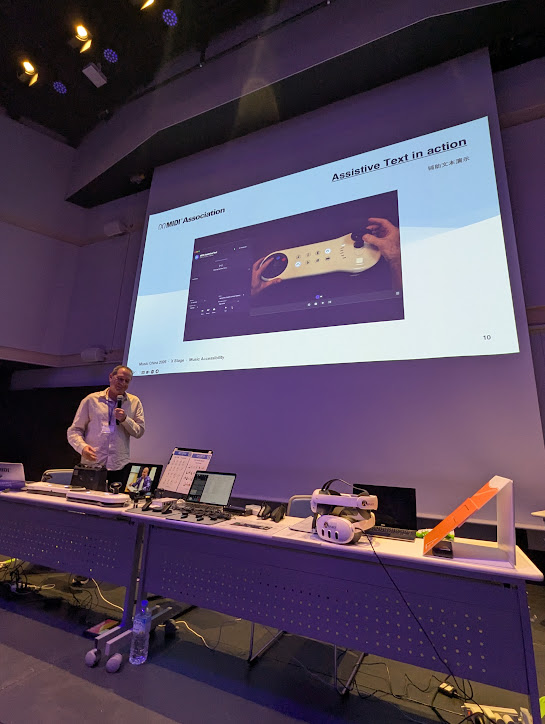
The exhibitors then presented their own work, and the MIDI Association’s slot closed the programme. It opened with the one-minute MASSIG film — the same short the Association had screened at Music China the week before, about musicians with disabilities making music — and then made the argument the rest of the day had been circling: the MIDI-CI Profile for Assistive Text, presented jointly by Mike Kent of AmeNote and Athan Billias.
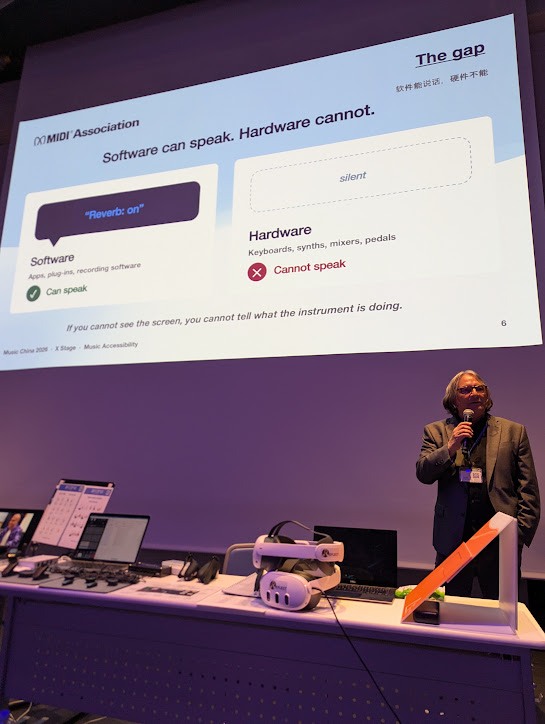
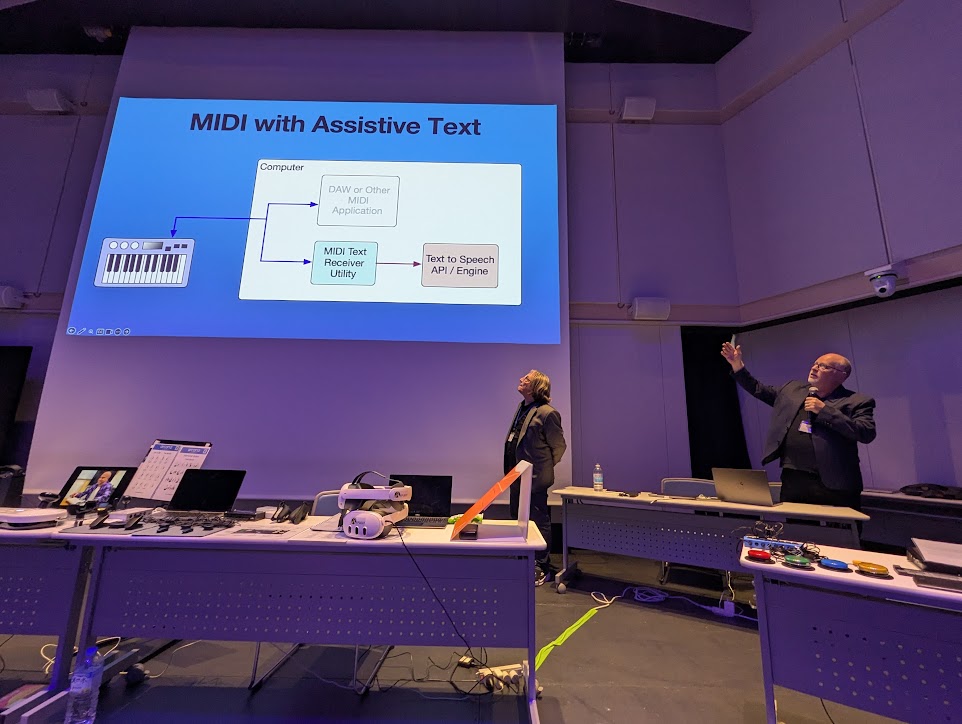
The problem is stated easily. Software can speak — apps, plug-ins and recording software announce themselves to a screen reader, which is why a blind producer can work in a DAW. Hardware cannot. Keyboards, synths, mixers and pedals have screens, menus, LEDs and multi-function controls, and none of it is readable by anything but an eye. If you cannot see the screen, you cannot tell what the instrument is doing.
The proposed fix is narrow, which is what makes it credible. An instrument sends the name of a control and its value as plain text. A small utility on the computer — sitting alongside the DAW rather than inside it — receives that text and passes it to a text-to-speech engine, or to whatever tools the player already uses. The player hears it spoken, feels it in braille, or reads it in large print. Solve text once and all three follow. No new hardware, no separate accessible product line.
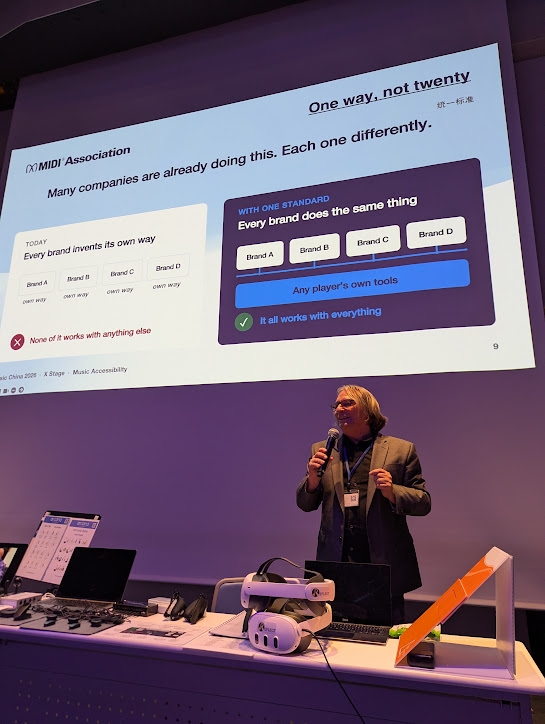
The second half of the argument was about duplication rather than novelty. Several manufacturers already do a version of this, each in a different way, and none of it interoperates — so a player who learns one brand’s approach starts again at the next. One standard, and every brand’s instrument works with every player’s own tools. The hard work gets done once, on everyone’s behalf.
The work is authored by Mike Kent and sits inside MASSIG, the MIDI Association’s Music Accessibility Standard Special Interest Group. The framing the group brought to Tokyo was two-sided and worth repeating: Kent’s half was accessibility from the start of development; the Profile’s half was simply why we need it.
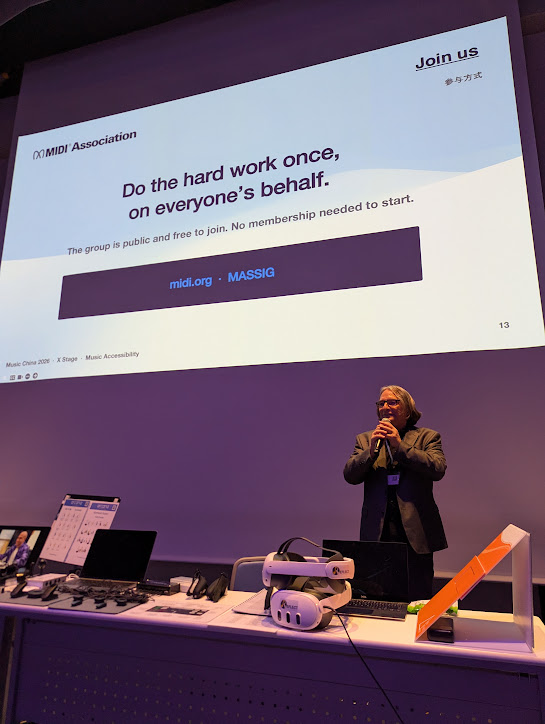
The last slide was an invitation rather than a conclusion. MASSIG is public and free to join, with no membership required to start — and above the link, the sentence that sums up the whole argument for standardising this rather than each company solving it alone:
Do the hard work once, on everyone’s behalf.
Who was there
The MIDI Association contingent came in from Shanghai and from four continents: Athan Billias (Chief Operating Officer), Mike Kent (AmeNote, Canada), Andrew Mee (Australia), Haim Kairy (Arcana Instruments, Israel) and Mike Venter (Azoteq), joined by Thomas Beltrame (Flinders University, Australia) — a 2026 MIDI Innovation Awards entrant, and on his first trip to either China or Japan.
On the Japanese side the event was organised by Tomisawa of Roland, Daisuke Miura and Tsuyoshi Maruyama of Yamaha, Toshihiro Sugawara of Korg, and Shimoyama of the AMEI office, with Ikuo Kakehashi and the Foundation staff hosting.
There was one further piece of event design worth recording, because it says what kind of room the organisers were trying to build. The Foundation’s office wanted strict staff passes. Kakehashi argued them down:
“Personally I don’t think it needs to be that strict. Since this time is also about mingling, I think a pass holder round the neck with your business card in it makes it easier for the public and invited guests to ask questions and strike up a conversation.”
AMEI prepared thirty of them.
And next year
Writing to the organisers two days afterwards, Ikuo Kakehashi was unambiguous:
“I appreciate all of your work on MIDI Meetup 2026 event. It is wonderful opportunity for us to meetup here at Artware hub every year! I believe it was successful and I am so happy to see everyone there share vision and passion. Safe trip back home and we will see next year for sure!”
Planning for MIDI MEETUP 2027 is already under way.
Sources
MIDI_Meetup_2026.docx — Japanese invitation letter, Kakehashi Arts and Culture Foundation, 18 September 2026
MIDI_MEETUP2026_meeting1007.pptx — organising committee minutes, 7 October 2026
Organising correspondence between the Kakehashi Foundation, AMEI and The MIDI Association, August–November 2026
Photographs supplied by Athan Billias, 6 November 2026