

Part 3 of five. The MIDI Association at Music China, Shanghai, 28–31 October 2026.
One face of the Lab 99 booth was given over to the MIDI Innovation Awards: this year’s entries, a QR code to the full list, and — more to the point — several of them sitting on the counter where you could pick them up.
What the awards are
A yearly look at what people are actually building. Run by The MIDI Association, sponsored by NAMM, and open to anyone: students, one-person companies and large manufacturers enter on the same terms.
Six categories:
- Commercial Hardware Products
- Commercial Software Products
- Prototypes and Non-Commercial Hardware
- Prototypes and Non-Commercial Software
- Artistic / Visual Project or Installation
- Best MIDI 2.0 Product
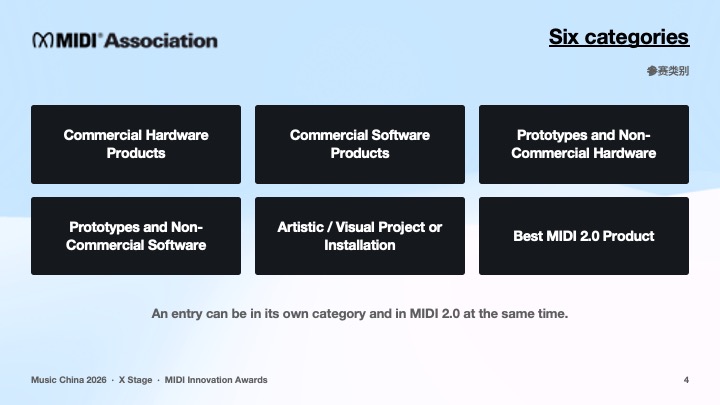
An entry can sit in its own category and in MIDI 2.0 at the same time.
The process is unusual enough to be worth stating plainly. Anyone submits a product, prototype or project at midi.org. Then the public votes — in 2026 voting ran from 8 to 22 September. Then a panel of judges picks each category. Every entry stays on midi.org afterwards, win or not, which is the part most competitions skip.
No product roadmap predicted most of what came through this year.
On the X Stage
The Awards session walked the audience through the 2026 finalists from the Chinese-language deck, with entrants on stage to talk through their own work and a live interpreter alongside.
On stage:
- Lawrence Levine — Executive Board, The MIDI Association
- Thomas Beltrame — REFLECT, Flinders University
- Shi Muyang (时沐阳) — Entropy Music
- Eliot Jackson– MIDI Sketch

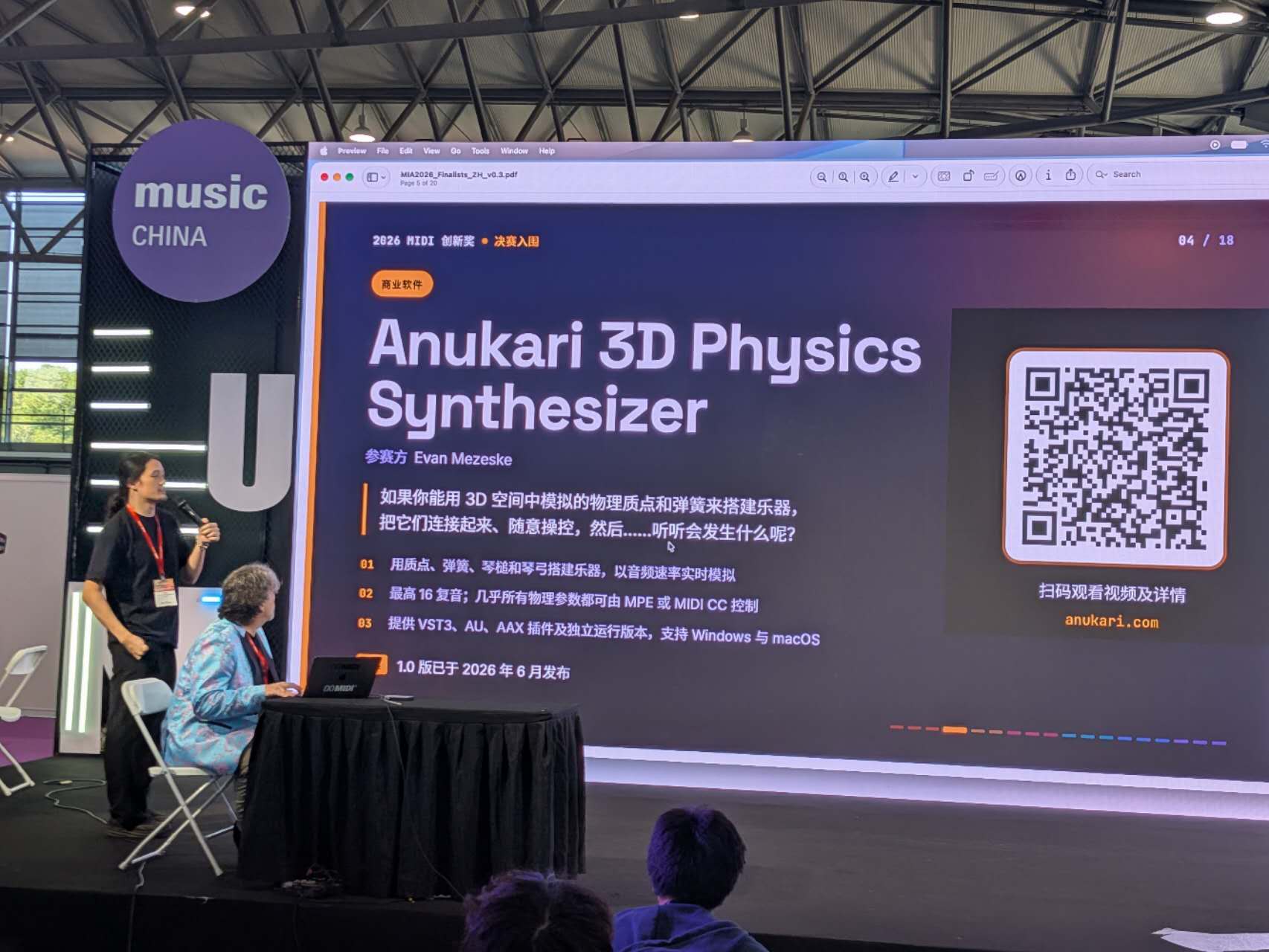
Anukari 3D Physics Synthesizer
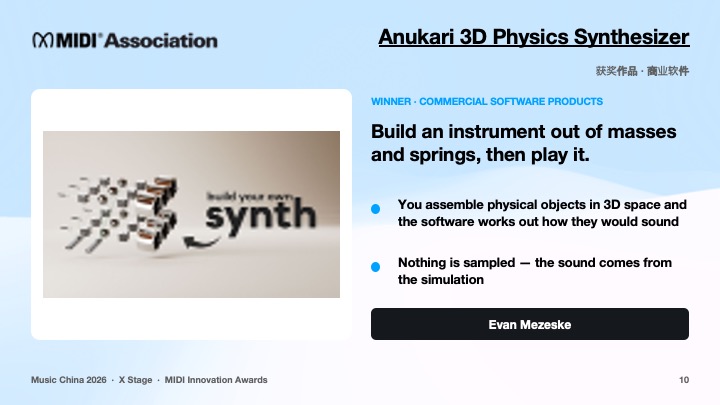
Evan Mezeske · Commercial Software
Assemble physical objects in 3D space — masses, springs, mallets, bows — and the software works out how they would sound, simulated at audio rate. Nothing is sampled; the sound comes out of the physics.
Up to 16-voice polyphony, with nearly every physics parameter controllable over MPE or MIDI CC. Version 1.0 shipped in June 2026 as VST3, AU and AAX plus a standalone, on Windows and macOS.
REFLECT
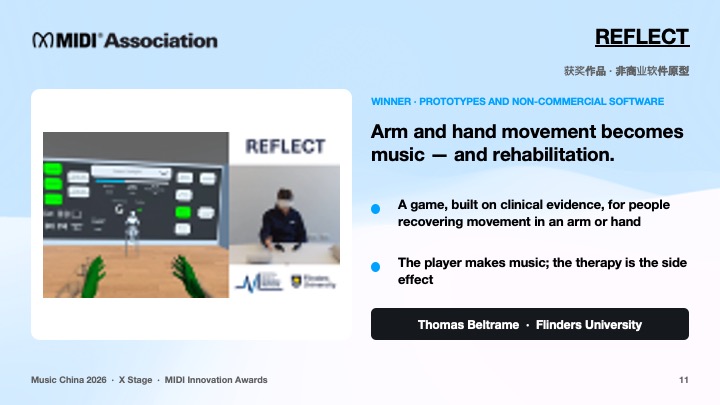
Thomas Beltrame, Flinders University · Non-Commercial Software
REFLECT drew a queue for four days, and it was the clearest demonstration on the stand of where accessibility work is going.
It is a game, built on clinical evidence, for people recovering movement in an arm or hand. Arm and hand movement becomes music. The player makes music; the therapy is the side effect — which is precisely the right way round, and the reason people keep doing it.
Thomas came to Shanghai and ran it himself: a pair of VR headsets beside the Awards wall, and him sitting alongside each visitor as they put one on.

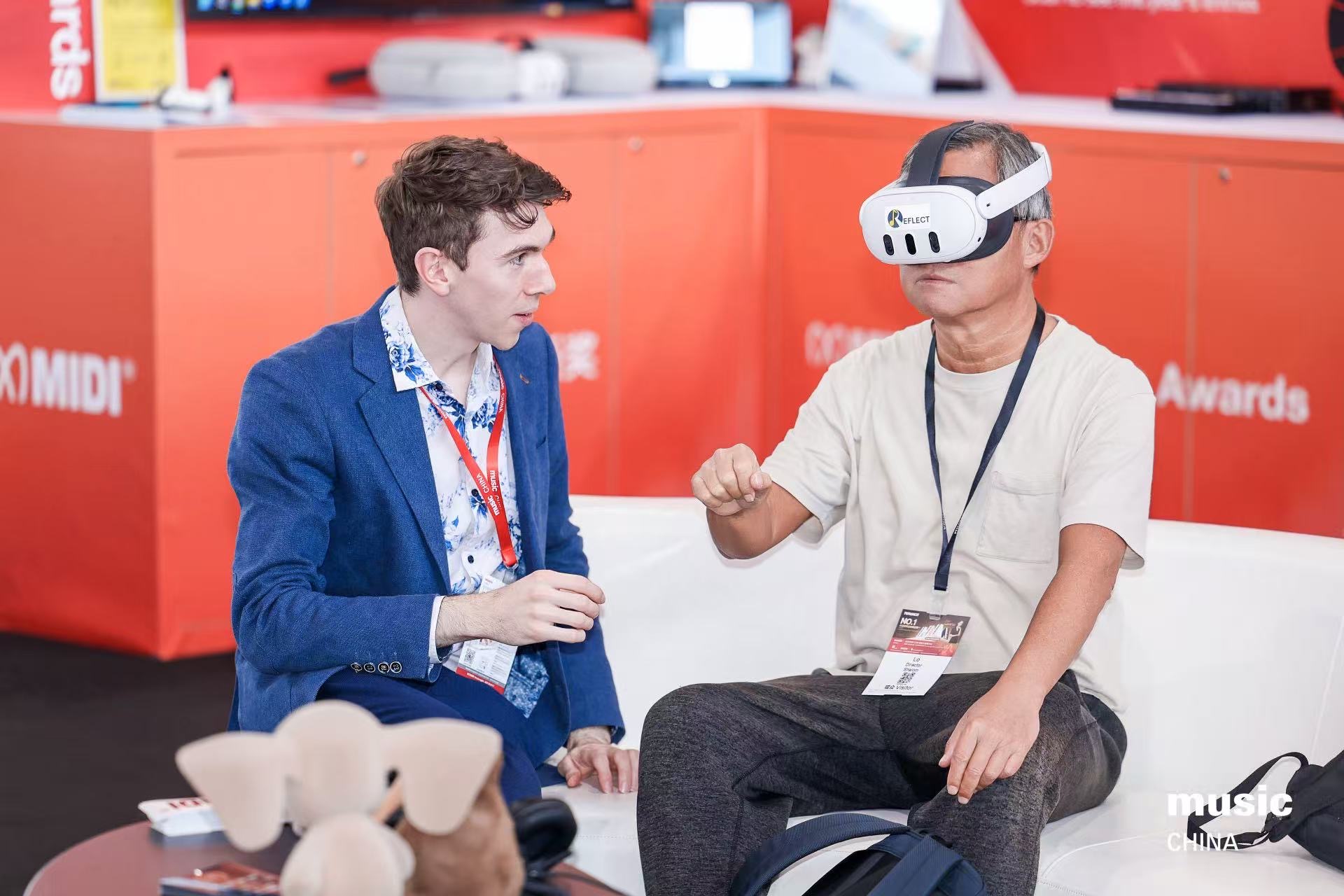
Thomas Beltrame on accessibility in VR
Dog Paw
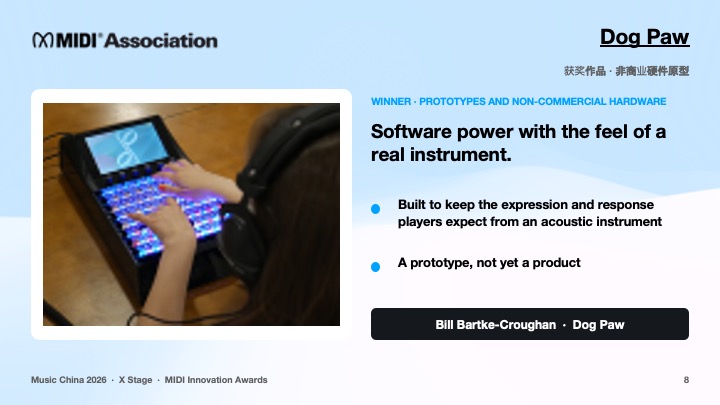
Bill Bartke-Croughan · Non-Commercial Hardware
Software power with the feel of a real instrument — a prototype built to keep the expression and response players expect from something acoustic. Not yet a product.
Dog Paw was the one entry that could not make it to Shanghai: its only unit had gone to Andrew Huang for the awards video.
Bionic and the Wires
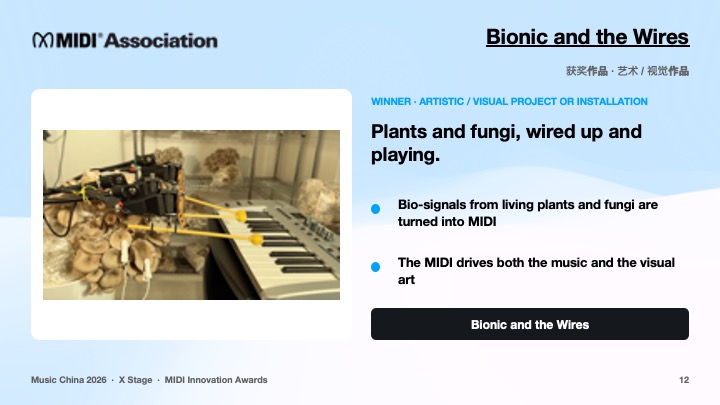
Artistic / Visual Project or Installation
Bio-signals from living plants and fungi, turned into MIDI. The MIDI then drives both the music and the visual art. Shown at Music China as media rather than as a live installation.
MIDI Sketch
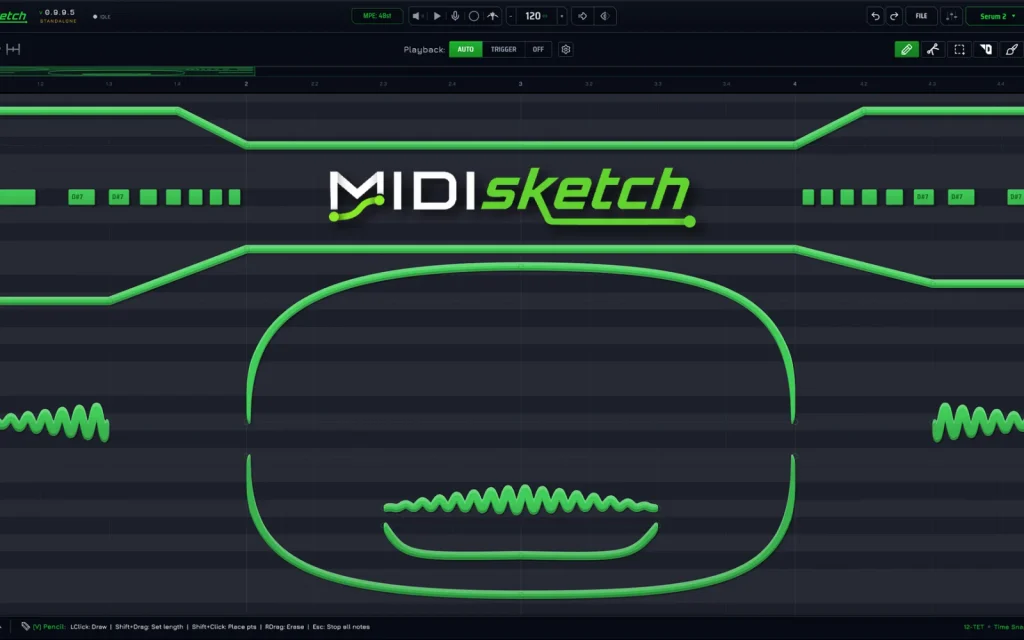
A piano roll built for expression, where the note itself bends. Sketch, record, or sing MIDI straight in, for any controller and DAW.
On the counter
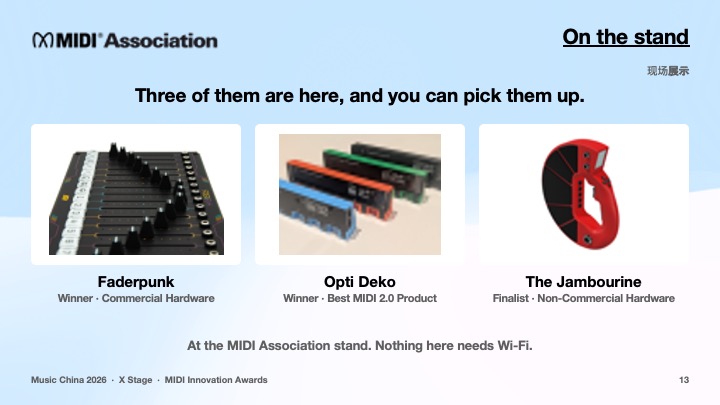
Three entries were on the stand to be picked up and played:
Faderpunk — Arthur Gibert, ATOV. Sixteen faders that run apps: a MIDI and CV modulator with sequencers, LFOs and generators you load like software. Open source, so anyone can add to it.
Opti Deko — Shohei Kubo, Collet Instruments. It upgrades a keyboard you already own. Optical sensors read small finger movements on the existing keys, giving fine pitch control including microtonal playing.
The Jambourine — Arne Schulze. A Non-Commercial Hardware finalist.
OHLA — Opto-Haptic Linear Attenuator (Mia Fanelli) arrived in time to be displayed alongside them.
Two more finalists had their own corner of the booth — Sleight and MIDISketch — covered in part 4.
What this year tells us
Three things showed up again and again across the 2026 entries, and they are a better summary of where instruments are going than any product roadmap:
- Accessibility is where the design starts, not an add-on at the end.
- Movement, breath and touch are becoming ordinary controls rather than exotic ones.
- MIDI 2.0’s higher resolution is being spent on expression — not on precision for its own sake.
If you license, distribute or fund products, this year’s entry list is a is an opportunity to get ahead of the curve with innovative MIDI products.
Entries for 2027 open next year, and the categories above are the only requirement: midi.org/innovation-awards.
The rest of this series
- Hall N2, Music X and Lab 99 — the booth, the stage and the Forum
- Music Accessibility and MIDI In Music Education at Lab 99 — who gets to make music, and what is standing in the way
- MIDI 2.0 Innovative Products at Lab 99 — Sleight and MIDISketch
- Today’s MIDI 2.0 Studio — a working studio you could buy this afternoon
Sources
MIA2026_Finalists_ZH_v0.3.pdf, the finalists deck shown on the X StageEN_MIDI-Innovation-Awards_Music-China.pptx, session deck — winner designations in this file are embargoed and are not used here- Photos supplied by Athan Billias, 1 November 2026