
ProtoZOA

Elevator Pitch

ProtoZOA

ProtoZOA is a flexible prototyping tool for MIDI 2.0. Open source firmware provides MIDI 2.0 interfaces and functions for developers to use in their own hardware and software products.

Product Description

Most USB MIDI 1.0 products rely on off-the-shelf silicon or existing libraries for USB MIDI functions. None of those exist yet for the Universal MIDI Packet (UMP) and the MIDI 2.0 protocol, blocking MIDI Association members (and in the future a wider group of developers) from prototyping core MIDI 2.0 UMP functionality today. Developing a USB device- side driver is not the core competency of most MIDI developers.


How It’s Innovative

ProtoZOA includes several innovations:
• It is the world’s first USB MIDI 2.0 prototyping hardware tool available anywhere.
• It is an example of the collaborative nature of MIDI as MIDI Association and AMEI members agreed not only to support the development of the tool financially , but also to validate and improve the MIDI processing (for example MIDI 1.0/MIDI 2.0 translation)
• It is based on low cost widely available Pico processors so it is affordable
• Perhaps most importantly the code will be Open Source

The plan is that initially MIDI Association members will access the code and contribute to improve it. But eventually Protozoa boards and the most of the code (like the Tiny USB Device driver implementation) will be made publicly available for use by anyone who wants to develop MIDI 2.0 products.
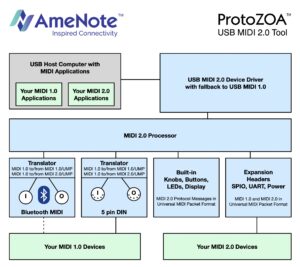
Diagram showing AmeNote and ProtoZOA logos, illustrating a MIDI 2.0 tool workflow with USB host, MIDI translator boxes (Bluetooth, 5-pin DIN, built-in controls), and your MIDI 1.0 and 2.0 devices connected.

Most Inspiring Use Cases

We believe that this prototyping tool will fuel the MIDI 2.0 revolution and inspire many new MIDI 2.0 hardware devices and software applications.

Over 50 ProtoZOAs are currently being shipped to MIDI Association and AMEI members all over the world.

It is the collaborative power of large companies like Apple, Google and Microsoft and smaller companies like AmeNote, Audio Modeling, Bome, Embodme, Geoshred, and many others working together that is truly inspiring.

Expansion Plans

The design includes openly available expansion slots, with plans to connect to other transports. ProtoZOA device has pins available to expand the built in hardware (knobs and buttons) and display options or for other developers to connect their own MIDI 2.0 hardware. It was designed to be very expandable in the future.

Commercialization

AmeNote plans to make the Protozoa widely available for $250 after initial testing by the MIDI Association and AMEI (the Japanese MIDI Association)